Data Security Outsourcing: 3 Must Haves for Security and Procurement
Acceptable data security outsourcing rests on three things working together: verifiable evidence such as SOC 2 Type II or ISO 27001, hardened technical controls like client-owned repositories and role-based access, and enforceable contract terms including a signed Data Processing Agreement (DPA) and right-to-audit clauses. Demand all three before signing anything. You retain ultimate accountability for the data no matter who touches it.
TL;DR:
- Require technical controls such as client-owned repositories, role-based access with automatic expiry, and encrypted storage and transit to prevent breaches from over-permissioned accounts.
- Confirm that vendor certifications like SOC 2 or ISO 27001 are current, scope-appropriate, and supplemented with actual technical control testing and real-time audits.
- Ensure contracts include enforceable right-to-audit, data return and deletion clauses, and documented offboarding procedures to prevent lingering access after termination.
- Monitor post-signature security through regular reviews of SOC reports, access logs, and operational exercises, rotating oversight activities to maintain ongoing risk management.
Table of Contents
- What Risks Does Outsourcing Actually Create?
- What Controls Should You Require From Any Vendor?
- SOC 2 vs. ISO 27001: What Each Certification Actually Proves
- What Belongs in Every Outsourcing Contract
- How Do You Audit a Provider After Signing?
- How This Looks in Practice at a Nearshore Delivery Model
- Can You Outsource Data Protection Itself?
- Next Steps, In Order
- Standards Worth Bookmarking
- Sources
- FAQ
What Risks Does Outsourcing Actually Create?
Outsourcing doesn’t create new categories of cyber risk. It amplifies the ones you already have by adding more hands, more networks, and more jurisdictions to the chain of custody.
The most common failure point is an expanded access surface. Every contractor who touches your repositories, credentials, or staging environments is another door into production data, and most breaches trace back to over-permissioned accounts that nobody remembered to lock down. A developer who needed admin rights for a two-week sprint still has them eight months later. That’s not malice. It’s neglect, and neglect is what auditors find.
Subcontracting compounds the problem. A vendor you vetted carefully might quietly hand pieces of the work to a subcontractor you’ve never heard of, in a country with different data protection rules than the one you signed for. That shift changes your cross-border transfer obligations without you knowing it happened.
A few other patterns show up again and again in outsourced arrangements:
- Offboarding delays that leave former contractors with live credentials weeks after their contract ends
- Alert fatigue from monitoring tools tuned for a 9-to-5 domestic workforce, not a distributed team working different hours
- Segregation-of-duties problems when the same vendor both operates a system and audits it
- Certification badges that look reassuring but cover a narrower scope than the buyer assumes
That last one deserves attention. A vendor waving a SOC 2 badge isn’t automatically safe. The report might cover only a subservice organization, exclude the actual development environment, or predate a recent infrastructure change. Third-party vendor risk assessments fail most often when buyers accept generic questionnaires instead of testing the specific technical controls that matter for a development partner.
What Controls Should You Require From Any Vendor?
Certifications tell you a vendor passed an audit once. Technical controls tell you whether your data is protected right now. You need both, but the controls are what you can actually verify week to week.
Here’s the priority order security teams should work through, from contract signing through daily delivery:
- Client-owned repositories with branch protection. Code lives in repos you own, not the vendor’s infrastructure, with mandatory code review before any merge.
- Role-based access control with time-bounded elevation. Contractors get exactly the permissions their task requires, elevated privileges expire automatically, and someone reviews access lists monthly.
- VPN-only or secure virtual workspace access. No developer touches production data over an open connection, and endpoints are managed through MDM so a lost laptop doesn’t mean a lost database.
- Encrypted storage and transit for everything, no exceptions. Data at rest and in motion gets the same treatment regardless of which office it passes through.
- Centralized secrets management. Tools like HashiCorp Vault or AWS Secrets Manager keep API keys and credentials out of code repositories and out of Slack messages, where they end up far more often than security teams want to admit.
- Synthetic or anonymized test data in any non-production environment, plus a software bill of materials (SBOM) when the project touches regulated data or critical infrastructure.
Offshore development security checklists consistently name client-owned repos, RBAC, VPN-only access, and secrets management as the controls that most directly stop breaches before they start, ahead of any certification.
Pro Tip: Set your monitoring baselines around your outsourced team’s actual working hours before you go live, not after. A distributed team working a different time zone will trip generic anomaly alerts constantly, and security staff who get flooded with false positives start ignoring real ones. CISA’s guidance on alert fatigue makes the same point: uncalibrated rules dull detection instead of sharpening it.
SOC 2 vs. ISO 27001: What Each Certification Actually Proves
A vendor mentioning both certifications in the same breath isn’t necessarily covering both bases. They measure different things.
SOC 2 Type II is an audit of specific controls over a defined period, examining whether the vendor actually followed its stated security practices day to day. ISO 27001 is a certification that a vendor’s overall information security management system meets an international standard, evaluated at a point in time rather than continuously.
Reading a SOC 2 report properly means checking a few things most buyers skip:
- The audit period the report covers, and whether it’s recent enough to matter
- Listed exceptions, since a report with zero exceptions is rarer and sometimes less trustworthy than one with a few, honestly disclosed
- Complementary user entity controls, meaning the security work the report assumes you are doing on your end
- The subservice organization list, which shows whether the vendor’s cloud provider or subcontractor is actually in scope
Ask for the artifacts, not the claim. A vendor telling you they’re “SOC 2 compliant” means very little. The actual report, with its scope and exceptions section, means everything.
What Belongs in Every Outsourcing Contract
Certifications and technical controls mean nothing if the contract doesn’t back them up with enforcement teeth. This is where security most often loses to a rushed procurement timeline.
A workable outsourcing agreement needs these clauses, in roughly this order of priority:
- A Data Processing Agreement (DPA) naming the exact data types involved, the purposes they can be used for, the processor’s obligations, and any rules governing sub-processors. Buyers remain legally accountable even after signing a DPA, which is exactly why the DPA has to be specific rather than boilerplate.
- Breach-notification timelines, spelled out in hours, not vague language like “promptly.” Twenty-four to forty-eight hours is a reasonable standard, with defined content requirements for what the notification must include.
- Right-to-audit provisions that specify remediation timelines and real enforcement mechanics, not just permission to ask questions once a year.
- Data return and deletion terms, including a certificate of destruction you can actually file for compliance purposes.
- IP assignment and jurisdiction clauses that settle ownership and legal venue before a dispute forces the question.
- Offboarding SLAs covering access revocation timing and handover artifacts, so a departing contractor’s credentials don’t outlive the contract.
Security requirements belong in the Statement of Work before procurement finalizes anything, not bolted on after signatures. A DPA negotiated after the relationship starts has far less leverage behind it.
How Do You Audit a Provider After Signing?
Selection is the easy part. Ongoing assurance is where most buyer oversight quietly dies, usually because nobody assigned it to a specific person with a specific calendar reminder.
Break the audit into three areas and rotate through them on a set schedule:
- Documentation review: the SOC 2 report, access logs, VPN architecture diagrams, MDM enrollment evidence, and recent penetration test summaries
- Technical verification: actually checking that RBAC permissions match what the vendor claims, not just reading their policy document
- Operational testing: tabletop incident exercises run jointly with the vendor, with named escalation contacts on both sides who have actual authority to revoke access
Run access reconciliation monthly for high-privilege accounts and quarterly for everything else. Watch for a specific set of red flags: accounts that should have been revoked weeks ago, gaps in audit logs nobody can explain, or exceptions in a compliance report that keep recurring instead of getting fixed.
The volume of breaches nationally gives this urgency context. The Identity Theft Resource Center’s annual report documented a record number of compromises, a reminder that breach preparation matters as much as breach prevention. Vendor risk frameworks recommend keeping oversight separate from operations for exactly this reason: a vendor auditing its own security work has an obvious conflict of interest.
How This Looks in Practice at a Nearshore Delivery Model
Translated into daily operations, these controls look less abstract than they sound on a checklist. A nearshore staffing arrangement that takes this seriously keeps repositories under client ownership from day one, applies RBAC before a new developer’s first commit, and routes secrets through a managed vault rather than a shared document.
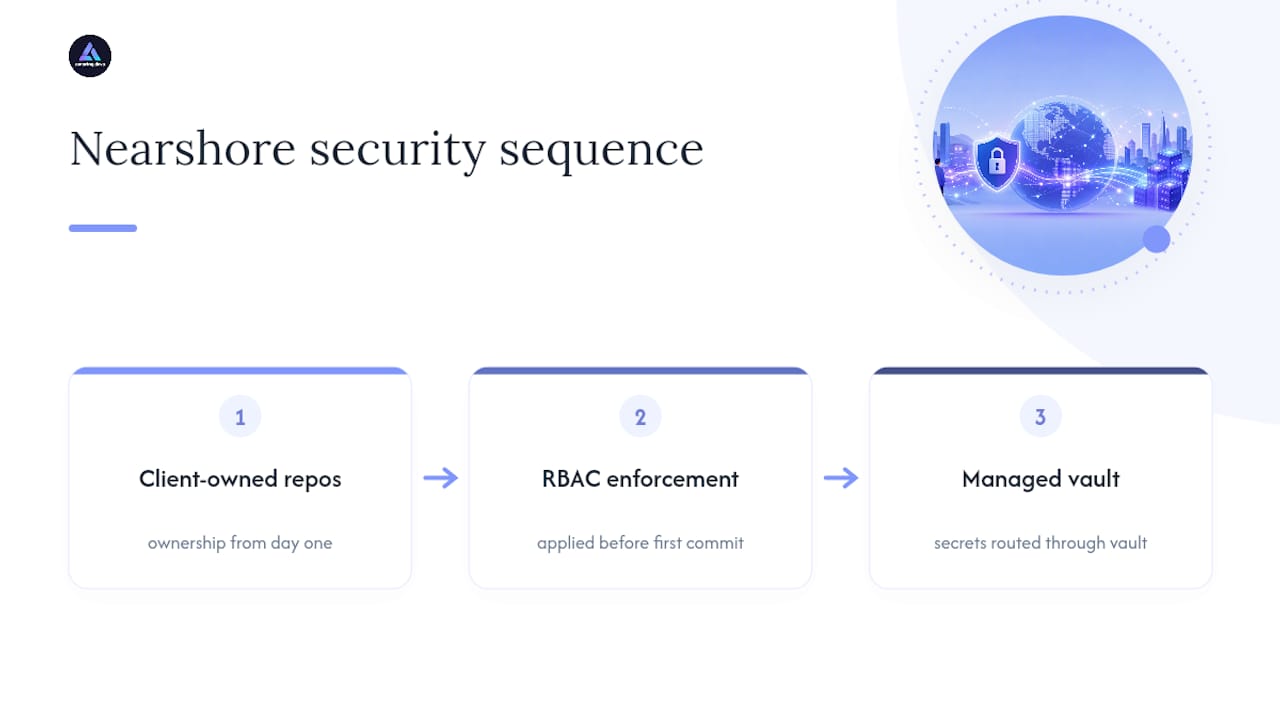
Some nearshore staffing arrangements build these expectations into their structure: contracts get managed formally, access provisioning follows the client’s own security policy rather than a generic template, and offboarding includes documented access revocation and handover artifacts when an engagement ends.
If you’re evaluating any vendor’s security walkthrough, ask pointed questions: Who owns the repository? What’s the actual RBAC review cadence? Can they produce a redacted SOC 2 report on request? A vendor that answers specifically, rather than gesturing at “best practices,” has usually done the work.
Can You Outsource Data Protection Itself?
You can outsource the operational work of data protection. You cannot outsource the legal accountability for it. Regulatory frameworks make this explicit: the buyer stays the controller even when a vendor handles processing.
Outsourcing a data protection officer role or privacy operations function works fine when it’s scoped clearly, with defined authority and regular evidence delivery, illustrated well by the GDPR request form showcase that highlights privacy request workflows and tooling. What you must verify: the outsourced privacy function’s independence, its exact remit, and whether it actually produces artifacts you can show a regulator. Delegate the task. Never delegate the liability.
Next Steps, In Order
Three things make outsourcing acceptably secure: a signed DPA with real breach timelines, client-owned repos with RBAC, and enforceable right-to-audit terms. If you have none of those in place yet, start this week: add DPA language to your procurement template, request current SOC 2 evidence before the next vendor call, and schedule a security walkthrough with a tabletop exercise attached. Get legal, security, and procurement in the same room before anyone signs.
— Gabriel
Standards Worth Bookmarking
For technical control frameworks, NIST’s cybersecurity guidance is the standard starting point security teams reference during vendor reviews. For monitoring calibration, CISA’s alert fatigue guidance linked earlier applies directly to distributed development teams. For contract-side privacy obligations, the Notre Dame Law Review’s analysis of privacy vendor limits is worth reading before assuming any single vendor covers every privacy task you need.
Ready to see these controls applied to an actual nearshore engagement? Amazing Devs manages the contracts, access provisioning, and compliance groundwork so your security team isn’t rebuilding this checklist from scratch with every new hire, and you can review the full staffing model before your next hiring decision.
Sources
- 2023 annual data breach report reveals record number of compromises | Identity Theft Resource Center
- Types of vendor risk and mitigation | Shared Assessments
FAQ
Who Are the Top DSPM Vendors?
Data security posture management is a specialized and fast-changing vendor category, and no single provider covers every privacy or security task a buyer needs. Match specific DSPM capabilities to your actual data footprint rather than picking a name off a rankings list.
Is Outsourcing a Dying Concept?
No. Outsourcing keeps growing, but the security expectations around it have tightened considerably, with buyers now demanding certifications, audit rights, and named contractual protections that weren’t standard even a few years ago.
What Is Data Outsourcing?
Data outsourcing means handing data processing, storage, or handling tasks to a third-party vendor, whether that’s a nearshore development team, a cloud provider, or a specialized data processor, while the buyer retains legal responsibility for how that data gets protected.
What Are the Four Types of Data Security?
Most frameworks group data security into physical security, network security, access controls, and encryption, covering everything from locked server rooms to VPN-only remote access to data encrypted at rest and in transit.
How Fast Should a Vendor Notify Me of a Breach?
Twenty-four to forty-eight hours is a reasonable contractual standard, with the notification required to include the type of data involved, the scope of exposure, and the remediation steps already underway.