Recruiters’ Technical Screening for Developers: Cap Tests at 90 Minutes
Run a short standardized coding assessment plus a 20 to 30 minute structured phone screen as your first technical filter after resume review. This sequence gives every candidate the same measurable test, speeds up shortlisting, and produces a defensible paper trail. Cap the hands-on assessment at under 90 minutes and keep the phone screen tight: longer tests do not improve signal, they just increase candidate drop-off.
TL;DR:
- Match assessments to daily work: algorithm challenges suit roles focused on high performance code, while project tasks fit API work and pair programming tests collaboration.
- A live coding probe takes 10 to 20 minutes, while a scoped take home task takes 30 to 60 minutes and carries greater abandonment risk.
- Choose 4 to 6 role specific competencies, weight them by seniority, set advancement thresholds before scoring, and document each rating with a brief justification.
- Have panelists score independently and record evidence before discussion; then reconcile differences against the rubric, watching for halo effects and similarity bias.
- Pilot assessments internally to check timing and scoring consistency, disclose the exact time commitment, and track completion rates by format to spot candidate drop off.
Table of Contents
- A practical technical screening checklist you can use today
- Assessment formats: what each one evaluates and when to use it
- Designing structured interviews that hold up under scrutiny
- Build a scoring rubric and candidate matrix in an afternoon
- Tools and rollout: keep completion rates high and scoring consistent
- Why rigorous screening matters more in nearshore hiring
- Get pre-screened nearshore developers without building the funnel yourself
- FAQ
- Sources
A practical technical screening checklist you can use today
A good first-round screen needs a template, not a brainstorm. Build one phone-screen script, one coding probe, and a shared rubric for what counts as a pass.
Phone-screen template. Ask six questions that map directly to the role’s core competencies, mixing a short behavioral prompt with a quick technical check:
- Walk me through a recent project and your specific contribution.
- How do you approach debugging a production issue you’ve never seen before?
- Describe a time you disagreed with a technical decision and what you did.
- What tradeoffs would you consider when choosing a data store for this kind of feature?
- How do you handle a task with unclear requirements?
- What questions do you have about the role or the team?
Coding probes. Use a 10 to 20 minute live or code-pair prompt for a quick read on problem-solving approach, or a 30 to 60 minute take-home micro-task with a clearly scoped deliverable when you need a cleaner code sample. Our pair-programming interview scripts give you a ready timing structure for the live version.
Decision signals. Sort outcomes into three buckets:
- Green: clear reasoning, working or near-working code, asks clarifying questions.
- Yellow: correct direction but needs prompting, or strong code with weak communication.
- Red: cannot explain their own approach, avoids tradeoffs, or ignores constraints.
Pro Tip: Score the phone screen immediately after the call, before you see the next resume. Memory fades fast and notes written an hour later are noticeably less accurate.
Assessment formats: what each one evaluates and when to use it
Six formats cover most hiring needs, and each predicts something different about on-the-job performance. A complete guide to coding assessment tests breaks them down by what they’re built to measure:
- Algorithmic challenges test raw problem-solving speed and are a reasonable fit for roles heavy on performance-critical logic.
- Project-based tasks ask candidates to build or extend a small feature, which fits API and integration-heavy roles better than pure algorithm puzzles.
- Simulations replicate a realistic work scenario, useful when the job involves specific tools or workflows you want to see in action.
- MCQ quizzes check breadth of knowledge quickly and work well as an early filter for high-volume pipelines.
- Pair programming evaluates communication and collaborative problem-solving alongside code quality.
- Take-home assignments give the clearest sample of independent work but carry the highest abandonment risk if scoped too broadly.
The format you pick should match the candidate’s actual daily tasks, not whichever test is easiest for your team to administer. That single decision shapes how predictive the result ends up being.
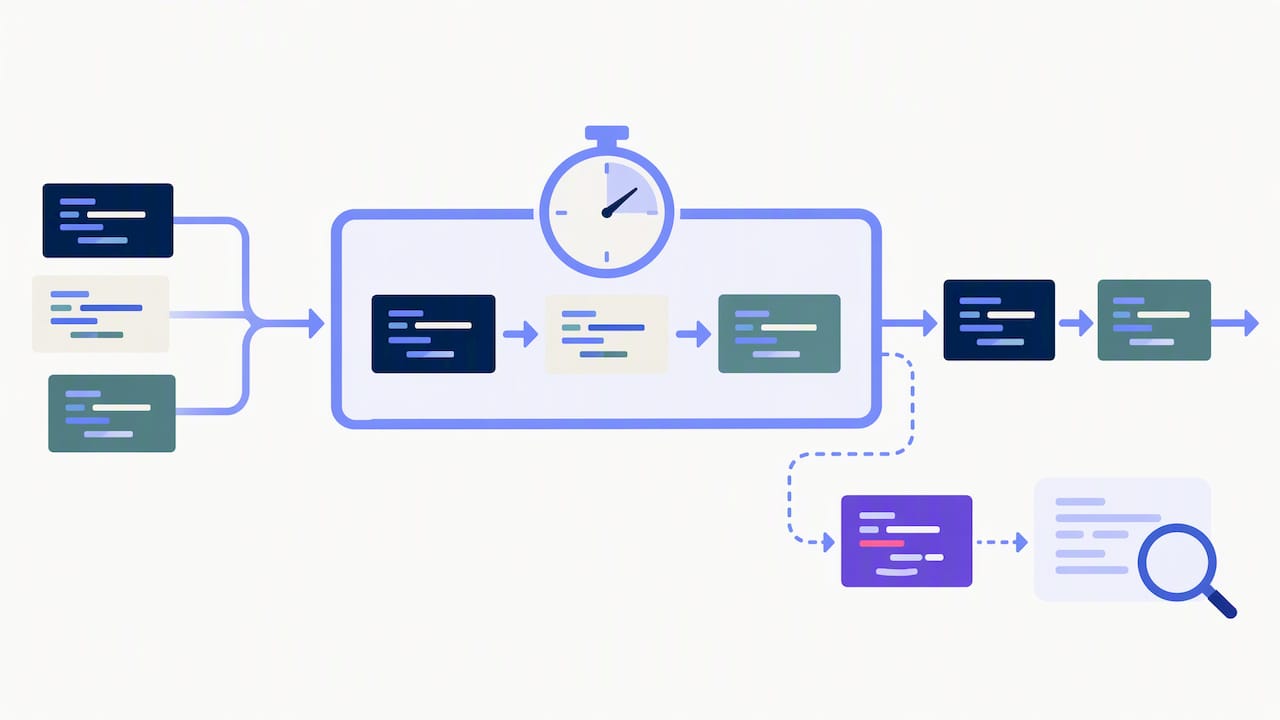
Cap screening-stage assessments at 60 to 90 minutes. Longer tests increase candidate abandonment and rarely add new signal beyond that window, according to HackerEarth’s assessment guide. Every format also needs someone on your engineering team to review ambiguous submissions, since automated scoring alone misses context on messy but workable code.
Designing structured interviews that hold up under scrutiny
Structured interviews, built from predetermined questions and standardized scoring, improve rater agreement and give you a documented, job-relevant record if a hiring decision is ever questioned. The OPM structured interview guide lays out an eight-step process you can compress into a working checklist:
- Analyze the job to identify what actually matters day to day.
- Pick 4 to 6 competencies, no more.
- Write behavioral questions tied to past experience.
- Write situational questions tied to hypothetical scenarios.
- Build a rating scale with example answers for each score level.
- Draft follow-up probes for incomplete answers.
- Pilot the questions with a small group before rolling out.
- Write an interviewer guide so every panelist runs the interview the same way.
A behavioral question might be: “Tell me about a time you had to refactor someone else’s code under a deadline.” A situational pairing: “If you discovered a critical bug the night before a release, what would you do?” Each gets a rubric snippet, for example a 3-out-of-5 answer that identifies the risk but skips stakeholder communication, versus a 5 that covers both the fix and the rollback plan.
Panels should score independently before discussing, then reconcile differences against the rubric rather than defaulting to the most senior interviewer’s opinion. Watch for halo effect, where one strong answer colors the rest of the scorecard, and similarity bias, where interviewers rate candidates who remind them of themselves more favorably.
Pro Tip: Have each panelist write their score and one supporting note before the debrief starts. It keeps the discussion anchored to evidence instead of gut feeling.
Build a scoring rubric and candidate matrix in an afternoon
A one-page rubric turns subjective impressions into comparable numbers. Structure it with a skills column, a plain-language definition of each skill, five proficiency examples, and a weight reflecting how much that skill matters for this specific role.
- List 4 to 6 competencies for most roles; adding more dilutes focus without adding accuracy.
- Weight senior roles toward architecture and judgment, junior roles toward fundamentals and learning speed.
- Set a numeric threshold in advance for who advances to onsite or offer stage, not after you’ve already seen the scores.
- Score blind to resume details like school or employer name where possible, to keep ratings tied to demonstrated skill.
- Document every score with a one-line justification, since that record is what makes the process defensible later.
Our candidate scoring matrix walkthrough shows how to put this together without needing a dedicated analyst.
Tools and rollout: keep completion rates high and scoring consistent
Pick a tool with role-based templates, blind scoring options, automated scorecards, and a dashboard that tracks completion rate and time-to-shortlist. AI-assisted test generation can produce a role-calibrated assessment from a job description in minutes, though a founder’s guide to crafting effective questions still recommends human review for edge cases where automated scoring misreads unconventional but valid solutions.
Before a full rollout, pilot the assessment with a few subject matter experts internally, confirm the time estimate holds, and fix any question that produces inconsistent ratings. For high-volume pipelines, guidance on managing one-way interviews at scale is worth reviewing before you commit to a format.
- Tell candidates the exact time commitment and format before they start.
- Hold the hard cap at 60 to 90 minutes for any screening-stage assessment.
- Send a status update within a set window regardless of outcome.
Pro Tip: Track completion rate by assessment type for your first few cohorts. A format with high drop-off is costing you qualified candidates before you ever see their work.
Why rigorous screening matters more in nearshore hiring
Screening gets harder across time zones and unfamiliar hiring markets. Every placement should be built on paired technical and cultural fit assessment, so hiring managers aren’t the only check between a resume and a contract, which matters when internal bandwidth for building a full screening funnel is thin.
— Gabriel
Get pre-screened nearshore developers without building the funnel yourself
When your team doesn’t have the bandwidth to run resume screens, coding assessments, and structured interviews for every open role, we handle that layer for you. Our nearshore staff augmentation service delivers developers who’ve already passed technical and cultural fit evaluation, plus contract and onboarding management so you’re not navigating paperwork on top of interviews.
This fits teams in a few specific situations:
- You need to fill a role faster than your current pipeline allows.
- Your engineers don’t have time to review take-homes or run pair-programming sessions this quarter.
- You’d rather hand off contract and compliance details than manage them in-house.
Check current availability through our nearshore staff augmentation page and tell us what the role needs.
FAQ
What does technical screening mean?
Technical screening is the first-round evaluation that checks whether a candidate has the coding and problem-solving skills a role requires, usually before a full panel interview. It typically combines a resume review, a short coding assessment, and a brief structured phone screen to filter candidates efficiently.
Is cracking the coding interview still relevant in 2026?
Classic algorithmic prep still matters for roles heavy on performance-critical code, but most hiring teams now weight it alongside project-based tasks and pair programming that reflect real daily work. Choosing the right assessment format for the actual job matters more than defaulting to algorithm puzzles alone.
What is the 80/20 rule in interviewing?
This isn’t a formal standard, so treat it as a practical guideline rather than a fixed rule.
What are the 5 C’s of interviewing?
There’s no single authoritative “5 C’s” framework used consistently across hiring guides, so definitions differ by source. Rather than relying on a catchy acronym, structured interview methods like the OPM framework recommend anchoring questions to specific job competencies instead.
Sources
- Structured Interview Guide (OPM)
- The complete guide to coding assessment tests for hiring (HackerEarth / Nxevos)