LATAM vs Eastern Europe: Which Region Should You Hire From?

For most US companies that need developers in the same working day, Latin America is the better fit. Brazil, Colombia, Mexico and Argentina sit within a few hours of US time zones, so stand-ups, pairing and code review happen live. Eastern Europe is a strong choice when the work is deep backend, data or security engineering and your team can live with a few hours of overlap, or run asynchronously.
The real decision is not which region is “better”. It is which constraint hurts you most: the clock, the budget, or the specific skill you cannot find at home. This guide walks through each, then gives you a way to decide.
TL;DR
- Time zone is the biggest practical gap. Brazil is one to three hours from US time zones depending on the season and your office. Poland, Romania and Ukraine are roughly six to seven hours ahead of the US East Coast.
- Cost is closer than the headlines suggest. Both regions cost well below US salaries. Compare the fully loaded cost of a working relationship, not the hourly rate alone.
- Skills differ in emphasis, not quality. Eastern Europe is known for algorithmic backend and security depth. Latin America is known for fast product iteration on modern web and mobile stacks.
- Many mature teams use both. Product-facing roles in LATAM, deep infrastructure in Eastern Europe, is a pattern worth considering.
- Process matters more than geography. A rigorous vetting and contracting process decides whether a hire works out.
Table of Contents
- What you are really choosing between
- Time zone and collaboration
- Cost: look past the hourly rate
- Skills and engineering culture
- Communication, English and culture
- Risk, legal setup and continuity
- When Latin America wins
- When Eastern Europe wins
- The hybrid option
- A simple way to decide
- Our perspective
- How Amazing Devs can help
- Screening candidates in either region
- FAQ
- Sources
What you are really choosing between
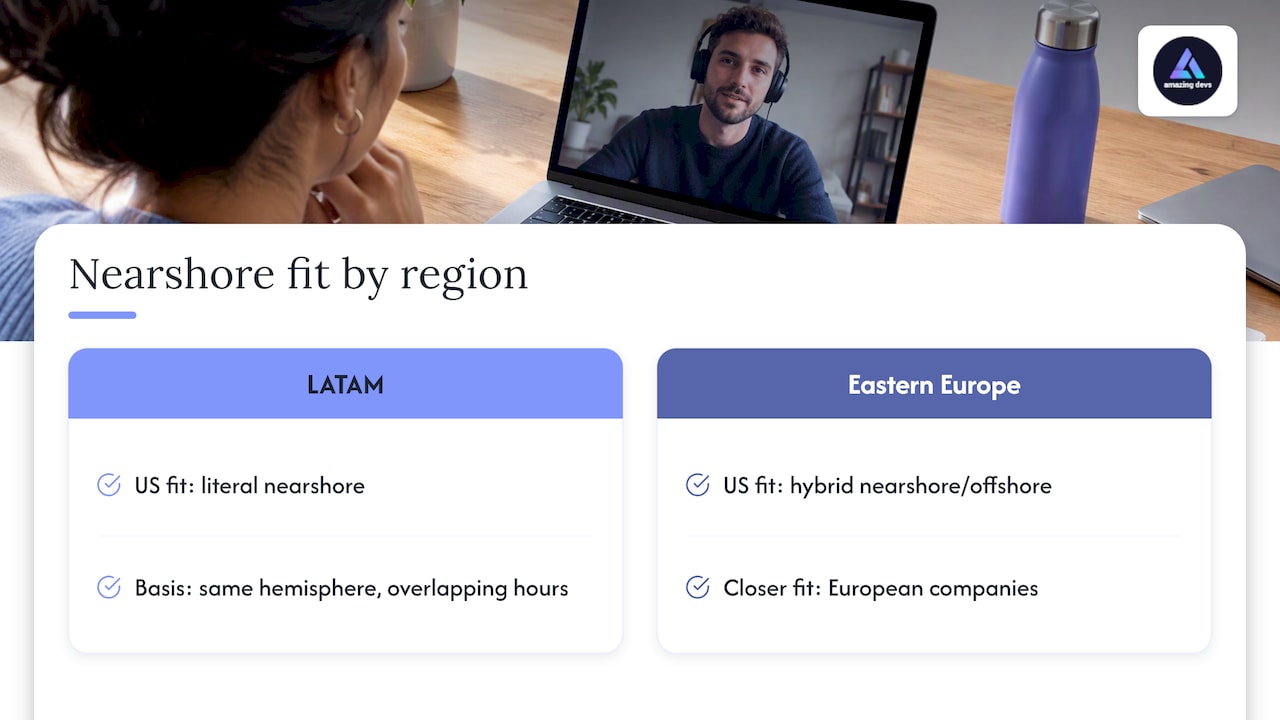
Both regions are called nearshore in US conversations, but they earned the label differently. Latin America is nearshore in the literal sense: same hemisphere, overlapping hours. Eastern Europe is nearshore mostly for European companies, and for US teams it is closer to a hybrid between nearshore and offshore.
That is why the comparison keeps coming back to the calendar. A great engineer six hours ahead of you can still be a poor fit if your product decisions are made in a 10 a.m. Slack thread and a 2 p.m. call.
It also helps to define the regions. “Eastern Europe” in hiring usually means Poland, Romania, Ukraine, Bulgaria, Hungary and the Czech Republic. “LATAM” usually means Brazil, Mexico, Colombia, Argentina, Chile and sometimes Costa Rica or Uruguay. Neither is one market. Brazil alone is a different hiring environment from Argentina, and Poland is different from Ukraine. Any article that treats each region as a single block, including this one, is giving you an average, so test the specific country you are considering.
Time zone and collaboration
This is where the two regions separate most clearly.
| Factor | Latin America (e.g., Brazil) | Eastern Europe (e.g., Poland, Romania) |
|---|---|---|
| Offset from US East Coast | Roughly 0 to 2 hours | Roughly 6 to 7 hours ahead |
| Overlap with a 9 to 5 US day | Most or all of it | A few hours in the US morning |
| Real-time collaboration | Natural: stand-ups, pairing, incident response | Possible but scheduled |
| Best working style | Synchronous, embedded in your team | Asynchronous, well-documented handoffs |
| West Coast teams | Still workable | Overlap shrinks to very little |
Brazil’s offset to US Eastern time changes with daylight saving, because the US shifts clocks and Brazil no longer does. Check the gap for your office and the season before you promise anyone a meeting time.
Eastern European developers often start early and finish by late afternoon in their own time. That gives you a morning window with your East Coast team. It works well for planned work and poorly for urgent bugs that surface at 4 p.m. in New York.
If you want to see what overlap does to delivery, we wrote a practical guide on timezone management strategies that cuts coordination delay. Its core point applies to either region: the cost of a time-zone gap is paid in waiting, and waiting is invisible on an invoice.
Cost: look past the hourly rate
Published rate tables for both regions vary widely. They depend on seniority, stack, city, and whether the figure is a contractor rate, a vendor bill rate or a salary. Treat any single number as a starting point.
What you can say with confidence is directional. Both regions cost far less than comparable US hires, and the gap between them has narrowed as demand for Eastern European engineers has pushed rates up. Seniors in Poland or Romania are not cheap by regional standards. Brazil, meanwhile, has a deep supply of mid-level and senior engineers and a currency that has historically moved against the dollar, which can help US buyers but is not something to build a plan on.
So compare the whole cost of ownership:
- Recruiting. Direct hiring in the US is expensive. We break down why in the cost to recruit developers.
- Employment setup. Hiring abroad directly can mean opening a local entity or using an employer-of-record. Using a partner who handles contracts removes this step.
- Coordination loss. Hours spent waiting for answers across a time gap are real salary cost.
- Turnover. A cheaper developer who leaves in eight months is more expensive than a fairly paid one who stays for three years.
For a closer look at what quotes tend to leave out, see our piece on nearshore developer rates in LATAM.
Skills and engineering culture
The stereotypes contain some truth, and they are worth treating as hypotheses rather than facts.
Eastern Europe has a long tradition of strong math and computer science education. Hiring managers commonly turn to it for complex backend architecture, algorithm-heavy work, embedded and systems programming, cybersecurity, and long-lived enterprise systems.
Latin America has a large, fast-moving product engineering culture. Brazil in particular has a big fintech, e-commerce and marketplace ecosystem, and its developers tend to be comfortable with modern web and mobile stacks, rapid iteration and close work with product managers and designers. Data work is growing too. If that is your need, our article on hiring data engineers in Brazil covers the talent pool in more detail.
One caution about talent-pool size. Headcount comparisons often come from LinkedIn profile counts, and the World Bank’s own methodology work notes that LinkedIn data best represent skilled labor in knowledge-intensive, tradable sectors. That fits software well, but profile counts still say nothing about whether a given person can do your job. The only reliable test is your own structured assessment.
Communication, English and culture
Both regions have strong English among working developers, especially at senior level. Do not assume either is automatically better. Test spoken English in the interview, with a real technical conversation, not a casual chat.
Culture is the less obvious gap. Many US managers describe Latin American teams as relationship-driven and comfortable with frequent, informal check-ins. Eastern European engineers are often described as direct, with a preference for clear specs and blunt technical feedback. These are generalizations, and individual variation is large. What matters is whether your management style matches the person you hire.
If you are building a distributed team across regions, a few ways to manage a remote team well, such as clear feedback habits and explicit expectations, matter more than the country on the contract.
Risk, legal setup and continuity
Three risks deserve a straight look.
Geopolitical risk. Ukraine’s talent pool operates under wartime conditions, and the war is also a consideration for neighboring markets when clients assess continuity planning. Many engineers there continue to deliver, but if you need guaranteed uptime from a single person, ask how backups and power or connectivity failures are handled. Latin America has its own risks, notably currency swings and political changes, which usually show up in pricing and not in day-to-day delivery.
Contracting and compliance. Whichever region you choose, decide early whether your developers will be employees, contractors or placed through a partner. Misclassification and local labor rules are the usual traps. This is a question for your employment lawyer or an advisor in the country in question, not something to settle from a blog post.
Intellectual property and data. Put IP assignment, confidentiality and access controls in writing from day one, and confirm how they are enforced locally. This applies equally to both regions.
When Latin America wins
Choose LATAM when:
- You run daily stand-ups, pair programming or live incident response.
- Your product team iterates weekly and developers need to talk to product and design in real time.
- Your company is on the West Coast or Central time, where a six to seven hour gap to Europe leaves almost no shared day.
- You are a startup and need engineers who behave like teammates, not a separate vendor.
- You want to hire in a few weeks without setting up a legal entity.
When Eastern Europe wins
Choose Eastern Europe when:
- The work is deep and well-specified: complex backend systems, algorithm-heavy components, security hardening or legacy modernization.
- Your team already works asynchronously, with strong documentation and written decision-making.
- You also serve European customers, so working hours in that region have a business benefit.
- You are comfortable with a few hours of morning overlap and no more.
The hybrid option
Some teams stop choosing and split the work. Product-facing engineers sit in Latin America, close to your hours, while a small group of specialists in Eastern Europe owns infrastructure, data systems or security. This works if you have a clear technical lead who owns the interfaces between the groups. It fails when you add the complexity of a second region before the first is running well.

Our advice: start with one region, get the process right, and add a second only for a skill you cannot find in the first.
A simple way to decide
Score each factor from 1 to 5 for your team, then weight them.
- Required overlap. How many hours of live work do your developers need each day? Under two, Eastern Europe is fine. Over four, favor LATAM.
- Skill specificity. Is the role a general product engineer, or a rare specialist? Rare specialists justify looking wherever the person is.
- Management capacity. Do you have a lead who can run an asynchronous team? If not, choose the region with more overlap.
- Speed. How soon do you need the person working? Check realistic timelines with any partner you use.
- Continuity tolerance. Can the project absorb a gap if one developer disappears for a week?
- Budget. Compare total cost, including recruiting, setup and coordination, not hourly rate alone.
If factors 1, 3 and 4 dominate, LATAM wins for most US teams. If factor 2 dominates, widen the search.
Our perspective
We are a Brazil-focused nearshore firm, so you should weigh our view with that in mind. Here is what we have seen shape outcomes more than region.
First, the match matters more than the map. A developer who fits your stack, your pace and your communication style will outperform a cheaper one who does not, in any country. That is why we put technical and cultural fit assessment at the center of recruitment instead of treating it as a final formality.
Second, time zone is a cost that clients tend to underestimate. A one-hour question that waits until tomorrow becomes a day of lost momentum. Multiply that by a team and a quarter, and the savings from a lower rate shrink quickly. For US teams that run on live collaboration, we think Brazil is the strongest answer.
Third, the bureaucracy is where good plans stall. Contracts, local compliance and payments are not why you want to hire a developer. We take that work on so you do not have to open a local entity or learn local labor rules to get started.
We do not claim Brazil is right for every project. If you have an infrastructure problem that needs a rare specialist and a team that works asynchronously, a hybrid or Eastern European hire may be right, and we would tell you so.
— Gabriel
How Amazing Devs can help
If your shortlist is leaning toward Brazil, our nearshore staff augmentation service places pre-vetted Brazilian developers into your team, with technical and cultural fit assessment, and contract management handled for you. Prefer to extend an existing group with long-term members? Look at our Team Extension Model. We also place QA specialists through nearshore QA contractors. You can read the practical steps in our guide on how to hire Brazilian developers, or start from our home page to describe your needs.
Screening candidates in either region
Whichever region you choose, your screening process decides quality. Keep technical tests short and relevant. We recommend capping them at 90 minutes, as explained in our guide to technical screening for developers. Use a structured interview with the same questions for every candidate, so you compare like with like.
If you recruit in-house, recruitment automation tools can help with early-stage interviewing at volume, though a human should always make the final decision. And if you want to move from screening to sourcing, our article on skills-based hiring and responsible AI shows how to widen the pool without lowering the bar.
FAQ
Is LATAM cheaper than Eastern Europe for developers?
Often slightly, but not always, and the gap has narrowed. Rates depend more on seniority, stack and engagement model than on region. Compare the total cost, including recruiting, setup, coordination and turnover, before deciding.
Which region is better for a US startup?
For most US startups, Latin America is the more practical choice because of the overlap with US working hours. Startups change direction often, and live conversation with product and design helps. If you only need a specialist for a defined, documented task, Eastern Europe can also work well.
Can I use both regions at once?
Yes, and some mature teams do. A common split puts product-facing engineers in Latin America and infrastructure or security specialists in Eastern Europe. Start with one region, and add the second only when you have a clear gap and a lead who can own the handoffs.
Is Eastern Europe still a safe choice given the war in Ukraine?
Poland, Romania and other EU members operate normally, while Ukraine’s developers work under wartime conditions. Ask any provider how it handles continuity, backups and replacement. Make that part of the contract, whichever country you pick.
How fast can I hire from Latin America?
It depends on role, seniority and process. Working with a partner that already has a vetted pool shortens the search, since you skip sourcing and local setup. Our guide on hiring Brazilian developers describes the steps and timeline we work to.