Best Feature Flag Tools in 2026: 8 Options Compared
The best feature flag software depends on your team’s size and what you need around the flags. LaunchDarkly fits enterprise governance. Statsig and Optimizely fit experimentation-led teams. PostHog fits teams that want analytics in the same product. Unleash, Flagsmith and GrowthBook fit teams that want open source or self-hosting. ConfigCat fits teams that want a flat, predictable bill. Whichever you pick, a tool only pays off when engineers wire it into your code and keep the flags clean. That is why we also cover the staffing side at the end.
TL;DR
- Enterprise governance: LaunchDarkly has the broadest SDK and integration coverage, with a free Developer plan to start.
- Experimentation-heavy: Statsig and Optimizely lead, with very different pricing models.
- Open source and self-hosting: Unleash, Flagsmith and GrowthBook give you control over where flags are evaluated.
- Predictable cost: ConfigCat uses flat pricing, and GrowthBook bills by seat rather than by traffic.
- The hidden cost: integration, flag clean-up and ownership take engineering hours, so plan capacity before you buy a tool.
Table of Contents
- What feature flag software does
- How to choose: six criteria that separate the tools
- The best feature flag tools compared
- Which one fits your stage
- The part no tool buys you: engineering time
- Add engineers who can run the rollout
- Our perspective
- FAQ
- Sources
What feature flag software does
Feature flags let a team deploy code to production while restricting who can see the feature. Microsoft’s cloud-native guidance describes the core benefits. You can enable a feature for specific users without restarting the app or deploying new code. You can roll it out gradually as confidence grows. You can switch off a problem feature quickly.
Feature flag software wraps that idea in a management layer. It gives you a dashboard, targeting rules, audit history and SDKs. Targeting usually means percentage rollouts and rules based on attributes like region, plan tier or custom metadata, as Datadog explains. Some tools add experimentation, analytics and automatic rollback on top.
How to choose: six criteria that separate the tools
Most products in this category can toggle a boolean. They differ in six places:
- Pricing model. Per service connection and monthly active user, per seat, per event, or flat. The model matters more than the headline price, because it decides how your bill grows.
- Experimentation depth. Do you need a stats engine and A/B testing, or only on/off switches and gradual rollouts?
- SDK coverage. Does it support your backend language, your frontend framework and your mobile apps?
- Hosting. SaaS only, or a self-hosted or private-cloud option for data-residency needs.
- Governance. Role-based access, change history and environment limits, which may be limited on free tiers.
- Clean-up. Atlassian points out that sustainable flag management needs clean-up governance, or old toggles pile up as technical debt.
A simple rule of thumb from the comparisons we reviewed: simpler tools suit teams that want a quick setup, while larger organizations need governance and cross-team collaboration, according to ConfigCat’s comparison.
The best feature flag tools compared
| Tool | Best for | Free option | Paid pricing model |
|---|---|---|---|
| LaunchDarkly | Enterprise governance, broad SDKs | Developer plan | Per service connection plus client-side MAU; Enterprise by quote |
| Statsig | Experimentation-heavy teams | Developer plan | Pro from $150/mo per project; Enterprise custom |
| PostHog | Analytics plus flags in one product | 1M feature-flag requests/mo | Usage-based, from $0.00005/event |
| Unleash | Open source, self-hosting, compliance | Open-source edition | From $75 per seat per month |
| Flagsmith | SaaS, private cloud or on-prem | 50,000 API requests, one team member | Start-Up at $45/mo |
| GrowthBook | Open source with experimentation | Free cloud tier and self-hosting | Per seat |
| ConfigCat | Flat, predictable spend | Free tier | Flat monthly rate, unlimited seats |
| Optimizely | Experimentation-led enterprises | Rollouts tier, one experiment at a time | Custom annual contracts |
Prices change often. Treat the figures below as a snapshot from the cited pages and confirm them on each vendor’s pricing page before you budget.
LaunchDarkly
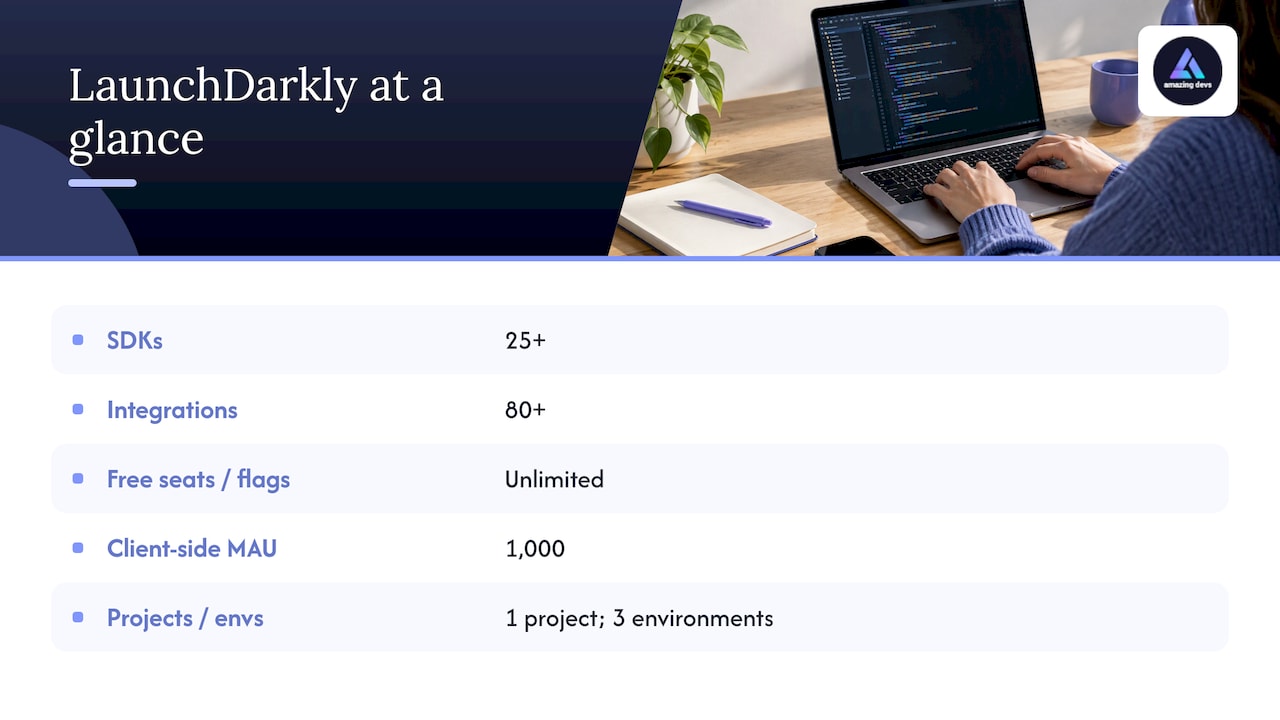
LaunchDarkly is the name most US teams start with. It offers 25+ SDKs and 80+ integrations, covering JavaScript, React, iOS, Android, Node.js, Python, Go, Java, .NET, Ruby, PHP and Rust. It also supports automatic rollback when release guardrails are breached.
The free Developer plan includes unlimited seats and flags, 5 service connections, 1,000 client-side MAU, 1 project and 3 environments, per a 2026 pricing review. The Foundation plan is billed per service connection and per thousand client-side MAU. One review lists $10 per service connection and another lists $12 per connection, so check the live page. A realistic small-to-midsize setup lands around $200 a month. Enterprise is quote-only.
Pick it if you need governance, audit and the widest integration list, and you can forecast connections and MAU.
Statsig
Statsig leans toward experimentation. Its free Developer plan covers 2M events a month and unlimited feature flag checks. Pro is $150 a month per project with 5M events included, then $0.05 per 1K events. Enterprise adds HIPAA eligibility with a BAA and warehouse-native deployment.
Pick it if product decisions at your company run on A/B tests and you want flags and metrics in one place.
PostHog
PostHog is a product analytics platform that includes feature flags, session replay and experimentation. Its free tier covers 1M events, 5K recordings and 1M feature-flag requests a month with unlimited seats and no credit card. After that it is pay-as-you-go with volume discounts and hard spend caps, and Enterprise starts at $2,000 a month.
Pick it if you would rather run one product for analytics, replays and flags than stitch three together.
Unleash
Unleash is open source and aimed at enterprise teams. Its Pay-as-you-go plan starts at $75 per seat per month with a 14-day trial and includes unlimited flags, projects and environments. Enterprise can be hosted or self-hosted. It offers official server SDKs for Go, Java, Node.js, Python, PHP, Ruby, Rust and .NET, plus frontend SDKs for Android, iOS, JavaScript and React, listed in its GitHub repository.
It supports self-hosting on AWS, Azure, GCP, OpenShift or bare metal and is SOC 2 Type II certified. Its SDKs also evaluate flags locally inside your application, so end-user data never reaches the Unleash server.
Pick it if security reviews and data residency drive your decision.
Flagsmith
Flagsmith’s free cloud tier covers 50,000 API requests and one team member. Start-Up is $45 a month with 3 seats and a million requests, and the open-source edition has a full self-host path. Flagsmith also lists SaaS, private-cloud and on-premises deployment for different data-sovereignty needs.
Pick it if you want a low-cost start with a clear route to self-hosting later.
GrowthBook
GrowthBook is open source and combines flags with experimentation. Its product page lists 24+ lightweight SDKs running on client, server, mobile and edge environments with local evaluation. It is one of the tools that charges per seat, so cost tracks team size rather than traffic.
Pick it if you want experimentation without traffic-based billing.
ConfigCat
ConfigCat’s pitch is flat-rate pricing with unlimited seats and predictable monthly spend. That suits small teams and finance leads who dislike usage surprises. Note that ConfigCat’s own comparison is the source for its positioning, so confirm plan limits on its pricing page.
Pick it if you want simplicity and a bill you can predict a year ahead.
Optimizely
Optimizely’s Feature Experimentation product offers flags and rollouts. The free Rollouts tier includes unlimited flags with controlled rollouts and targeting, capped at one experiment at a time. Paid plans are custom annual contracts. One buyer-data analysis cites a median contract around $78,000 a year across 109 logged buyers. Its stats engine decides significance for you, and SDKs evaluate flags in-process.
Pick it if you run a mature experimentation program with a budget to match.
Which one fits your stage
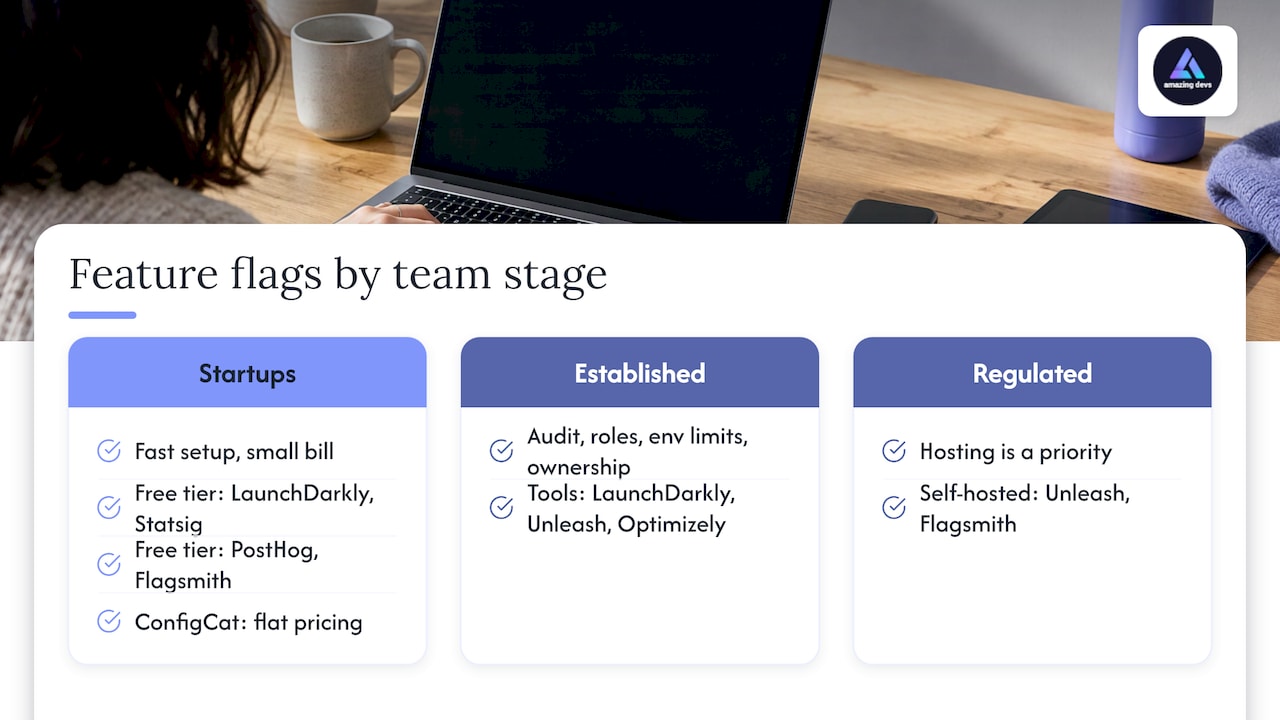
Startups usually need a fast setup and a bill that stays small. A free tier from LaunchDarkly, Statsig, PostHog or Flagsmith gets flags into production in an afternoon. ConfigCat suits teams that want flat pricing from day one.
Established teams care more about audit history, role-based access, environment limits and who owns each flag. LaunchDarkly, Unleash and Optimizely are built around those needs. Regulated teams should add hosting to the list. Unleash and Flagsmith both offer self-hosted paths.
For most teams the shortlist is two tools. Run a two-week trial of each against one real feature, using your own SDK and your own CI pipeline.
The part no tool buys you: engineering time
Buying the software is the cheap step. The work that follows is where flag programs succeed or stall:
- Integration. SDKs must be added to each service and client, with sensible defaults when the flag service is unreachable.
- Naming and ownership. Every flag needs an owner and a planned removal date.
- Clean-up. Retiring stale flags is the work that keeps technical debt down.
- Rollout discipline. Gradual rollouts only reduce risk if someone watches the metrics and is ready to switch the flag off.
If your team is already stretched, the constraint is capacity, not tooling. Hiring a US-based engineer for this is slow and expensive. Our guide to in-house versus vendor development lays out the trade-offs. If your engineers sit across time zones, our timezone management strategies cover the coordination side.
Add engineers who can run the rollout
Amazing Devs provides nearshore developers from Brazil. Our process covers sourcing, technical and cultural fit assessment, and contract management, so you do not carry the hiring overhead. If you want extra hands to integrate a flag platform or to retire old flags, nearshore staff augmentation lets you add pre-vetted developers to your existing team. The Team Extension Model fits teams that want developers working as part of their own squad. Our nearshore QA contractors can cover testing of flagged paths.
We publish no prices for these services, so talk to us about the roles you need.
Our perspective
We see the feature flag tool as the easy half of the decision. The hard half is the people who integrate it, own it and keep it tidy.
Every comparison above ends the same way: a flag platform does little until engineers add SDKs, define targeting rules and remove old toggles. That is ordinary engineering capacity, and it is what we provide. We place Brazilian developers who are assessed for technical skill and cultural fit, and we handle contracts and the bureaucracy around them, so your team keeps its focus on the release process.
Our advice: choose the tool that matches your stage and hosting needs, assign a named owner per flag, and make sure you have the developer hours to do the integration properly. If hours are the gap, that is the conversation we are here for.
Gabriel
FAQ
What is the best feature flag tool for a small team?
Start with a free tier. LaunchDarkly’s Developer plan, Statsig’s Developer plan, PostHog’s free allowance and Flagsmith’s free cloud tier all cover early-stage use. ConfigCat suits teams that want a flat bill. Pick the one whose SDKs match your stack.
Are there open-source feature flag tools?
Yes. Unleash, Flagsmith and GrowthBook all have open-source editions with self-hosting. Self-hosting gives you control over where flags are evaluated and data lives, though your team then runs the infrastructure.
How is feature flag software priced?
Models differ. LaunchDarkly bills by service connection and client-side MAU, Statsig and PostHog by events or requests, Unleash and GrowthBook by seat, and ConfigCat at a flat rate. Optimizely uses custom annual contracts. Compare the cost at your expected scale, not at the free tier.
Do feature flags replace testing?
No. Flags separate release from deployment, so you can limit exposure and switch a feature off quickly. You still need tests on both the on and off paths of every flag.
Sources
- Feature flags, Microsoft Learn
- What are feature flags and how are they implemented, Datadog
- Feature flagging tools: choosing the right tool, ConfigCat
- 10 best feature flag services in 2026, smplkit
- Jira feature flagging, Atlassian
- Manage feature flags in production, LaunchDarkly
- Best feature flag services 2026, Techplained
- Top 5 feature flag management platforms of 2026
- Best feature flags platforms of 2026, Subrupt
- Statsig pricing 2026
- PostHog vs Amplitude, MakerStack
- Unleash feature management platform
- Unleash on GitHub
- Unleash profile, European Tech Map
- Feature flag tools compared by how they bill
- 7 best feature flag tools, Flagsmith
- GrowthBook feature flags
- Optimizely vs LaunchDarkly 2026