In-House vs Vendor Development: How to Choose
In-house development makes sense when software is your core product, your roadmap is stable and you can hire and keep engineers at a steady pace. A vendor makes sense when you need capacity faster than you can hire, need a skill you will not use year-round, or want to cap fixed costs. Most growing companies end up with a mix of the two. This guide shows how the models differ on cost, speed, control and risk, and how to decide without guessing.
TL;DR
- In-house gives you the most control and the deepest product knowledge, but it carries fixed costs: salaries, benefits, tools and a hiring process that can stall a roadmap.
- A vendor gives you capacity and skills on demand, but you take on management, security and continuity risks that need written terms and real oversight.
- The cost gap is rarely salary against rate. It is fully loaded employment cost, recruiting and idle time against vendor fees, onboarding and coordination.
- Hybrid setups, where a core in-house team is extended by vendor developers, are the usual answer when you need to scale without rebuilding your org chart.
- Decide on four questions: how core the work is, how fast you need it, how sensitive the data is, and how long you need the capacity.
Table of Contents
- What the two models actually mean
- Cost: what a developer really costs each way
- Speed and scalability
- Control, knowledge and culture
- Security and compliance risk
- Side-by-side comparison
- When each model fits
- How to evaluate a vendor before you sign
- A simple way to decide
- Our perspective
- Extend your team without the hiring delay
- FAQ
- Sources
What the two models actually mean
In-house development means your own employees build and maintain the software. You control the process, the team and the culture, and you carry the full cost of hiring, managing and keeping them.
Working with a vendor means an outside company handles some or all of the development. A 2024 ISBSG paper on in-house versus outsourced application development describes the trade: outsourcing shifts control and management responsibility to the partner, while in-house work gives a deeper understanding of business needs and culture, at the price of higher fixed costs such as salaries, benefits and infrastructure.
“Vendor” covers very different arrangements, and mixing them up is the most common reason comparisons go wrong:
- Project outsourcing. The vendor owns a defined scope, delivers it and is paid for the outcome. You manage the contract, not the people.
- Staff augmentation. Vendor-sourced developers work inside your team, follow your process and report to your engineering lead. You manage the work; the vendor handles sourcing, contracts and payroll logistics.
- Managed or dedicated teams. A vendor assembles a team for your product and runs much of the delivery. You set direction and review results.
If you are still weighing the first two, our comparison of outsourcing vs staff augmentation goes deeper on when each wins.
Cost: what a developer really costs each way
Salary is the smallest part of the in-house story, and the easiest to underestimate.
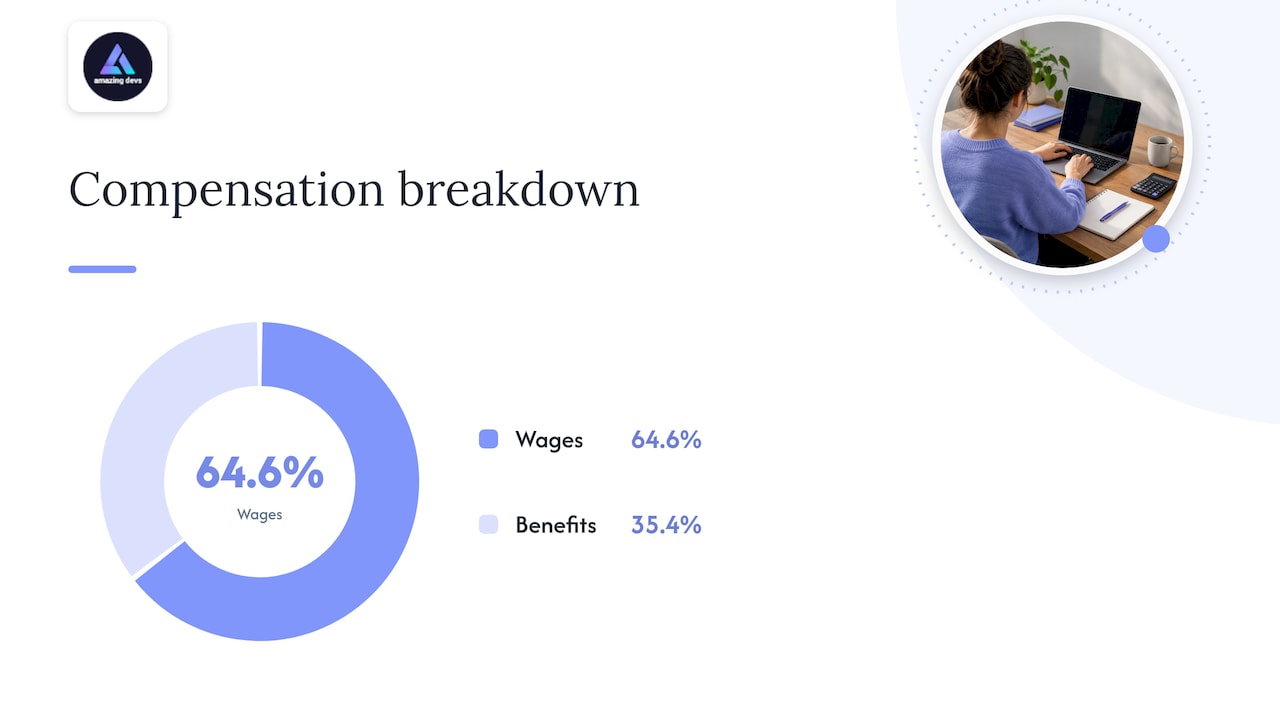
The U.S. Bureau of Labor Statistics puts the median pay for software developers at $135,980 per year in 2025. That is wages only. On top of it sit benefits: BLS employer cost data show that, as of the second quarter of 2026, benefits made up 35.4% of total compensation for private-industry workers in information industries.
Here is a rough illustration, not a quote. If wages are about 64.6% of total compensation, a $135,980 wage implies total compensation of roughly $210,000 per year, before you add equipment, software licenses, office or remote-work stipends, management time and recruiting. Your own numbers will differ by city, seniority and benefits plan, so rebuild the calculation with your payroll data.
Then add the cost of finding the person. Agency fees, internal recruiter time, interview hours from senior engineers and a vacant seat all count. We broke that down in what it costs to recruit developers, and the numbers surprise most hiring managers.
Where vendor costs hide
A vendor’s hourly or monthly rate looks simple, but a fair comparison needs the extras on that side too:
- Time your own staff spend writing specs, reviewing work and attending meetings.
- Onboarding and knowledge transfer when people rotate.
- Rework when requirements were not understood the first time.
- Contract extras: change requests, minimums, notice periods.
- Security and compliance review before the first line of code.
We cover these in the hidden costs of outsourcing. The point is symmetry: compare fully loaded cost to fully loaded cost, over the same period, for the same output. If you want a side-by-side for one role, see what a developer really costs nearshore vs in-house.
Fixed versus variable
In-house cost is mostly fixed. You pay the engineer in a slow quarter and in a crunch. Vendor cost is more variable: you can scale capacity up for a launch and down afterward, subject to your contract’s notice terms. That flexibility is often worth more than any rate difference, especially for startups whose roadmap changes every quarter.
Speed and scalability
Hiring speed is where in-house plans most often slip. SHRM’s 2026 benchmarking reports a median time-to-fill of 39 calendar days for nonexecutive positions in the U.S.. That figure covers all nonexecutive roles, and specialized engineering searches commonly run longer. It also counts only the search; add notice periods, onboarding and the weeks before a new hire is productive.
The same SHRM research found that over two-thirds of U.S. organizations reported struggling to hire for open positions in 2026. If your plan depends on filling five engineering seats this quarter, treat that as a real risk to the schedule.
A vendor with a bench of vetted developers can usually shorten the path from decision to first commit, because sourcing and screening are already running. The advantage is real only if the vendor’s screening is rigorous. A fast but weak match costs more than a slow good one.
Control, knowledge and culture
In-house teams win on context. They sit in the same planning meetings, absorb why a decision was made three years ago and feel the consequences of technical debt. That matters most for core product work, where architecture decisions compound.
Vendors can match this more than people expect, but only when the model allows it. A project-based vendor working from a spec will build the spec. A staff augmentation developer embedded in your stand-ups, using your tools and reporting to your lead, behaves much more like an employee. Time zone overlap decides how well that works, so if you consider offshore options, read nearshore vs offshore and our notes on managing time zones.
Control also has a legal side. Whoever builds the software, you want explicit intellectual property assignment, confidentiality terms and a clean handoff. One practitioner overview lists IP ownership, security requirements, handoff and vendor lock-in risks, and communication barriers as the items to assess, and suggests NDAs, explicit IP assignment and termination terms to protect the engagement. Have your counsel review all three before work starts.
Security and compliance risk
The more critical the system, the more rigor a vendor relationship needs. The FFIEC, which writes IT guidance for U.S. financial regulators, says outsourcing can provide technology, skills and delivery capacity but reduces direct control and may increase operational and technology risk. Its conclusion is practical: planning, diligence and oversight should become more rigorous as the activity becomes more critical. You do not need to be a bank to borrow that principle.
Three specific controls are worth putting into any vendor agreement:
- Security requirements in the contract. CISA and its partners’ guidance on software supply chains recommends that customers use contractual security requirements, vulnerability disclosure and mitigation, incident reporting, and verification of third-party software, as set out in the September 2022 ESF supplier guidance.
- Supply-chain visibility. The FFIEC recommends policies covering vendor selection, traceability, ongoing due diligence, geographic risk and subcontractor flow-down clauses. Ask any vendor who else touches your code or data.
- Continuity. NIST-referenced guidance notes that technology escrow agreements can mitigate supplier insolvency, failure to maintain services or change of ownership. For software you cannot lose, that is worth a conversation with your lawyer.
Some work should stay in-house or with a tightly restricted team. The same practitioner overview notes that federal contractors under NIST SP 800-171, or organizations with FedRAMP requirements, face strict compliance mandates that may call for in-house development or highly vetted vendor teams. If you handle payment data or sanctions screening, see our guides on PCI compliance outsourcing, data security in outsourcing and OFAC screening vendor questions. For regulated environments, confirm requirements with your compliance officer or security counsel before you pick a model.
Side-by-side comparison
| Factor | In-house team | Vendor (staff augmentation or outsourcing) |
|---|---|---|
| Cost structure | Mostly fixed: wages, benefits, tools, recruiting | Mostly variable: rate or monthly fee plus your management time |
| Time to start | Search, offer, notice period, onboarding | Depends on the vendor’s bench and your onboarding |
| Scaling up or down | Slow up, painful down | Faster, bounded by contract notice terms |
| Control | Highest | Depends on the model: high with embedded staff, lower with project outsourcing |
| Product knowledge | Builds over time and stays with you | Must be transferred and protected from turnover |
| Specialized skills | Hire or train | Access to skills you need for a short stretch |
| Security and IP | Governed by employment terms | Governed by contract, audits and oversight |
| Management load | Your managers | Shared, but never zero |
When each model fits
Choose in-house when
- The software is your product or your main competitive edge.
- The roadmap is stable enough to keep a full team busy year-round.
- Data sensitivity or regulation restricts who can touch the code.
- You have the hiring muscle: recruiters, a strong employer brand and engineering managers with capacity.
Choose a vendor when
- You need capacity sooner than your hiring pipeline can deliver.
- The need is temporary: a migration, a launch, a one-off integration.
- You need a specialty, such as QA automation or a specific stack, that you will not use constantly.
- Budget forces you to avoid long-term fixed commitments.
- Your internal team is strong but too small, and the bottleneck is hands, not direction.
Choose a hybrid when
Most companies reading this land here. A hybrid model keeps architecture, product ownership and the critical knowledge in-house, and uses vendor developers to extend capacity around that core. It works well when:
- You have a technical lead who can direct additional developers but cannot hire fast enough.
- Work divides cleanly, for example feature delivery versus testing, or new builds versus maintenance.
- You want to test a vendor on a small scope before committing more, and possibly convert strong contributors later where the contract allows it.
The risk in a hybrid is two classes of engineer. Prevent it by giving vendor developers the same tools, rituals and context as employees. Our overview of nearshore partnership models and staff augmentation use cases shows how teams set this up in practice.
How to evaluate a vendor before you sign
Treat vendor selection as a risk decision, not a price comparison. The FFIEC’s guidance says that before choosing a third party you should assess its ability to perform as expected, adherence to your policies, compliance with applicable laws, and conduct of the activity, with more diligence for higher-risk or more complex work. A workable process:
- Classify the work. Is this a marketing site or the system that holds customer money? The answer sets how deep you go. The FFIEC scales diligence to the criticality of the function, information sensitivity, complexity and supplier location and ownership.
- Ask for evidence, not claims. Request references, sample contracts, security policies and any independent audit reports. A professional vendor-risk guide suggests collecting contracts, SLAs, policies, audit reports, questionnaires and performance metrics, then documenting findings in a risk matrix with corrective actions and due dates.
- Test the people. Interview the developers who will work on your product, not only the sales lead. Run a paid technical exercise if the stakes are high.
- Verify the business. Procurement should look at price, quality, delivery speed and financial health, and arrange service-level agreements, as the FFIEC describes in its acquisition roles guidance. Our vendor onboarding checklist helps screen for fraud.
- Manage after signing. Ongoing oversight should include clear contracts, annual audited financial statements, review of independent IT-control audits and attention to responsiveness, per the FFIEC’s third-party management guidance. Even if you are not regulated, the habit is sound.
If you hire through a vendor, also understand how the developers are engaged. EOR versus contractor explains the legal and operational differences.
A simple way to decide
Score your situation on four questions. No formula, just honest answers.
- How core is the work? The closer to your product’s differentiator, the more weight in-house carries.
- How fast do you need it? If your hiring funnel cannot meet the date, in-house alone is not a plan.
- How sensitive is the data? High sensitivity means tighter vendor controls, or in-house for the most restricted parts.
- How long is the need? Under a year or uneven demand points to a vendor; a permanent, steady need points to employees.
When the answers split, which is common, go hybrid: keep the core, extend the edges, and review every quarter.
Our perspective
We place Brazilian developers with U.S. companies, so you should read us as having a view. Here it is.
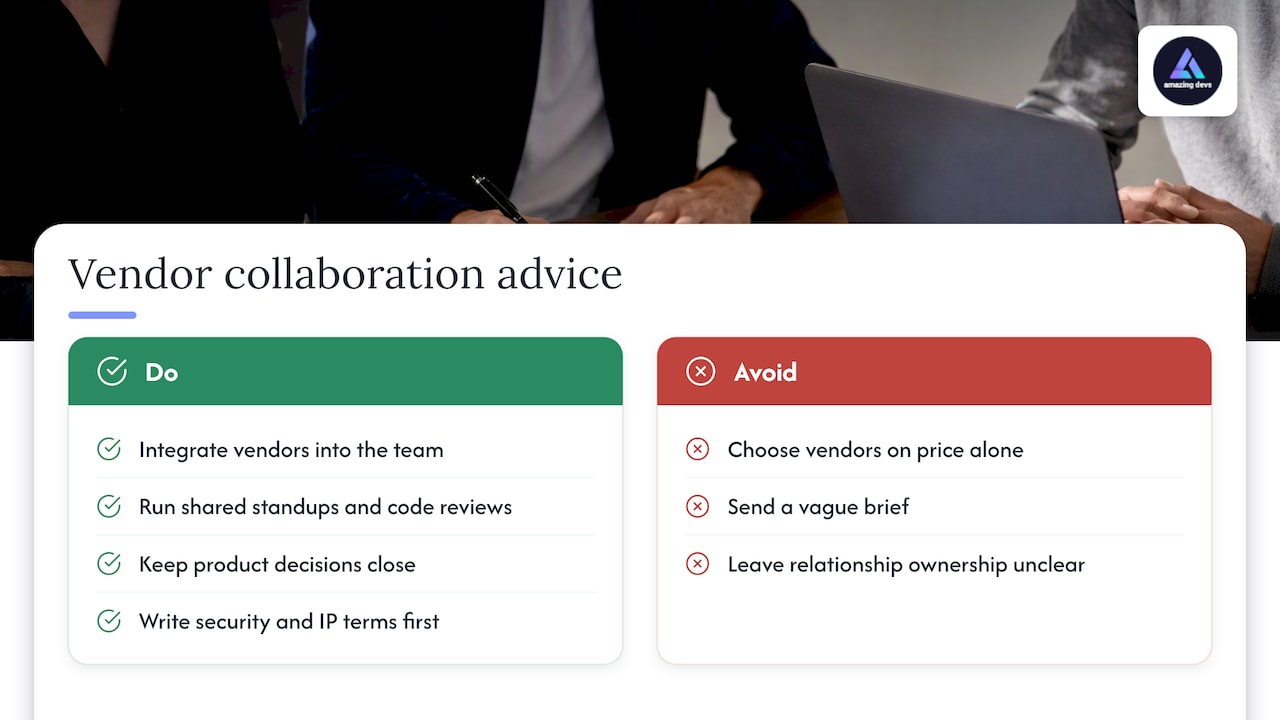
The companies that get the most from a vendor are not the ones hunting for the lowest rate. They are the ones that treat outside developers as part of the team: same standups, same code review, same access to the product context. When that happens, the in-house versus vendor question loses its edge.
The failures we see come from the opposite habit: a vague brief, a vendor chosen on price alone and nobody on your side who owns the relationship. That fails with any model. A mediocre in-house hire has the same effect, only slower and more expensively.
That is why we put so much effort into assessment before placement. We look at technical skill and at cultural and business fit, because a strong engineer who cannot work well with your team is not a strong match. We also handle the contracts and the bureaucracy around nearshore hiring, so your managers spend time on the product and not on paperwork. Our engineering team stays involved after the match, because the first months decide whether it works.
Our honest advice: keep your architecture and product decisions close, use a vendor to add capacity where hiring is the bottleneck, and write down security and IP terms before anyone starts.
— Gabriel
Extend your team without the hiring delay
If your plan is hybrid, or you simply need more engineers than your pipeline can produce, our nearshore staff augmentation service places pre-vetted Brazilian developers into your team. We source and assess candidates for technical and cultural fit, manage the contracts, and support the engagement after the match. The Team Extension Model fits companies that want developers working as an extension of their own team, and we also supply nearshore QA contractors.
Tell us the roles, the stack and the timeline through our site, and we will show you what a match could look like.
FAQ
Is in-house development always more expensive than using a vendor?
Not always. In-house cost includes wages, benefits, tools and recruiting, and those costs continue whether or not the work is steady. A vendor can cost less for temporary or uneven demand, but for a permanent, full-time need, a well-managed employee can be competitive. Compare fully loaded costs over the same period, including your management time on the vendor side.
When should a company outsource instead of building in-house?
Outsource when you need capacity faster than you can hire, need a specialty for a limited time, or want to avoid fixed costs while the roadmap is uncertain. Keep work in-house when it is your core differentiator, when regulation restricts who can access the code, or when you can keep a team busy all year.
What is a hybrid development model?
A hybrid model keeps product ownership, architecture and key knowledge with your employees, and adds vendor developers for extra capacity or specialized tasks. It works best when vendor developers join your processes and tools instead of working in isolation.
What security risks come with a development vendor?
The main ones are unclear IP ownership, weak access controls, hidden subcontractors, slow vulnerability and incident reporting, and difficulty recovering your code if the relationship ends. Address each in the contract, check the vendor’s evidence before signing, and involve legal and security staff for sensitive systems.
Is outsourcing software development dead?
No. Hiring remains hard for many U.S. employers, and SHRM’s 2026 data shows over two-thirds reporting hiring struggles. That keeps external capacity, including staff augmentation and nearshore teams, in steady use. What has changed is that buyers expect tighter oversight and closer integration with their own teams.
Sources
- Inhouse versus Outsourced Application Development (ISBSG, 2024)
- FFIEC IT Examination Handbook: Third-Party Relationship Risk Management
- FFIEC: Due Diligence and Third-Party Selection
- FFIEC: Supply Chain Risk Management
- FFIEC: Acquisition
- FFIEC: Acquisition Roles
- FFIEC: Third-Party Management
- SHRM: 2026 Recruiting Executives Benchmarking
- U.S. Bureau of Labor Statistics: Occupational Outlook Handbook
- U.S. Bureau of Labor Statistics: employer cost data, benefits share of compensation
- CISA: Securing the Software Supply Chain, Recommended Practices for Suppliers (September 2022)
- NIST Cybersecurity Framework 2.0 concept paper on technology escrow
- App Development Authority: In-House vs. Outsourced App Development
- How to perform proper vendor management and third-party risk reviews