Software Development SLA: What to Include and How to Measure It
A software development SLA (service level agreement) is the part of your contract that turns “we’ll take care of it” into numbers you can check: what is covered, how fast the provider responds, how quickly problems get fixed, and what happens when they are not. The best ones are short, measurable and reviewed on a schedule. If you hire developers through a nearshore staff augmentation model, the SLA looks different from an outsourced-project SLA, and getting that difference right saves you the most arguments.
This guide covers what to put in the agreement, how to define response and resolution times, which metrics are worth tracking, and how to adapt the document when you extend your own team with remote engineers.
TL;DR
- An SLA is a written agreement that records what service is delivered, to what standard, how it is measured and what follows a miss.
- Use measurable terms: severity levels, response and resolution targets, support hours, reporting cadence, exclusions and remedies.
- A “4-hour SLA” is not a standard. It means whatever the contract defines, so check what starts the clock and what counts as resolved.
- Match the model to the engagement: outcome-based SLAs suit outsourced projects, while embedded developers are better governed by availability, onboarding, replacement and performance terms.
- Review metrics monthly and the SLA itself quarterly, and track every amendment by version.
Table of Contents
- What a software development SLA actually establishes
- Choosing the right SLA model
- What to include in the agreement
- Metrics that belong in a development SLA
- Response time versus resolution time
- SLA, KPI, SLO and SOP: how they differ
- Adapting the SLA when you extend your team with nearshore developers
- Monitoring and reviewing the SLA
- Common mistakes to avoid
- How we support this at Amazing Devs
- Our perspective
- FAQ
- Sources
What a software development SLA actually establishes
The U.S. banking regulators’ IT handbook describes an SLA as a formal agreement that records the parties’ shared understanding of the services and how they will be delivered. It covers responsibilities, quality, security, availability, timeliness, contacts, metrics, approvals and what to expect when something goes wrong.
In plain terms, the SLA answers five questions:
- What exactly is the provider responsible for?
- To what standard, and measured how?
- Who do you call, and how fast do they answer?
- What happens if the standard is missed?
- How and when can either side change the terms?
AWS makes the same point from the cloud side: an SLA sets promised service levels and measures such as uptime, delivery, response and resolution times, and may specify additional support or pricing discounts when targets are missed.
An SLA is not the whole contract. It sits next to the master services agreement, the statement of work, and the clauses on intellectual property and confidentiality. If you are drafting those too, our guides on developer contract rules that protect IP and contractor IP assignments cover the surrounding terms.
Choosing the right SLA model
CIO’s guide to service-level agreements separates customer-based SLAs, tailored to one customer, from operational SLAs that cover routine service operations such as uptime and maintenance scheduling. For software work, it helps to think in three practical models.
| Engagement | What you buy | What the SLA should measure |
|---|---|---|
| Support and maintenance of a live product | Incident handling, bug fixes, patches | Severity levels, response and resolution times, availability, support hours |
| Fixed-scope project delivery | A finished deliverable | Milestones, acceptance criteria, defect rates, rework terms |
| Staff augmentation or dedicated developers | Engineers working inside your team and process | Availability and overlap hours, onboarding time, replacement time, delivery and quality indicators you already track |
Most confusion comes from borrowing a support-style SLA for an embedded-team engagement. If a developer sits in your standups and works your backlog, a “4-hour resolution” target for tickets makes little sense. What you care about is that the person is available during agreed hours, ramps up quickly, ships at an agreed quality and can be replaced fast if the fit is wrong.
What to include in the agreement
The FFIEC says an SLA should give clear, measurable expectations, accountability for both parties, and recourse for missed expectations, linked to incentives, penalties and termination provisions. It also recommends identifying service priorities and responsibilities, the nature and scope of the service, performance expectations, reporting and resolution requirements, termination terms and points of contact.
Translated into a checklist for a software engagement:
- Scope. Which applications, environments and activities are covered, and which are excluded. A software-development SLA guide from Pactolane says the document should state which software, environments and activities are covered and excluded. Staging, legacy modules and third-party integrations are the usual disputes.
- Severity definitions. Write down what counts as critical, high, medium and low in business terms, not technical ones. “Customers cannot check out” beats “service degraded.”
- Response and resolution targets for each severity level.
- Support hours and time zone. State them explicitly, including holidays. This matters doubly when the team is in another country.
- Delivery and quality measures. Defect escape rate, test coverage, code review turnaround, sprint commitments met.
- Measurement method. Name the tool or report that is the source of truth, so no one argues over whose numbers count.
- Reporting cadence and escalation path. Who reports what, how often, and to whom a problem escalates.
- Exclusions. Outages caused by your own infrastructure, changes you requested out of process, or events outside either party’s control.
- Remedies. Service credits, extra support, root-cause analysis, or termination rights after repeated misses.
- Change review. How terms are revised as the product evolves.
AWS’s own list of possible SLA elements adds a few worth considering: security standards, disaster recovery, and signatures alongside the overview, service description, exclusions, objectives, tracking, penalties and termination. If your product handles payments or regulated data, add the compliance duties here too. Our PCI compliance outsourcing checklist shows what a merchant still owns when work is outsourced.
Metrics that belong in a development SLA
CIO’s guide lists availability, defect rates, technical quality, security measures and business results as possible SLA metrics for technology services. Pick few, and only those you can measure from data both sides can see.
AWS describes a service level objective (SLO) as an agreement within an SLA about a specific metric, such as response time or uptime, and recommends agreeing on metrics backed by data. That advice is the filter: if neither party can pull the number from a system, do not put it in the contract.
A practical starter set:
- Availability: the share of time the service is usable. AWS notes it can be measured over a specified daily window or continuously across 24 hours, so say which one you mean.
- Response time: how fast a ticket is acknowledged.
- Resolution time: how fast normal operation is restored.
- Defect escape rate: bugs found in production versus before release.
- Delivery predictability: the share of committed work finished in the sprint.
- Review turnaround: how fast pull requests get a first review.
For delivery speed and team health, engineering leaders often pair these with DORA and SPACE measures. Our guide on diagnosing remote developer performance with SPACE and DORA explains how to read them without turning them into surveillance.
CIO also suggests that business outcomes can be measured through existing KPIs when the provider’s contribution can be calculated. That is a fair test: tie a metric like conversion or onboarding time to a provider only when you can isolate the provider’s part of it.
Response time versus resolution time
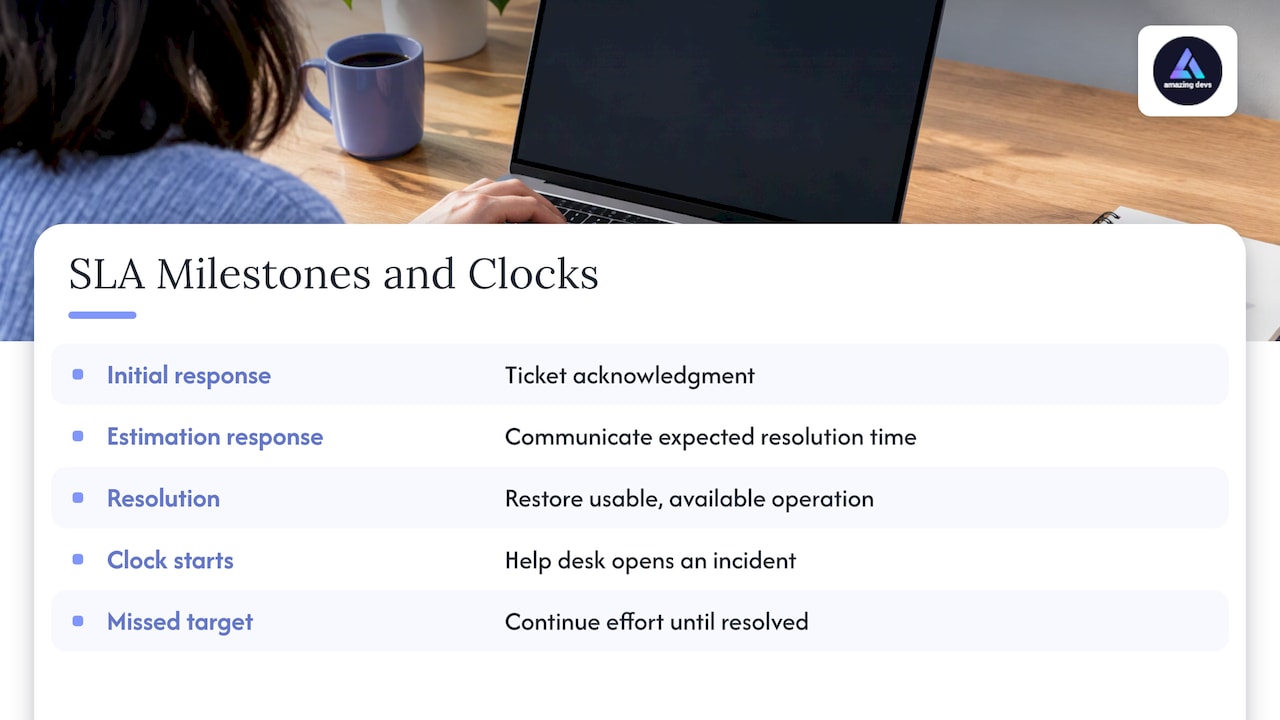
The most common SLA fight is about definitions, not numbers. The Project Management Institute’s example SLA defines initial response as ticket acknowledgment, estimation response as communicating an expected resolution time, and resolution as restoring the application to usable and available operation. Three different clocks, three different promises.
The same document measures response and resolution from the moment the help desk opens an incident, and calls for continuous effort if an issue is not resolved within its target. Two details to copy into your own agreement: the starting event for each clock, and what the provider must do if the target slips.
What a “4-hour SLA” means
There is no universal meaning. In PMI’s example, a top-severity incident gets a 15-minute initial response, a 2-hour estimate, updates every 30 minutes and a 4-hour resolution target. That is one organization’s example, not an industry standard.
When a vendor offers “a 4-hour SLA,” ask these four things in your own review:
- Is it 4 hours to respond or 4 hours to resolve?
- Does the clock run 24/7 or only during business hours?
- Does it apply to every severity or only the highest?
- What counts as resolved: a workaround, a hotfix, or a permanent fix?
A worked example: a checkout bug is reported at 4:30 p.m. Friday. Under a business-hours clock with a 4-hour target, the clock may not finish until Monday morning. Under a 24/7 clock, the target lands at 8:30 p.m. Friday. Same number, very different weekend.
SLA, KPI, SLO and SOP: how they differ
These terms get mixed up, and the confusion leaks into contracts.
- SLA: the commitment between two parties, with consequences attached.
- SLO: a specific target inside the SLA, such as response within 30 minutes.
- KPI: a number you track to judge performance. It may or may not be promised to anyone.
- SOP (standard operating procedure): the internal how-to for performing a task. It describes the method, not the promise.
A useful rule: the SLA says what will be delivered, the SOP says how the team does it, and KPIs tell you whether the whole thing is working. A KPI can graduate into an SLO when both parties agree to commit to it.
Why a 100% commitment is a warning sign
A 100% target leaves no room for planned maintenance, third-party failures or ordinary human error, so it either gets quietly excluded around or gets missed. Realistic agreements state a target below 100%, define exclusions such as scheduled maintenance windows, and name the remedy for a miss. Aim for a number the provider can hit with the team and tools in place, and one that matters to your users.
Adapting the SLA when you extend your team with nearshore developers
If you hire engineers who work inside your process, you are not buying tickets closed, you are buying capacity and quality. The SLA should reflect that. Terms worth writing down:
- Working hours and overlap. Agree on the daily window when the developer is reachable and attends ceremonies. Nearshore teams in Brazil sit in time zones close to U.S. business hours, which is the main reason many companies choose them. Our guide to timezone management moves for managers shows how to structure the overlap.
- Time to start. How many days from signed agreement to a developer’s first day.
- Replacement terms. How quickly a replacement is proposed if the fit is not right, and who bears the ramp-up time.
- Performance expectations. Agreed delivery and quality indicators, reviewed on a set rhythm. Our performance management guide for contractors lays out how to set them.
- Confidentiality and IP. Signed before access to code is granted. See our guide on NDAs for contractors.
- Contract administration. Who handles invoicing, local paperwork and compliance with the contractor’s home-country rules.
That last point is where a staffing partner earns its keep. Cross-border engagements add paperwork that an SLA between you and a single freelancer would never cover. Choosing a partnership structure up front also shapes the SLA; our overview of nearshore partnership models and the comparison of outsourcing vs staff augmentation help you decide which model your agreement should describe.
If you are hiring AI-focused engineers, add scope clarity as a term: which models, data and evaluation criteria the developer is expected to work with. Our AI project scoping guide and the page on what LLM engineers do help you write that section.
Monitoring and reviewing the SLA
An SLA that is signed and filed does not protect anyone. PMI’s example schedules monthly metric reviews and quarterly SLA reviews, with amendments when required and changes tracked by version number and date. That rhythm works well for software teams too.
A simple review routine:
- Monthly: compare actual metrics with targets, list the misses, and record the cause of each.
- Quarterly: ask whether the targets still match the product. A product that went from beta to paying customers needs tighter severity definitions.
- After a major incident: hold a root-cause review and decide whether the SLA, the process or the scope needs to change.
- At every amendment: bump the version and date it, so you always know which terms applied when.
Keep the metric list short. Five numbers that both sides read every month beat twenty that nobody opens.
Common mistakes to avoid
- Measuring what is easy rather than what matters. Lines of code or hours logged say little about outcomes.
- Penalties without a path to improvement. Credits compensate you, but they do not fix the cause. Pair them with a root-cause review.
- Unclear starting events. If the contract does not say when the clock starts, the dispute is built in.
- No owner on your side. Someone on your team must read the reports and run the review.
- Copying a cloud-provider SLA for a people-based engagement. Uptime language fits infrastructure. Capacity, fit and delivery fit teams.
How we support this at Amazing Devs
We place pre-vetted Brazilian developers through nearshore staff augmentation and the Team Extension Model. Our recruitment and assessment process looks at technical skill and cultural fit, and we manage contracts and the bureaucratic work around them, so you can focus on setting delivery expectations with your developers rather than on paperwork. If your product also needs testing capacity, we offer nearshore QA contractors.
To discuss how an engagement could be structured for your team, start at getamazingdevs.com.
Our perspective
Most SLA problems we see described by tech leaders are really expectation problems that were never written down. A support-style SLA gets signed for a team that is meant to work as part of the company, and then everyone is surprised when the metrics do not capture what matters.
Our view is that when you extend your team with developers, the best protection is a good match from the start. That is why we put so much into assessing technical skill, communication and cultural fit before anyone joins, and why we take on the contract management and bureaucracy that otherwise land on your desk.
Then keep the agreement simple. Agree the working hours, the way you will measure delivery, the review rhythm and the escalation path. Review it monthly, and treat it as a living document. Our engineering team stays close to the engagement so that problems surface early, while they are still easy to fix.
Gabriel
FAQ
What is the difference between an SLA and a KPI?
An SLA is a commitment between a provider and a customer, with agreed consequences if it is missed. A KPI is a number you track to judge how work is going, with no promise attached. A KPI becomes part of an SLA when both parties agree to commit to a specific target for it.
Who needs a software development SLA?
Any company that depends on an outside provider or an embedded external team for software delivery or support benefits from one. It is most valuable when problems are costly, when several parties share responsibility, or when work crosses borders. Even a short agreement beats unwritten expectations.
What should happen when a provider misses an SLA target?
The agreement should name the remedy in advance. Common options are service credits, extra support, a documented root-cause analysis, and termination rights after repeated misses. The FFIEC handbook recommends linking SLAs to incentives, penalties and termination provisions.
How often should we review the SLA?
Review performance metrics monthly and the agreement itself quarterly, a cadence taken from the PMI sample SLA. Also review it after any major incident or scope change, and record each amendment by version and date.
Is a 99.9% or 100% target realistic?
A 100% target leaves no room for maintenance or outside failures, so it is rarely deliverable. Pick a figure the team can actually reach, define the exclusions, and tie it to what your users notice. Make sure the contract says how availability is measured.
Sources
- FFIEC IT Examination Handbook: Service Level Agreement
- AWS: What is SLA?
- CIO: What is an SLA? Best practices for service-level agreements
- Project Management Institute: Service Level Agreement example
- Pactolane: Software development service level agreement