Build an AI Team in Weeks, Not Quarters: U.S. Nearshore Playbook
The fastest, lowest-risk way to build an AI team is staff augmentation if you already have an engineering lead and a steady roadmap, or an embedded nearshore partner if you’re short on recruiting bandwidth or need engineers fast. Staff augmentation typically gets engineers working within 2 to 4 weeks; embedded partners can start in under 4 weeks. The company runs both models with pre-vetted Brazilian developers.
TL;DR:
- Staff augmentation delivers engineers in 2 to 4 weeks, and embedded nearshore partners can start in under 4 weeks, making them faster options than direct hire.
- Prioritize shipped production experience and real-world failure stories over algorithmic trivia when vetting AI candidates.
- Small teams of one to four engineers with clear ownership and defined roles are sufficient for proof-of-concept projects, with senior engineers leading architecture decisions.
- Governance failures often stem from unclear ownership and late security planning, so define access, responsibilities, and IP terms before onboarding any nearshore engineer.
- A short, 4 to 8-week pilot with measurable milestones is the best way to evaluate a team’s actual production capability before committing to long-term staffing.
Table of Contents
- Which Hiring Model Fits Your AI Project?
- How Do You Vet for Real Production AI Skill?
- What Roles Do You Actually Need on an AI Team?
- What Governance Rules Prevent Nearshore Failures?
- How Should a First AI Team Pilot Be Structured?
- What I’ve Seen Break (and What Actually Works)
- Get Your Nearshore AI Team Running in Weeks, Not Quarters
- Sources
- FAQ
Which Hiring Model Fits Your AI Project?
Direct hire, staff augmentation, and embedded partnership solve different problems. The right choice depends on how much recruiting capacity you have and how fast you need production code shipped.
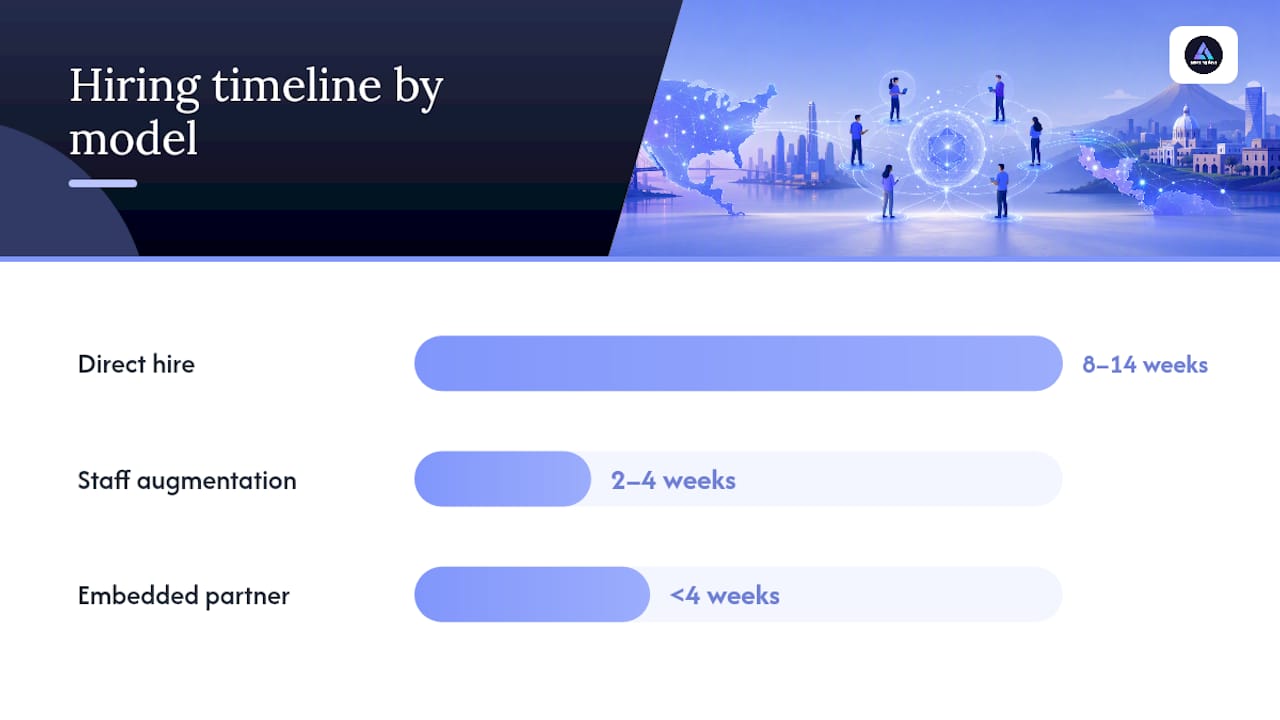
Direct hires take 8 to 14 weeks to source, interview, and onboard. That timeline works when you’re building a permanent core team and want full control over IP and culture, but it’s a poor fit when a competitor is already shipping. Staff augmentation typically delivers working engineers in 2 to 4 weeks, and an embedded partner can often start in under 4 weeks while also owning delivery accountability, not just headcount.
Run through this before deciding:
- Recruiting capacity: If nobody on your team has time to screen resumes and run technical interviews this quarter, skip direct hire.
- Timeline pressure: A funding milestone or investor demo 6 weeks out rules out anything slower than augmentation.
- Compliance burden: Data privacy and IP assignment take longer with direct international hires than with a managed staffing arrangement.
- Need for accountability: An embedded partner takes ownership of outcomes; augmented staff still need your engineering lead directing the work.
Nearshore talent adds a practical wrinkle here. Same-day overlap with U.S. teams speeds up the evaluate-adjust-retest cycle that AI projects depend on, while offshore engagements tend to win on raw hourly cost when the work is already well-specified. For AI systems that still need heavy iteration, that overlap difference is often worth more than the rate difference.
How Do You Vet for Real Production AI Skill?
Most AI interviews test the wrong thing. Whiteboard algorithm questions tell you almost nothing about whether someone can keep a model serving traffic at 2 a.m. when an upstream API starts returning malformed responses. What you actually need is evidence of production judgment, and that requires a different kind of screening.
Start with mandatory evidence before a candidate even reaches a live interview. Ask for shipped production systems, not side projects. Ask for Git history showing real commits under review, not a solo repository with one giant initial commit. Ask for a specific story about a monitoring alert that fired and what the rollback looked like. Candidates who can’t produce this usually haven’t operated AI systems at scale, regardless of how they perform on a coding test.
Run these three checks in sequence:
- Async written brief. Give the candidate a short, ambiguous product problem and ask for a written technical plan within 48 hours. This tests communication clarity across time zones, which matters more for nearshore collaboration than most teams expect.
- Production-debug scenario. Present a broken pipeline (a drift issue, a flaky third-party API, a runaway inference cost) and ask them to walk through diagnosis out loud. Strong candidates ask about logging and monitoring before touching code; weak ones jump straight to rewriting.
- Architecture walkthrough. Have them explain a system they actually built, including what they’d change if they rebuilt it today. Hesitation here is a bigger red flag than a wrong technical answer.
The MLOps checklist matters just as much as the interview performance: deployment pipeline maturity, tracing and observability, drift detection, cost controls, and how they’ve handled sensitive data in the past. Hiring guides consistently point to shipped production experience and concrete failure-mode stories as better predictors than generic scores, and the strongest vetting rubrics weight proof-of-work and written communication over algorithmic puzzles.
Pro Tip: Score the async written brief on a simple rubric: clarity of assumptions stated, tradeoffs named explicitly, and whether they flagged what they’d need from you before starting. A candidate who asks good clarifying questions in writing will ask them in Slack too, which is exactly what you want at 9 a.m. Brazil time when your team is still asleep.
What Roles Do You Actually Need on an AI Team?
You don’t need ten specialists to start. You need clear ownership across a small number of roles, and you need to know who’s accountable when something breaks in production.
- AI/ML engineer: Owns model selection, training or fine-tuning, and integration into the product.
- Data engineer: Owns the pipelines feeding the model, including data quality and freshness.
- MLOps engineer: Owns deployment, monitoring, versioning, and rollback procedures.
- Product/AI lead: Owns the roadmap and translates business goals into technical requirements.
- QA/eval engineer: Owns systematic evaluation, including regression testing against prompt or model changes.
On small teams, one person often wears two hats, usually AI/ML engineer plus MLOps early on. What can’t be blurred is ownership of prompt versioning, model update approval, and monitoring response. Assign a name to each, not a team.
For proof-of-concept work, one to four engineers is usually enough. Pair a senior AI/ML engineer with a mid-level generalist rather than staffing two juniors. A nearshore-embedded structure works well here because the senior engineer can own architecture decisions while the partner handles day-to-day implementation without waiting on a full internal hiring cycle.
What Governance Rules Prevent Nearshore Failures?
Most nearshore engagements don’t fail because of skill gaps. They fail because nobody defined who owns what before code started shipping, and by the time the gap surfaces, it’s already caused a production incident.
Set explicit overlap hours before day one, not after the first missed deadline. A daily async summary should cover what shipped, what’s blocked, and what decision is needed from the U.S. side by end of day. Documentation standards matter more than most teams admit: a living SPEC.md for each feature, architecture decision records (ADRs) for anything with long-term consequences, and CI/CD pipelines that block untested code from reaching production. Observability isn’t optional for AI systems specifically, since silent model degradation is far harder to spot than a crashed server.
Lock down these items before any nearshore engineer touches production access:
- Access tiers (who can deploy, who can only merge to staging)
- IP assignment terms in the contract, confirmed before onboarding starts
- Data handling rules, especially for any system touching customer data
- Named escalation paths for AI-specific incidents: model drift, hallucinated outputs, and third-party API outages
Governance failures trace almost entirely to unclear ownership and late security planning, and the common fix is defining ownership before the first commit, not after the first incident. Contracts and onboarding checklists should name who approves prompt changes and model updates explicitly, since ambiguity here is what causes drift disagreements six months into a project.
How Should a First AI Team Pilot Be Structured?
A short paid pilot beats a long-term commitment every time you’re evaluating a new hiring model or partner. It gives you real signal on production capability without locking you into a year-long contract based on interview performance alone.
- Week 1: Discovery. Named engineers review your codebase, define scope, and agree on evaluation metrics with your product lead.
- Weeks 2 to 4: Delivery. The team ships against a defined milestone, with your internal lead reviewing code and checking in on the agreed overlap hours.
- Weeks 5 to 8: Stabilization and handover. The team documents what was built, transfers operational knowledge, and you assess whether the working relationship justifies scaling.
A 4 to 8 week paid pilot with named engineers and measurable deliverables is the standard de-risking move before committing to a longer engagement. If the pilot hits its milestones and the team communicates well across time zones, that’s your signal to add engineers using the same staff augmentation model rather than restarting the vetting process from scratch.
What I’ve Seen Break (and What Actually Works)
Governance gets skipped more often than skill gets misjudged. The pattern repeats: a team hires a strong engineer, skips the ownership conversation about who approves model updates, and three months later two people think they own the same prompt version. That’s not a hiring failure. It’s a documentation failure that happened before day one.
The interview mistake I see most is testing algorithms when the job is judgment. A candidate who can recite gradient descent from memory but freezes when asked how they’d debug a silently degrading model in production is not who you want paging at 2 a.m. The vetting process builds around shipped production evidence and cultural-fit conversations as they predict long-term fit better than a technical score alone.
Start small. Insist on production references before you insist on anything else.
— Gabriel
Get Your Nearshore AI Team Running in Weeks, Not Quarters
Everything in this guide, the vetting rubric, the governance checklist, the pilot structure, still requires someone to actually source and screen the engineers. This part is handled directly by the nearshore staffing provider, cutting time-to-first-engineer from the 8 to 14 weeks a direct hire takes down to a matter of weeks.
The provider recruits Brazilian developers with production AI experience, screens them for cultural fit and communication style before presenting resumes, and manages contract and legal complexities to streamline the process. That covers the governance gaps this guide flags as the most common source of nearshore failure: ownership, access, and IP terms handled before onboarding, not after an incident.
If you’re ready to test the model with a real engagement, the team extension approach is built exactly for the pilot structure described above: named engineers, a defined scope, and a clear path to scale if the first weeks go well. For teams that need staffing flexibility across multiple roles at once, nearshore staff augmentation covers everything from a single ML engineer to a full pod. Start with a short pilot and see how the working relationship holds up before committing further.
Sources
- How to Hire Nearshore AI Engineers in LatAm in 2026 | GoGloby
- How to Hire Nearshore AI Developers: A Guide
- Nearshore vs offshore for AI product development
- Offshore vs Nearshore AI Development: 2026 Comparison
FAQ
How Long Does It Take to Build an AI Team With Nearshore Talent?
Staff augmentation typically gets engineers working in 2 to 4 weeks, and an embedded partner can often start in under 4 weeks. Direct hiring for the same roles usually takes 8 to 14 weeks once you account for sourcing, interviews, and onboarding.
What Should You Test for in an AI Engineering Interview?
Test for shipped production experience, not algorithm trivia. Ask for a specific story about a monitoring alert or rollback, and run a debug scenario involving model drift or a flaky API to see how the candidate reasons under ambiguity.
How Many Engineers Do You Need to Start an AI Project?
One to four engineers is usually enough for a proof-of-concept phase. Pair a senior engineer who can own architecture with a mid-level generalist rather than staffing multiple juniors at once.
Is Nearshore or Offshore Better for Building an AI Team?
Nearshore usually wins for AI work still in heavy iteration, since same-day overlap speeds up the evaluate-adjust-retest cycle that model development depends on. Offshore can work well for well-specified, lower-iteration tasks where unit cost matters more than collaboration speed, and many teams end up running a hybrid model that pairs both.
What Does It Cost to Work With Amazing Devs?
Pricing depends on the roles, seniority, and engagement model you need, so current rates are available directly on the Amazing Devs site rather than as a flat number. A short paid pilot is the recommended way to see real costs against real deliverables before committing to a longer engagement.