Hire LLM Engineers in Days: 4 Core Tasks and a Nearshore Option
An LLM engineer is an applied engineer who adapts, fine-tunes, evaluates, and productionizes large language models for real product use. Core deliverables include trained adapters, an evaluation harness, and a deployed retrieval-augmented service with monitoring attached. Hire one when your product needs reliable, auditable LLM behavior at scale, not just a prototype built on a single prompt.
TL;DR:
- Prioritize building and automating evaluation suites that track model regressions and prevent production drift, especially with continuous monitoring.
- Strong candidates must demonstrate expertise in parameter-efficient fine-tuning methods like LoRA and QLoRA, alongside production-ready deployment skills.
- Focus on developing precise deployment strategies that optimize latency and cost through techniques like batching, caching, and quantization at scale.
- Use practical interview tasks such as prompt engineering, adapter fine-tuning, and inference system design to assess real-world LLM engineering skills.
Table of Contents
- Core responsibilities: development, fine-tuning, evaluation, and operations
- Technical skills and tools that make a candidate job-ready
- Fine-tuning and evaluation: approaches, metrics, and common pitfalls
- Production deployment and inference ops: SLOs, latency, scaling, and cost
- How to hire and evaluate LLM engineers: job description and interview tasks
- Career path and compensation context
- How we help teams staff LLM engineering roles
- A hiring manager’s take on where to focus first
- Ready to staff an LLM engineering role?
- FAQ
- Sources
Core responsibilities: development, fine-tuning, evaluation, and operations
Day to day, an LLM engineer moves between four kinds of work: building prompt and retrieval modules, preparing fine-tuning datasets, training and testing adapters, and shipping deployment artifacts that a platform team can run without hand-holding. The split across product, infrastructure, and data teams varies by company size. In a startup, one person often owns all four stages. In a larger org, an LLM engineer partners with data engineers on pipelines and with platform teams on serving infrastructure, while owning the model adaptation and evaluation layer directly.
Some of this work requires real seniority: designing an evaluation framework that catches regressions, deciding between parameter-efficient and full-parameter tuning, and setting rollback criteria for a bad model push all demand judgment built from experience. Other tasks, like writing prompt templates, labeling preference data, or running a known fine-tuning recipe, are reasonable for an engineer with a few months of ramp-up and good supervision.
Typical deliverables include:
- A versioned prompt and retrieval library with test cases attached.
- Fine-tuned adapters with documented training data and hyperparameters.
- An automated evaluation suite that runs against every model candidate.
- A deployment package with latency, cost, and quality thresholds defined.
- A rollback plan tied to specific evaluation failures.
Most hiring mistakes trace back to skipping that last item: teams ship a model that looks good in a demo with no plan for when it degrades in production.
Technical skills and tools that make a candidate job-ready
Screening for this role means checking two layers: general software engineering strength and model-specific depth. A candidate who can fine-tune a model but cannot write a tested, containerized service will create maintenance problems down the line.
Software engineering fundamentals to verify:
- Solid Python, with real experience writing and maintaining tests.
- Comfort with CI/CD pipelines for automated builds and deployments.
- Containerization skills, usually Docker, for reproducible environments.
- Version control discipline for both code and datasets.
Model-specific skills worth probing in an interview:
- Parameter-efficient fine-tuning methods, particularly LoRA and QLoRA, which let teams adapt large models with far lower compute and memory requirements than full-parameter training.
- Instruction tuning and preference-based alignment approaches.
- Embedding generation and retrieval-augmented generation (RAG) architecture.
- Practical fluency with Hugging Face Transformers, TRL’s SFTTrainer for supervised fine-tuning workflows, LangChain or a comparable orchestration layer, and an inference server such as vLLM or TGI.
- Working knowledge of a vector database and basic observability tooling for tracking latency and output quality in production.
A candidate strong in model mechanics but weak in AI-native development practices for shipping and maintaining that code is a partial hire. The strongest candidates treat the model as one component in a tested, observable system rather than the whole product.
Fine-tuning and evaluation: approaches, metrics, and common pitfalls
Choosing between parameter-efficient fine-tuning and full-parameter training comes down to compute budget, safety requirements, and how easily you need to roll back. PEFT techniques like LoRA and QLoRA make in-house adaptation practical for teams without large GPU budgets, and they keep the base model untouched, which simplifies rollback if a tuned adapter underperforms.
A practical fine-tuning and evaluation sequence looks like this:
- Define the task narrowly and collect representative examples, not just easy ones.
- Build a dataset with human-in-the-loop labeling and, where relevant, preference pairs for RLHF or RLAIF-style training.
- Train with PEFT first, reserving full-parameter tuning for cases where adapters clearly underperform.
- Run automated evaluation against a held-out set that mirrors real traffic, not curated demo prompts.
- Add human review for a sample of outputs before any production rollout.
- Set up continuous evaluation so new model snapshots are checked against the same suite going forward.
Recent surveys of post-training methods point to continuous evaluation as the piece teams most often skip, which lets silent quality regressions slip into production undetected.
The most common mistakes are overfitting to a handful of toy prompts that look great in a demo, and building an evaluation harness too weak to catch drift once real users start sending messy, unpredictable input.
Pro Tip: Run your evaluation suite against the previous production model every time, not just the new candidate, so you can see relative regressions instead of absolute scores in isolation.
Production deployment and inference ops: SLOs, latency, scaling, and cost
Getting a model to perform in a notebook is a different problem from keeping it fast and affordable under real traffic, which requires addressing the practical integration challenges outlined in The Challenges in Adopting Generative AI Agents and Bots. Inference cost tends to rise with longer, more deliberative reasoning, which makes instance-level optimization a direct lever on your bill, not just a technical nicety.
Key instance-level techniques:
- Request batching to improve GPU utilization.
- KV-cache reuse to avoid recomputing shared context.
- Decoding-length prediction to better schedule requests.
- Quantization to shrink memory footprint without retraining.
At the cluster level, teams make deliberate choices about GPU placement, load balancing across instances, and whether to run on cloud infrastructure or on-prem hardware, each with different cost and control trade-offs.
A survey of production LLM serving strategies finds that combining request scheduling, decoding-length prediction, and KV-cache reuse at scale is often more impactful for meeting cost targets than marginal gains in model accuracy from serving-level engineering.
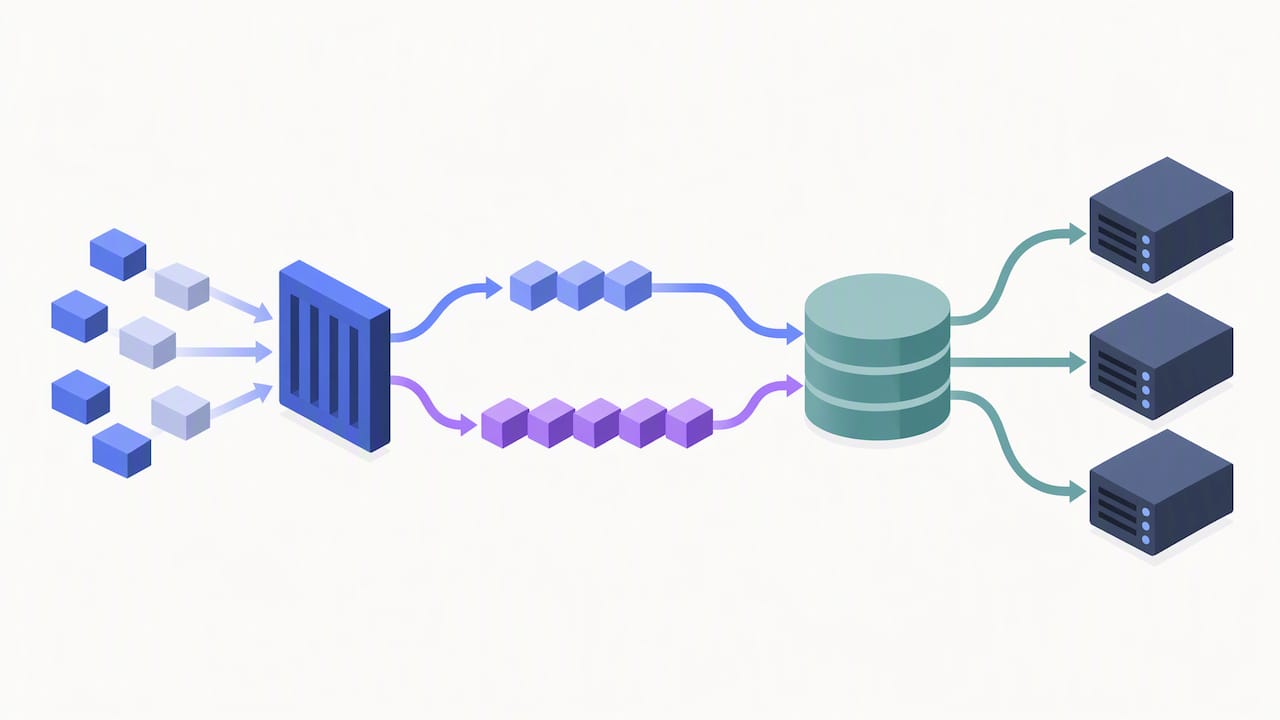
Track latency percentiles (p50, p95, p99), per-token cost, and a hallucination or error rate as core service-level metrics. Once a product depends on these numbers, hiring needs shift: you need at least one person comfortable with infrastructure and scaling, not just model training, or production reliability suffers.
How to hire and evaluate LLM engineers: job description and interview tasks
A tight job description beats a long wish list. Structure it around a short summary, three to five core responsibilities, a must-have skills section, and a separate nice-to-have list so candidates self-select accurately.
Practical interview tasks that reveal real skill:
- A prompt engineering task: solve an ambiguous task with prompts plus test cases, not just a single clever prompt.
- A PEFT micro-task: fine-tune a small adapter on a provided dataset and explain the hyperparameter choices.
- A systems-design prompt: design an inference service for a given latency and cost target, including fallback behavior.
Score candidates across four dimensions:
- Software craft: tested, readable, maintainable code.
- Systems thinking: sensible trade-offs under latency and cost constraints.
- Evaluation rigor: a real plan for catching regressions, not just a final score.
- Production experience: evidence of having operated a model in front of real users.
For nearshore candidates, a short paid pilot, typically two to four weeks on a real backlog item, reveals communication and delivery quality far better than a resume review. Our MLOps hiring guide walks through a fuller version of this scoring rubric for technical hires.
Career path and compensation context
LLM engineering typically sits inside a broader software or machine learning organization, with progression from engineer to senior engineer to a role owning evaluation frameworks or platform architecture across multiple product teams. As of May 2024, the median annual wage for software developers in the United States was $133,080, with the top 10% of earners making over $211,450, and the Bureau of Labor Statistics projects 15% employment growth from 2024 to 2034, well above average for all occupations.
Senior pay in this specialty tends to track ownership of production systems: a fine-tuning pipeline and evaluation framework that catches regressions before they reach users, and a RAG service running reliably at scale, both signal the kind of experience that typically corresponds to compensation above the median.
How we help teams staff LLM engineering roles
We connect teams with pre-vetted developers experienced in LLM engineering, screened for both technical depth and cultural fit through a thorough assessment process. For teams exploring options, we support several engagement patterns, including short paid pilots, team extension, and dedicated talent placements for ongoing LLM engineering roles.
We assist with contracts and logistical management to help your team focus on technical vetting. Our guide to hiring ML engineers through nearshore talent covers the pilot structure in more detail for teams ready to move forward.
A hiring manager’s take on where to focus first
If you hire one LLM engineer this year, prioritize evaluation rigor, production experience, and software craft, in that order. Speed, control, and cost rarely line up: a fast in-house hire costs more, a nearshore pilot costs less but needs a trial run first, and skipping evaluation discipline to save time is the trade-off that backfires hardest.
— Gabriel
Ready to staff an LLM engineering role?
If you need LLM engineering capacity without the months-long search, we run a short discovery call to scope the role, then propose vetted candidates or a paid pilot within days.
- Start with a discovery call to define must-have skills and timeline.
- Review matched candidate profiles or launch a short pilot.
- Scale through team extension once the fit is proven.
Reach out through our nearshore staff augmentation page to get started.
FAQ
What do LLM engineers do?
LLM engineers adapt, fine-tune, evaluate, and deploy large language models for product use, which includes building prompt and retrieval systems, preparing training data, and running evaluation suites. Most of the work centers on adapting pre-trained models rather than training foundational models from scratch, with production reliability as the main goal.
What engineer makes $500,000 a year?
Compensation at that level is uncommon and tends to reflect senior or staff-level roles at large technology companies rather than a typical market rate. The Bureau of Labor Statistics reports the top 10% of software developers earned over $211,450 as of May 2024, with figures above that reflecting exceptional seniority, equity, or company-specific pay structures.
Which jobs are most likely to survive AI?
There is no official ranking that names specific roles as AI-proof, so any such list should be treated as a general guess rather than a verified source. Roles requiring systems judgment, evaluation of ambiguous outputs, and accountability for production decisions, including LLM engineering itself, tend to be more resilient because they involve overseeing and validating AI systems rather than competing with them.
How much do LLM engineers get paid?
Pay for LLM engineers tends to track general software developer compensation, where the median annual wage was $133,080 as of May 2024, with senior specialists earning well above that based on production ownership and evaluation expertise. Exact figures vary by region, company size, and seniority.
How do I become an LLM engineer?
Start with strong software engineering fundamentals, then build model-specific depth through parameter-efficient fine-tuning, retrieval-augmented generation, and evaluation design, ideally with a portfolio project deployed as a real service. Employers generally value production experience and evaluation rigor over research credentials alone for this specialty.
Sources
- Software developers, quality assurance analysts, and testers: Occupational Outlook Handbook | U.S. Bureau of Labor Statistics
- LLMs have a new limit: it costs more to think longer | Shift Magazine
- Gemma model fine-tuning | Google AI for Developers
- A comprehensive survey of post-training language models (PoLMs) — arXiv