Recruiters: Use Skills Based Hiring and Responsible AI to Source Engineers
The most effective approach to sourcing software engineers is a multi-channel playbook anchored in skills-based evaluation, with AI-assisted discovery backed by human review at every decision point. Start by defining three to five must-have skills for the role, then pick two channels, likely referrals and a code platform, to begin outreach this week. Everything else in your process should support those two moves.
TL;DR:
- Referrals remain the most reliable channel due to their inherent vetting and ease of use, especially when incentivized and streamlined for participants.
- Skills-based hiring with rubric scoring and realistic work samples consistently uncovers capable candidates beyond traditional resumes, particularly for non-traditional or self-taught engineers.
- AI tools can accelerate sourcing and outreach but require human oversight to prevent inaccuracies, outdated info, or tone-deaf messaging in candidate selection.
- Nearshore augmentation is most effective when internal pipelines slow down, specialized skills are scarce locally, or rapid scaling outweighs in-house recruiting capacity.
- Monitoring key metrics like response times, conversion rates, and time-to-hire guides operational adjustments and helps decide when external staffing is justified.
Table of Contents
- Channel playbook: where to find software engineers and when to use each channel
- Evaluate skill: skills-based hiring, rubrics, and fast work samples
- Using AI and sourcing tools responsibly: governance and practical checks
- Outreach and engagement: message design, timing, and conversion tactics that work for engineers
- Metrics, pipeline design, and operational cadence for predictable hiring
- Publisher perspective: when nearshore staff augmentation fits into your sourcing playbook
- Author perspective: one recruiting habit to change this quarter
- How Amazing Devs can help: nearshore staff augmentation as an operational option
- FAQ
- Sources
Channel playbook: where to find software engineers and when to use each channel
Referrals should sit at the top of your sourcing list, not because they’re trendy, but because a warm introduction from a current engineer carries built-in vetting that no amount of boolean search can replicate. Operationalize referrals by setting a standing bonus, prompting engineers after every sprint retro, and giving them a one-line pitch they can forward without thinking. A referral program only works when it’s easy to use, so remove any friction between “I know someone” and “I submitted them.”
Code platforms like GitHub and GitLab let you source on direct evidence of skill rather than a resume’s claims. Look for recent commit activity, repository quality over sheer volume, and genuine open-source contributions rather than forked tutorials. A candidate who maintains a small, well-documented library tells you more about their craft than a profile listing ten frameworks.
Beyond referrals and code platforms, your channel mix should flex by role and urgency:
- LinkedIn works best for passive candidates with specific titles or years of experience, especially for mid to senior roles.
- Developer communities (Discord servers, Slack groups, specialized forums) surface engineers who are active but not actively job hunting.
- Conferences and meetups build longer-term pipelines and work well when you have months, not weeks, to fill a role.
- Campus recruiting fits entry-level and internship pipelines where you’re training for fit rather than screening for immediate output.
- Niche job boards (language-specific or stack-specific boards) cut through noise for hard-to-find specialties like embedded systems or distributed databases.
Deciding when to bring in a staffing partner or nearshore augmentation usually comes down to three signals: your internal pipeline is taking too long to fill urgent roles, you need a specialty skill set your current network doesn’t cover, or you need to scale a team faster than your hiring process can absorb. None of these signals mean your sourcing is broken. They mean the math of time, cost, and specialization has shifted, and an external partner can close that gap while your internal pipeline keeps building for the long term.
Evaluate skill: skills-based hiring, rubrics, and fast work samples
Skills-based hiring means evaluating candidates on demonstrated ability rather than filtering by degree, job title, or years of tenure. NIST guidance recommends skills-based hiring using rubric-based assessments, a practice that widens your candidate pool by including self-taught engineers, career switchers, and candidates whose resumes undersell their actual capability.
A simple rubric needs only three to five criteria scored consistently across every candidate:
- Problem decomposition: Can they break a vague problem into clear, testable steps?
- Code quality: Is the solution readable, tested, and reasonably efficient for the task?
- Communication: Do they explain tradeoffs and reasoning as they work?
- Debugging approach: When something breaks, do they narrow the cause systematically?
- Domain fit: Does their experience align with your actual tech stack and problem space?
Score each criterion on a 1 to 4 scale with written anchors for what each score looks like, and have two interviewers score independently before comparing notes. This keeps gut feeling from overriding evidence.
For work samples, keep the task close to real work. A two-hour take-home that mirrors an actual bug fix or small feature beats a whiteboard algorithm question every time, because it tests the job, not test-taking skill. Grade fairly by using the same rubric for every candidate and by reviewing submissions blind to the candidate’s name or background where your process allows it.
Match the method to seniority: junior and mid-level candidates benefit from a scoped coding task, senior candidates are better evaluated through system-design discussions where they reason about tradeoffs out loud, and staff-level or architect candidates are often better assessed through a portfolio review paired with a technical conversation about past decisions.
Pro Tip: Cap any take-home task at two hours and say so explicitly. Longer tasks filter for free time, not skill.
Using AI and sourcing tools responsibly: governance and practical checks
AI-assisted sourcing tools now handle a lot of the manual grind: enrichment tools fill in contact details and work history, boolean search assistants translate plain-language role descriptions into complex search strings, and outreach automation sequences follow-ups without a recruiter manually tracking every thread. Each of these speeds up volume, but none of them replaces judgment.
Their blind spots show up fast if you’re not watching:
- Enrichment tools can surface outdated job titles or merge two people with similar names.
- Boolean assistants can over-fit to keyword matches and miss candidates who describe their skills differently.
- Outreach automation can send tone-deaf follow-ups if a candidate has already responded through another channel.
OPM guidance on AI in federal hiring calls for preserving human oversight and documenting decisions wherever AI influences a hiring outcome, along with a framework for assessing AI use cases by risk level. That same discipline translates well outside government hiring: log which tool flagged a candidate and why, have a human confirm any AI-generated shortlist before outreach, and periodically audit whether the tool’s picks actually match who you end up hiring. Our playbook on hiring AI engineers walks through similar governance habits for technical roles specifically.
Before you reach out to anyone an AI tool surfaces, cross-check it against live signals: recent GitHub activity, a Stack Overflow profile with real answers rather than just a username, or a recent conference talk. These signals confirm the tool’s suggestion rather than replace your own judgment.
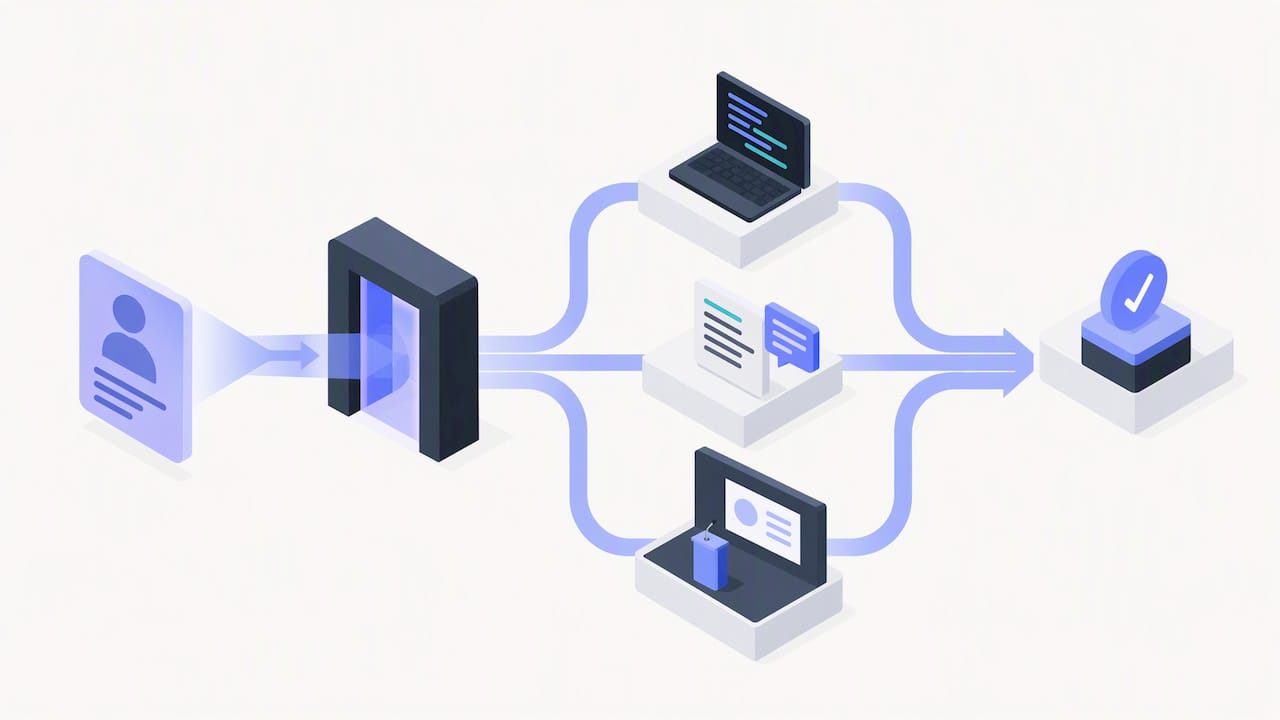
84% of developers are using or plan to use AI tools in their workflow, according to the 2025 Stack Overflow Developer Survey, with 51% of professional developers using AI tools daily. That means a sourcing message referencing modern AI-assisted workflows, rather than generic “we use cutting-edge tech” language, will resonate more with the engineers you’re trying to reach. For a broader look at how enterprises are adapting their hiring and operations around AI, see this overview of 2026 AI automation trends.
Outreach and engagement: message design, timing, and conversion tactics that work for engineers
A good outreach message has three parts: a specific reason you’re reaching out to this person (not a generic “I saw your profile”), a concrete detail about the role or problem they’d be working on, and a low-friction ask like a 15-minute call rather than a full application.
- Initial message: Open with the specific project or repository that caught your attention, state one concrete detail about the team or problem, and close with a single clear ask.
- Follow-up message: Reference the first message briefly, add one new piece of information (a team update, a project detail), and repeat the same low-friction ask.
Three touches spaced several days apart tends to outperform either a single message or an aggressive daily cadence. Most engineers who respond do so by the second message, so a third serves mainly as a clean close rather than a conversion driver.
Beyond direct messaging, engagement works best when it doesn’t feel like a pitch. Inviting a candidate to a technical talk your team is hosting, offering a short pairing session on a real problem, or welcoming them into a community event you sponsor all let candidates evaluate you while you evaluate them, with far less pressure than a formal interview.
Employer brand assets amplify every cold message you send. A technical blog post explaining how your team solved a hard problem, or sponsorship of an open-source project your target candidates actually use, gives a cold outreach message instant credibility: the candidate can verify your claims before they ever reply.
Metrics, pipeline design, and operational cadence for predictable hiring
A healthy engineering funnel is measurable at every stage, not just at the final offer.
- Time-to-first-response on outreach messages: a healthy benchmark is under 48 hours for your own follow-up, regardless of whether the candidate replies quickly.
- Sourced-to-screened conversion rate: tracks whether your channel targeting is working before you invest interviewer time.
- Screened-to-offer conversion rate: flags whether your rubric or interview process is too strict or too loose.
- Time-to-hire: measured from first contact to signed offer, segmented by seniority since junior and staff-level hires move at very different speeds.
- Offer-accept rate: a sharp drop here usually signals a compensation or role-clarity problem, not a sourcing problem.
Set service-level targets for each stage, such as 48 hours for recruiter follow-up and five business days for hiring-manager feedback after an interview, and track when a candidate sits in a stage past that window. A simple weekly cadence works well: a short recruiter and hiring-manager sync to review pipeline movement, flag stalled candidates, and agree on next actions before the week ends.
Use the same decision rules every time you’re deciding whether to scale internal sourcing or bring in a staffing partner: if time-to-hire is consistently blowing past your targets for a specific skill set, or your sourced-to-screened rate for that role is persistently low despite trying multiple channels, that’s your signal to look outside. The BLS Occupational Outlook for software developers notes continued strong demand driven by AI, IoT, robotics, and security needs, which is part of why competitive specialty roles often take longer to fill through a single channel alone.
Publisher perspective: when nearshore staff augmentation fits into your sourcing playbook
Nearshore augmentation tends to be the right call in a few specific situations: you need to scale a team faster than your internal pipeline can realistically absorb, you need a specialty skill set that’s thin in your local market, or cost pressure means you need senior-level output without senior-level local salaries. It works best as a complement to internal sourcing, not a replacement, letting your recruiting team stay focused on core hires while an augmentation partner fills urgent or specialized gaps.
A short onboarding checklist helps you get ROI from augmented talent quickly:
- Confirm tech stack alignment before the engagement starts, not during week one.
- Set clear code review and communication norms so the augmented engineer integrates with your existing workflow.
- Define success metrics for the first 30 and 90 days.
- Assign a single internal point of contact for faster issue resolution.
Our own approach emphasizes a rigorous recruitment and assessment process built around both technical and cultural fit, so clients receive developers matched to their specific stack and working style rather than a generic placement. We handle contract and bureaucratic complexity directly, which is often the hidden friction point in augmentation engagements. For a closer look at how augmentation compares with traditional outsourcing, see our breakdown of outsourcing versus staff augmentation.
The trade-offs worth watching: time zone overlap, communication norms, and making sure contract terms are clear on ownership and IP from day one.
Author perspective: one recruiting habit to change this quarter
Most teams still default to resume keyword matching dressed up as “screening,” which filters out strong candidates who simply describe their skills differently than a job description does. The fix isn’t complicated: build a three-to-five criterion rubric, score every candidate against it the same way, and pair it with a tighter channel mix instead of blasting every job board at once. That single change surfaces better candidates faster because you’re finally measuring the thing you actually care about. If you’d rather hand the sourcing and vetting work to a partner while you focus on the rubric and interviews, the next section covers that option.
— Gabriel
How Amazing Devs can help: nearshore staff augmentation as an operational option
When your internal pipeline can’t move fast enough, or you need specialized engineering skills without the cost of a full local hire, nearshore staff augmentation gives you a direct path to vetted talent without building a sourcing function from scratch.
- We run candidates through technical and cultural fit assessment before you review profiles.
- We handle contract terms and the bureaucratic complexity involved in cross-border hiring.
- We match developers to your tech stack rather than offering a generic placement.
If you’re weighing whether augmentation fits your current hiring gap, our nearshore staff augmentation page details how the engagement works and what to expect in the first weeks.
FAQ
What engineer makes $500,000 a year?
Compensation at that level is unusual and typically limited to senior staff or principal engineers at large, high-paying tech companies, often tied to equity grants rather than base salary alone. The Bureau of Labor Statistics Occupational Outlook covers typical qualifications and demand drivers for the profession generally, though it doesn’t report pay figures at that extreme.
What is the 40/20/40 rule in software engineering?
This isn’t a term defined in standard hiring or engineering literature, and usage of the phrase varies informally depending on the source. Rather than rely on an undefined rule, apply a documented rubric with clear criteria, as recommended in NIST guidance on skills-based hiring, for consistent evaluation.
Is AI replacing coders?
AI tools are changing how developers work rather than replacing the role outright. The 2025 Stack Overflow Developer Survey found that 84% of developers are using or plan to use AI tools, with many using them daily as part of their workflow rather than as a substitute for their job.
What is L1, L2, L3, and L4 developer?
These labels refer informally to seniority or support tiers and vary by company rather than following one fixed industry standard. Most engineering organizations define their own leveling framework, so it’s worth confirming the specific definition a job posting or company uses rather than assuming a universal scale.
How long should it take to hire a software engineer?
Time-to-hire varies significantly by seniority and specialty, with junior roles typically moving faster than senior or highly specialized positions. Tracking your own time-to-hire against stage-by-stage service-level targets, rather than a single industry number, gives you a more accurate read on whether your pipeline is healthy.
Sources
- Use of Artificial Intelligence in the Federal Hiring Process (OPM memo)
- An Employer’s Guide to Writing Effective Cybersecurity Job Descriptions (NIST guidance)
- Software Developers, Quality Assurance Analysts, and Testers : Occupational Outlook Handbook : U.S. Bureau of Labor Statistics
- 2025 Stack Overflow Developer Survey