Paying Isn’t Enough for Nearshore Contractor IP Assignments
Copyright in contractor-created work starts with the contractor, not with you, and paying an invoice does not change that. The document that moves ownership to your business is a signed, written assignment that conveys the rights in present-tense language. Without it, you may hold only an implied permission to use what you commissioned.
TL;DR:
- A work made for hire label covers commissioned output only in listed statutory categories, so pair it with an assignment when custom software is involved.
- Define work product to include code, designs, documentation, inventions, and later updates; list preexisting tools separately and license any materials embedded in deliverables.
- Confirm each signer owns the contributed rights or is authorized to transfer them, then keep the executed agreement with deliverables and repository records.
- Use a master agreement to assign all work created under current and future statements of work, and require incoming contributors to sign before accessing code.
- For contractors based abroad, have local counsel review moral rights terms; some rights cannot be transferred, so include consent to edits where permitted.
Table of Contents
- What does an IP assignment actually do?
- Why work made for hire is not a safe substitute for assignment
- What belongs in a contractor IP assignment clause?
- How do patents and recordation fit in?
- Which chain-of-title steps prevent the most common failures?
- How do you handle moral rights waivers?
- How should IP terms work with confidentiality and non-compete clauses?
- How do you manage IP rights for iterative work and updates?
- How is an IP assignment different from a license?
- How do you make assignments enforceable across jurisdictions?
- What our team does about contractor IP in nearshore placements
- Get contracted developers with the IP paperwork handled
- FAQ
- Sources
What does an IP assignment actually do?
An assignment is a conveyance of specified rights to your business. The rights transferred depend on the agreement. Under federal copyright law, copyright first belongs to the author, which for contractor deliverables means the person who wrote the code or made the design. Your business gets title only if a signed writing transfers it.
That is why “we paid for it” fails as a legal argument. Consider what does and does not move ownership:
- Payment of invoices: shows a commercial relationship, not a transfer of copyright.
- Delivery of files or repository access: gives you possession, not title.
- A verbal promise or email thread: do not assume it satisfies the signed-writing rule for copyright transfers; use a signed assignment.
- A signed assignment naming the work and the parties: this is the instrument that actually conveys ownership.
Treat the assignment as core chain-of-title paperwork, the thing a buyer or investor will ask to see, rather than boilerplate.
Why work made for hire is not a safe substitute for assignment
Many businesses assume a “work made for hire” label solves everything. For a commissioned contractor, the test is narrow. As the Ninth Circuit’s jury instruction on works made for hire frames it, a specially ordered or commissioned work qualifies only when every one of these holds:
- The work falls into one of the statutory categories, such as a contribution to a collective work or a compilation.
- The parties agree in a written instrument that the work is made for hire.
- The agreement expressly designates it as a work made for hire.
- Both parties sign it.
Custom software and most other contractor output often fall outside the listed categories, so the safe approach is to pair a work-made-for-hire clause with a fallback assignment. If the statutory label fails, the assignment still conveys everything. If you are unsure whether a person is a contractor or an employee at all, our guide on telling contractors and employees apart explains the signals that matter.
What belongs in a contractor IP assignment clause?
A strong clause is specific, present-tense and hard to misread. Work through these elements when you draft or review an agreement:
- Present-tense conveyance. Use “hereby assigns” and convey “all right, title, and interest” in the deliverables. A promise to assign later may leave a gap until the transfer is documented in a signed writing.
- A broad work product definition. Cover source and object code, documentation, designs, inventions, improvements, data and anything else created in the engagement.
- Background materials. Require a schedule listing the contractor’s pre-existing code, libraries and tools. A contractor can keep rights in pre-existing material unless the agreement says otherwise, so add a license for anything that ends up inside your deliverables.
- Warranties and protections. Include originality and non-infringement warranties, indemnity triggers, confidentiality terms and a further-assurances obligation so the contractor must sign supporting documents later.
- Signature mechanics. Obtain a signed assignment from the rights owner or an authorized agent, and store the executed copy with the deliverables.
Pro Tip: Ask for the assignment to be signed before work starts, then reaffirm it with a short acceptance note at each delivery.
Our article on rules for developer contracts that protect IP goes deeper on negotiation points.
How do patents and recordation fit in?
Inventions need their own attention. If a contractor might create something patentable, the agreement should expressly assign inventions and patent rights and obligate the contractor to cooperate with applications, prosecution and enforcement.
Then comes paperwork. The USPTO explains how to record an assignment, including the cover sheet that identifies the documents. Keep three points in mind:
- Recording creates public notice that a transfer occurred.
- Recording is ministerial: the Office does not decide whether the assignment is valid.
- You need the properly executed assignment first, and only then should you record it so the public record reflects your chain of title.
If you are sorting out which kind of protection a deliverable even carries, the USPTO’s overview of intellectual property types separates copyright, patents, trademarks and trade secrets in plain terms.
Which chain-of-title steps prevent the most common failures?
The usual failure pattern is boring: no signed assignment, a definition of work product that is too narrow, undisclosed pre-existing material, or a missing signature. The statutory ownership and signature rules make each of those fixable, but only before a deal or dispute forces the question. Run this checklist on every engagement:
- Confirm the signer is the actual human creator, or capture a creator-level signature in addition to any company signature.
- Attach the signed assignment to the deliverables and the repository record, and keep commit logs and timestamps.
- Require a background materials schedule, and identify open-source and third-party components with their licenses.
- Maintain one central IP schedule, and record patent or trademark assignments where appropriate.
- Close out the engagement with a confirmation that all deliverables and access credentials have transferred.
Pro Tip: Review the IP schedule at every contract renewal, because gaps tend to appear when scope changes.
Verified time and delivery records double as supporting evidence of who did what and when.
How do you handle moral rights waivers?
Moral rights are the personal rights of an author, usually the right to be credited and the right to object to distortion of the work. U.S. copyright law gives them limited reach for most commercial work, but contractors based elsewhere may come from systems where they are stronger and sometimes cannot be fully transferred.
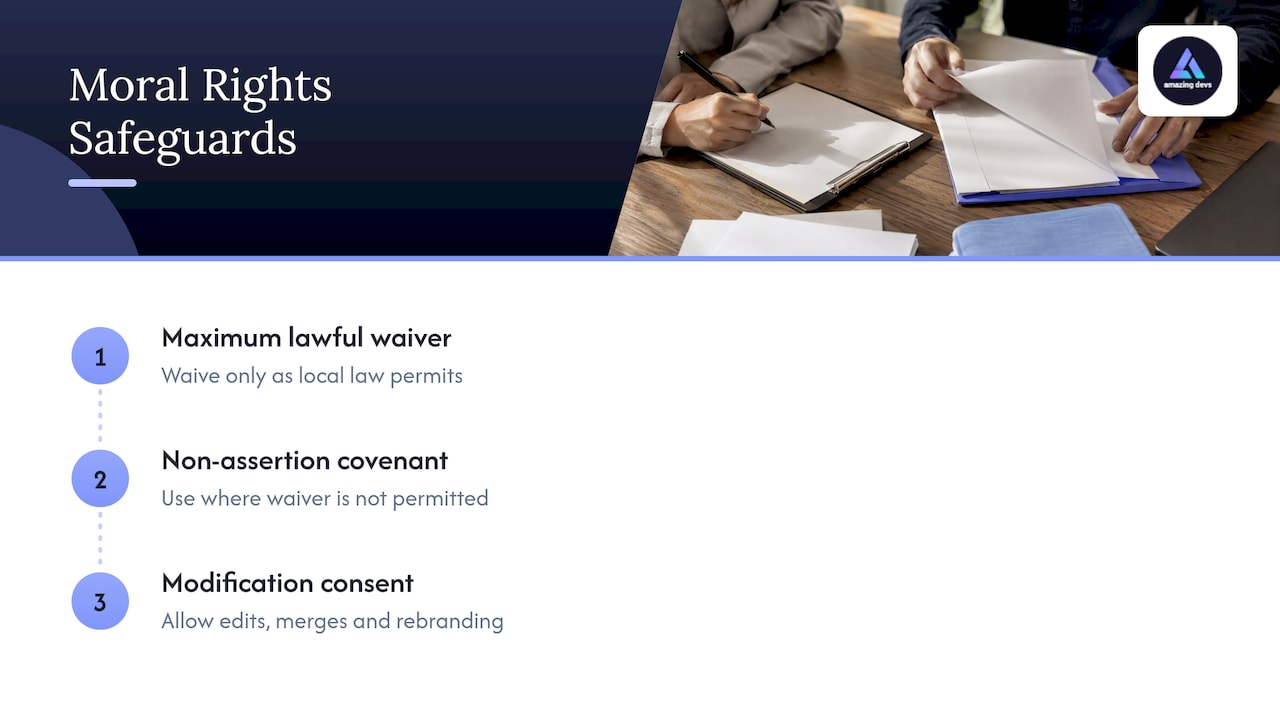
That matters whenever your contractor lives outside the U.S. A clean approach has three parts. First, include an express waiver of moral rights to the fullest extent the contractor’s local law permits. Second, where a waiver is not permitted, add a covenant not to assert those rights against your business, its successors and its customers. Third, add a consent to modifications, so your team can edit, merge and rebrand the work without asking permission each time.
Draft these terms in plain language and have the contractor sign them with the assignment itself, not in a separate, easily lost document. If your product credits contributors publicly, say in the agreement that credit is optional rather than owed, so nobody assumes an attribution right.
Because moral rights rules vary by country, have counsel in the contractor’s home jurisdiction confirm that the waiver language works there. This is a drafting detail that is cheap to get right at signing and expensive to fix after a dispute.
How should IP terms work with confidentiality and non-compete clauses?
These clauses protect different things, and they work best when they reference each other. The assignment decides who owns what the contractor creates. Confidentiality protects information the contractor sees or generates but that may not be copyrightable, such as architecture decisions, customer data and unreleased roadmaps. Trade secrets, one of the four main IP categories, depend on that secrecy being maintained.
Tie them together in the contract:
- Define confidential information to include deliverables in progress, so unfinished work is protected before assignment takes effect.
- State that confidentiality duties survive termination, with ownership of the work staying with your business regardless.
- Ask counsel whether a whistleblower immunity notice is required for your trade secret agreements. Our piece on NDAs, notice and offboarding covers what to consider and how to run the exit.
- Keep any non-compete terms separate from the IP assignment. Ask counsel to assess whether they are appropriate and enforceable in the relevant jurisdiction, and do not make your IP ownership depend on them.
The cleanest structure is an assignment that stands alone, with confidentiality supporting it and any restrictive covenant severable. If a court trims a non-compete, your ownership of the code should not move with it. For sensitive deliverables, pair these terms with secure delivery practices from our data security outsourcing guidance.
How do you manage IP rights for iterative work and updates?
Most contractor relationships do not end with one delivery. Features get added, bugs get patched and new modules are built over months. If your assignment covers only a named project, later updates can slip outside it.
Draft for the long run. Use a master services agreement with an assignment that covers all work product created under any statement of work, current or future. Each new statement of work then inherits the same present-tense conveyance, and nobody needs to sign a fresh transfer for every sprint.
Operationally, a few habits keep the record tidy:
- Keep all contractor commits in a repository you control, so authorship and dates are traceable.
- Update the background materials schedule whenever the contractor introduces a new library or reusable component.
- Treat derivative works carefully: improvements to contractor-owned background material should be addressed in the contract, because ownership of an improvement to something you do not own is easy to dispute.
- Log handoffs at the end of each statement of work with a short written acceptance that references the assignment.
If a contractor changes mid-project, require the departing person to confirm the assignment still covers everything they produced, and require the incoming person to sign before touching the code. A single unsigned contributor in the history is exactly the kind of gap that surfaces during due diligence.
How is an IP assignment different from a license?
An assignment transfers ownership. A license grants permission to use while ownership stays with someone else. The distinction affects which rights the recipient can exercise, including whether the recipient can use or license the work onward, and what happens when the relationship ends.
The Supreme Court’s freelancer analysis in Tasini, discussed in this law journal article on the decision, shows why precision matters: a client’s rights in a collective work do not automatically erase a freelancer’s rights in separately contributed pieces. So decide what you actually need before you draft.
| Arrangement | What you get | Best fit |
|---|---|---|
| Full assignment | Ownership of the deliverables | Custom code at the core of your product |
| Exclusive license | Exclusive rights within the license’s stated scope; the agreement should specify what rights are granted | Specialized components the contractor reuses elsewhere |
| Non-exclusive license | Right to use alongside others | Background tools and libraries |
Most businesses want an assignment for custom work and a license for the contractor’s pre-existing tools, which is exactly the split the background materials schedule creates. A license should also state its scope, whether it is perpetual, whether it can be transferred in a sale of your business and whether you may modify the licensed material. Silence on those points is where later arguments begin.
How do you make assignments enforceable across jurisdictions?
Remote and nearshore engagements can involve more than one country’s laws. Ask counsel in the relevant jurisdictions to review how the agreement should address ownership and any formalities. Do not assume that a choice-of-law clause, a worldwide assignment, or a backup license will have the intended effect everywhere. Keep executed agreements and related records organized, and seek local advice on worker classification when it is relevant.
For contracts you manage across many countries, automation can help with signature workflows. DocuPOW’s resources on smart contract intelligence cover tooling for reviewing agreements and tracking whether required signatures are in place.
When the stakes are high, such as a core product or a funding round, a short review by counsel in the contractor’s country is inexpensive insurance.
What our team does about contractor IP in nearshore placements
In our nearshore placements, we treat the assignment as part of onboarding, not an afterthought. We manage contract logistics and help make sure deliverables transfer cleanly when work is handed over. That removes much of the administrative friction that makes IP paperwork slip in staff augmentation engagements. We are glad to discuss your setup.
— Gabriel
Get contracted developers with the IP paperwork handled
We provide Brazilian developers through nearshore staff augmentation, and we manage the contracts and onboarding that go with them, including the logistics of getting IP assignments executed. You get pre-vetted engineers without taking on the bureaucracy of setting up each engagement yourself. Visit our nearshore staff augmentation page to learn how we handle contract support for your team.

FAQ
What is an IP assignment agreement?
It is a signed written document that transfers specified rights from their owner to another party. For contractor work, it can transfer rights in code, designs or inventions when properly drafted and signed. Without a signed writing transferring copyright, copyright generally stays with the author under the copyright statute.
What is the most common form of violation of intellectual property?
Our sources do not rank violations by frequency. In contractor engagements, the most common practical failure is a gap in the chain of title, such as a missing signature or an undisclosed pre-existing component. Fixing that gap before a dispute is far easier than after.
What are the four types of intellectual property?
The main categories are copyright, patents, trademarks and trade secrets, as the USPTO’s overview describes them. Code and creative expression generally involve copyright, inventions involve patents, brand identifiers involve trademarks and confidential know-how can be a trade secret.
How can you legally protect your intellectual property?
Start with signed written assignments from every contributor, a clear definition of work product and a schedule of background materials. Add confidentiality terms and, for inventions, record executed patent assignments with the USPTO. Have counsel review anything business critical.