Performance Management for Contractors: A Practical Guide
Managing contractor performance means agreeing on what “good” looks like before work starts, measuring it on a steady rhythm, and fixing problems while they are still small. The method differs by context. Federal agencies follow a formal evaluation process. A startup or scale-up managing contract developers needs something lighter but just as deliberate. This guide covers both, then goes deep on software contractors, where most teams struggle.
TL;DR
- Federal contracts above the simplified acquisition threshold require a performance evaluation at least annually and at completion, recorded in CPARS. Private companies can borrow the structure without the paperwork.
- Set up governance in the first week: a RACI matrix, a definition of done, a review cadence and an escalation path.
- For software contractors, measure working software and business value, not hours or lines of code.
- Treat performance management as relationship management. Ongoing feedback beats an end-of-contract review.
- The cheapest performance problem to fix is the one you prevented by vetting for technical and cultural fit before the contract is signed.
Table of Contents
- What “contractor performance management” covers
- What the federal model requires
- The part most teams miss: governance before performance
- Measuring software contractors
- A 90-day performance plan for a new contractor
- Prevent problems before you sign
- Our perspective
- Where Amazing Devs fits
- What about the “5 C’s” of performance management?
- FAQ
- Sources
What “contractor performance management” covers
The phrase means different things depending on who is searching. Three readings are common:
- Government contracting. An agency evaluates a vendor against contract requirements, and the result feeds future source selections.
- Construction and trades. An owner or general contractor scores subcontractors on quality, safety, schedule and cost.
- Technology and knowledge work. A company manages independent contractors or staff augmentation developers who work inside its own teams and tools.
The tools differ, but the logic is the same: clear expectations, objective evidence, regular conversation, and consequences that are proportionate. We write mainly from the third context, because it is the one we work in every day, but the first is the best-documented model in the United States, so it is worth understanding.
What the federal model requires
The Federal Acquisition Regulation sets the standard. Under FAR 42.1502, past performance evaluations must be prepared at least annually and when the work under a contract or order is completed. They are required for contracts that exceed the simplified acquisition threshold, and the results go into the Contractor Performance Assessment Reporting System, known as CPARS.
The rules in FAR Subpart 42.15 also set out who is accountable and how the information is used. Evaluations are meant to rest on objective facts and written narratives, and they feed into later source selection decisions. The official CPARS guidance notes that the FAR requires this information to be collected and used when agencies choose vendors.
Two lessons carry over to any business, even one with no federal contracts:
- Evaluate on a schedule, not on a mood. An annual or quarterly review that always happens beats an angry conversation that happens only when something breaks.
- Write down the evidence. A rating with a specific example behind it can be discussed. A rating without one starts an argument.
Who completes the evaluation
On federal contracts, the contracting officer or a designated assessing official prepares the evaluation, and the contractor gets a chance to comment. In a private company, the equivalent is the person who owns the outcome: usually the engineering manager or product lead, not procurement alone. Procurement manages the paper. The manager sees the work.
The part most teams miss: governance before performance
Most performance problems are expectation problems. A UK government Contract Management Playbook makes the point well: effective contract management is about the relationship, not only compliance, and it starts by establishing a governance path early, often through a RACI matrix that sets out who is responsible, accountable, consulted and informed. Done early, this prevents contractors from drifting away from organizational goals. The playbook is British, but the practice transfers directly to a US company.
A workable governance setup in the first week looks like this:
| Element | What to decide | Example |
|---|---|---|
| RACI matrix | Who approves, who reviews, who is informed | Contractor writes code, your tech lead approves merges, product owner accepts stories |
| Kickoff conference | Scope, goals, tools, communication norms | One hour in week one, written notes shared afterward |
| Review cadence | When you formally look at results | Weekly check-in, monthly scorecard, quarterly business review |
| Escalation path | Who to call, in what order, in what time | Tech lead first, then engagement manager within two business days |
| Exit terms | What happens if the fit is wrong | Notice period and knowledge transfer defined in the contract |
Match the effort to the risk. Guidance on contract management consistently stresses tailoring oversight to risk and complexity, and the Texas contract management guide devotes a section to risk assessment across every stage of procurement. A contractor writing marketing copy needs less structure than one with access to your production database.
Measuring software contractors
Hours logged are the weakest measure of a developer’s value. They show presence, not progress. A better approach follows what the Software Engineering Institute at Carnegie Mellon describes in its agile metrics research: for agile development, one of the most important measures is delivered business value, and monitoring shifts from intermediate documents to the frequent delivery of working software.
A short scorecard that works
Pick five to seven measures, review them monthly, and discuss trends, not single data points.
- Delivered work against the sprint commitment. Did the stories that were accepted match what was planned?
- Definition of done. Agree early on what “done” means: tested, reviewed, documented, deployed to staging. Work that misses it does not count.
- Quality. Defects found after acceptance, rework rate, review comments per pull request.
- Flow. Cycle time from first commit to production, and deployment frequency.
- Collaboration. Responsiveness in standups and code review, quality of written updates, proactive flagging of blockers.
- Business outcome. Did the feature move the metric it was built to move?
For the flow and team-health side, we have written a separate piece on how to diagnose remote developer performance with SPACE and DORA, which goes further into those frameworks.
Metrics traps to avoid
The same SEI research warns against leaning on proxy measures such as lines of code. Velocity, measured in story points per sprint, is useful for a team’s own planning, but it is unique to each team. Do not use it to compare one contractor with another, and do not turn it into a target. When velocity becomes a quota, estimates inflate and quality workarounds appear.
Two more traps we see often:
- Measuring the contractor but not your own side. If requirements arrive late or acceptance takes a week, no contractor can hit the schedule. Include your own response times in the review.
- Saving the feedback for the review. Agile work needs stakeholders who prioritize and accept work continuously. A contractor who learns in month six that the direction was wrong has been badly served by the process, whatever the contractor’s skill.
A 90-day performance plan for a new contractor
This is the structure we recommend to teams adding contract developers.
- Days 1 to 7: set up. Hold the kickoff, share the RACI matrix, write the definition of done, grant access with least privilege, and name a buddy on your team.
- Days 8 to 30: calibrate. Start with small, well-scoped tickets. Review every pull request carefully. Meet weekly for 20 minutes on what is working and what is not. Expect the first sprint to be slower.
- Day 30: first formal check. Compare delivered work with the plan. Agree on two or three specific improvement goals. Write them down.
- Days 31 to 60: expand. Increase scope and autonomy if the first month went well. If it did not, run a short corrective action plan: the problem, the evidence, the target, the date.
- Day 60: second check. Review the scorecard trend. Decide whether to keep scaling, hold, or change the engagement.
- Days 61 to 90: embed. Move to a monthly rhythm. Add the contractor to planning and retrospectives as a full participant.
- Day 90: business review. Look at outcomes, not activity. Decide on the next quarter’s scope.
The corrective action plan deserves emphasis. Good contract management treats performance reporting as an ongoing feedback loop with corrective actions, not as an administrative task completed when the contract ends. The CPARS guidance reflects the same principle: communication between the buyer and the contractor should be open and frequent.
Prevent problems before you sign
The best performance management starts in recruiting. A contractor who is technically strong but poorly matched to your working style, time zone or communication habits will show up on your scorecard within weeks.
The hiring market has also shifted. According to an AI labor market update, hiring of AI engineering talent grew by more than 25% year over year in 2025. That makes a plain “can they code” screen insufficient. Your evaluation criteria should include how a developer uses AI tools in daily work, how they review generated code, and how they collaborate in an agile team.
Before you sign, check:
- Technical fit: a practical coding exercise on a problem close to your real stack, not a puzzle.
- Cultural fit: a behavioral interview about feedback, disagreement and ambiguity.
- Working-hours overlap: real-time overlap with your team. We cover this in our guide to timezone management strategies.
- Contract terms: IP ownership, confidentiality and exit terms, which we cover in four rules for developer contracts that protect IP.
- Security obligations: access controls and data handling, covered in our piece on data security in outsourcing.
- Total cost: the cost of management time, rework and turnover, not only the hourly rate. See the hidden costs of outsourcing.
Our perspective
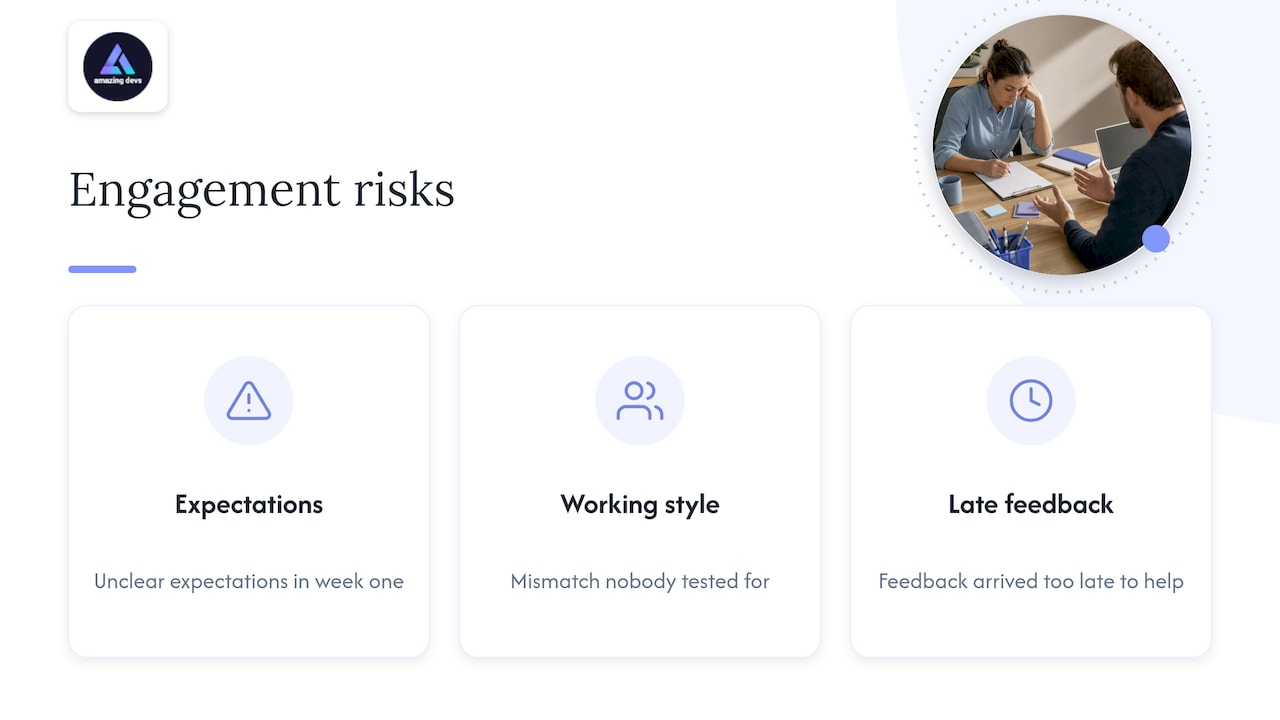
We place Brazilian developers with US companies, so we see the same pattern repeatedly. When an engagement struggles, the cause is rarely raw skill. It is usually one of three things: unclear expectations in week one, a mismatch in working style that nobody tested for, or feedback that arrived too late to be useful.
That is why we put so much weight on the front end of the process. Our recruitment and assessment look at technical ability and cultural fit together, because a developer who is excellent in isolation but cannot work inside your team is not a good hire for you. We also handle the contract and bureaucratic side, so your managers spend their time on the work and the relationship rather than on paperwork.
Our advice to managers is simple. Treat a contractor like a member of the team with a clearer contract. Give them context, give them a definition of done, and give them honest feedback every week. Most of what looks like a performance problem at month three is a communication gap that was visible at week two.
— Gabriel
Where Amazing Devs fits
If you are building a team of contract developers and want performance management to start from a strong position, our nearshore staff augmentation service gives you pre-vetted Brazilian developers who have been assessed for technical and cultural fit, with contracts handled for you. If you want engineers to work as an extension of your own squad, look at the Team Extension Model. For testing capacity, see our nearshore QA contractors. You can also talk to us about the roles you need to fill.
What about the “5 C’s” of performance management?
You may come across a “5 C’s” framework in contractor guides. One version, from a contractor business guide, runs: check the current state, improve cash flow, improve customer experience, create and commit to a plan, and correct and improve. It is aimed at trades contractors running their own business for profitability, not at managers evaluating a vendor. There is no single standard version of this framework, so check which one a source means before you adopt it.
FAQ
What is a performance contractor?
The term is used in two ways. In energy services, a performance contractor is a firm paid based on the results it delivers. In general contract management, it simply means a contractor whose work is measured against agreed performance standards. Check the definition in the contract you are reading.
Who completes the CPARS evaluation?
On federal contracts, the contracting officer or a designated assessing official prepares it, and the contractor can comment. Under FAR 42.1502, evaluations are due at least annually and when the work is completed. Private companies do not use CPARS, but the same ownership principle applies: the person closest to the work should write the assessment.
How often should I review a software contractor’s performance?
Hold a short check-in every week, a scorecard review every month, and a business review every quarter. Add a formal check at day 30 for a new contractor. More frequent, smaller conversations catch problems when they are cheap to fix.
Should I compare contractors by velocity?
No. Velocity is specific to each team and depends on how it estimates. The SEI’s agile metrics guidance cautions against using it to compare teams or as an estimating model. Compare delivered business value and quality instead.
Sources
- FAR 42.1502 Policy, Acquisition.gov
- FAR Subpart 42.15 Contractor Performance Information, Acquisition.gov
- CPARS, official website
- Guidance for the Contractor Performance Assessment Reporting System, CPARS
- Contract Management Playbook, UK government, March 2026
- Contract Management Guide, State Office of Administrative Hearings, Texas
- Agile Metrics: Seven Categories, CMU Software Engineering Institute
- AI Labor Market Update
- A Contractor’s Guide to Higher Profits and Less Chaos