Reference Checks for Engineers: A Hiring Manager’s Guide
A reference check on an engineer is a structured call with a former manager or close collaborator. Its job is to confirm what the candidate told you and to learn how they work day to day. It is a confirmation step, not a screening tool. Run it after your technical interviews, with written consent, with open-ended questions tied to the role, and by phone rather than email.
This guide covers timing, choosing references, the questions that surface real signal, the legal guardrails in the US, and how to adapt the process for AI-enabled engineers and for remote or nearshore hires.
TL;DR
- Reference checks are a supplemental signal. Research summarized by Test Partnership puts their predictive validity for job performance at 0.26, against 0.58 for structured interviews. Use them to confirm fit, not to pick finalists.
- Get written permission first, ask every finalist the same job-related questions, and avoid anything that could reveal a protected characteristic.
- Call, don’t email. Written references are almost always glowing. Hesitation on a call tells you more.
- Prioritize recent direct supervisors over old colleagues, and ask behavioral questions about debugging, code review, ownership and collaboration.
- For AI-enabled engineers, add questions about how they use AI tools and protect code quality.
Table of Contents
- What a reference check is, and what it is not
- Where references sit in your hiring process
- Choosing the right references
- How to run the call
- Reference questions that work for engineers
- Reading the answers
- Staying on the right side of the law
- Reference checks for AI-enabled engineers
- Our perspective: references are the last check, not the first
- Hiring remote or nearshore engineers
- A reference check checklist you can reuse
- FAQ
- Sources
What a reference check is, and what it is not
Many teams confuse two different things. Employment verification confirms dates, job title and sometimes salary. A reference check is a qualitative conversation about how the person performs under pressure, solves problems and collaborates. The American Employers Alliance makes the same distinction, and notes that the second kind requires open-ended, behavioral questions rather than yes/no confirmations.
Both have a place. Verification catches fabricated titles and inflated tenures. The reference conversation tells you what a resume cannot: whether this engineer ships reliably, takes feedback well, and leaves a codebase better than they found it.
It also helps to be realistic about what you will hear. Former employers often limit themselves to start date, end date and title, which is why SHRM’s advice is to do the check anyway as part of due diligence, even when it looks pro forma. A thin answer is still data, and a fabricated claim still gets caught.
Where references sit in your hiring process
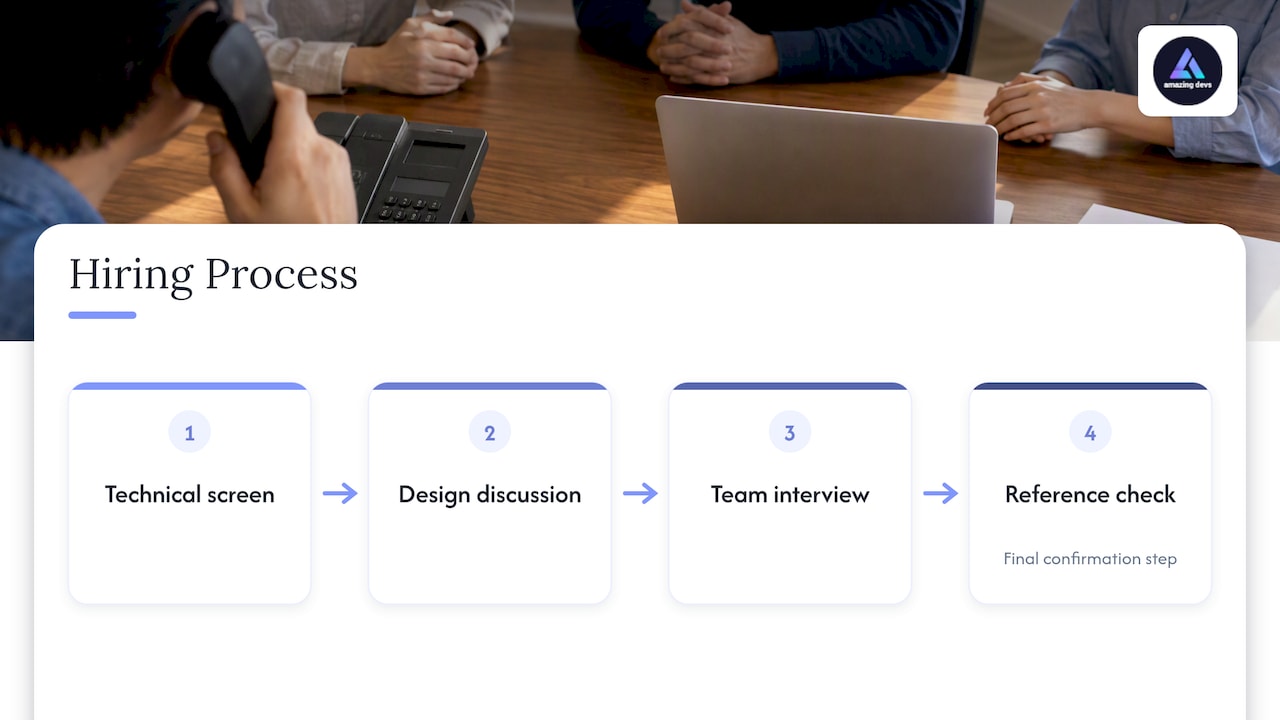
Reference checks are the last confirmation step, not the first filter. By the time you call, the candidate should already have passed a technical screen, a design or architecture conversation and a team interview. If you are still tuning those earlier stages, our guides on capping technical screening tests at 90 minutes and running system design interviews in one hour cover them.
The reason for the order is simple. Interviews and structured exercises predict performance better. A reference call is expensive for the other person’s time and sensitive for the candidate’s current employer, so you spend it on people you would actually hire.
Before or after the offer?
ADP’s 2025 checklist describes the best practice as checking after a conditional offer, for consistency and compliance. It adds that checking earlier is not illegal as long as you apply the same process to every candidate.
For engineers, a practical pattern works well:
- Ask finalists for three references at the final interview stage, and tell them what to expect.
- Extend a conditional offer, contingent on satisfactory references and any background screening.
- Run the calls within a few days so the offer does not go stale. Strong engineers are usually fielding other offers.
If your candidate is still employed, say so explicitly. Never contact the current employer without their permission. Most engineers will point you to a former manager or a trusted collaborator from a previous company instead.
Choosing the right references
Who you call matters more than how many. Two guidelines from recruiters cited by SHRM: freshness matters, and supervisors matter. A direct manager from the last five years knows the technical skills the candidate has built recently. A reference from a decade ago often does not. Aim for two or three supervisors covering the most recent ten years.
For an engineer, the ideal mix looks like this:
| Reference type | What they can tell you | Weight |
|---|---|---|
| Direct manager, last 5 years | Reliability, growth, how they handle pressure and feedback | High |
| Tech lead or senior peer who reviewed their code | Code quality, design judgment, review behavior | High |
| Cross-functional partner (product, design, QA) | Communication, estimation honesty, collaboration | Medium |
| Someone they managed or mentored | Leadership, how they treat junior people | Medium for senior roles |
| Peer from a previous company | General working style | Lower |
Be cautious about references the candidate hand-picked from friends. It is fair to ask for a manager and a peer, and to politely request at least one person who worked directly above them. Some teams ask for a reference who was senior to the candidate precisely to avoid a friendly peer who would never say anything critical.
How to run the call
Get consent and set expectations
Obtain written authorization before contacting any reference. According to the research behind ADP’s checklist, written consent is a legal prerequisite for most reference contacts in the US and reduces defamation liability. It also shows the candidate you run a professional process. Tell them who you plan to call and roughly what you will ask.
Call, don’t email
Treegarden’s guidance is blunt: written references are almost universally positive and carry negligible signal, while a phone call lets you hear hesitation, unusually short answers and long pauses before a polite yes. Plan 20 to 25 minutes so the reference has room to talk.
Frame it as helping the hire succeed
References often fall back on name, rank and serial number. SHRM’s reference check article suggests a way around this: instead of asking whether the person was a good employee, ask what you need to know to build an environment where the candidate will succeed. That moves the reference from a defensive posture to an advisory one, and it tends to produce real answers about strengths, blind spots and management style.
A simple structure for the call:
- Introduce yourself and the role in two sentences. Confirm the reference’s relationship to the candidate and the dates they worked together.
- Ask 6 to 8 behavioral questions, listed below.
- Close with the advisory question about how to set the candidate up for success.
- Ask whether there is anyone else you should talk to. Sometimes this opens a second, more candid source.
- Write your notes within an hour, before details blur.
Reference questions that work for engineers
Generic questions get generic answers. Tie each one to something the role actually requires, and ask for a specific example rather than an opinion. If you are calibrating a role against the market, a source such as salary data for software developers helps you ask sensible questions about level and scope, since a reference’s description of responsibilities should line up with the pay band the candidate claims.
Scope and level
- What was their role and level on the team, and what were they accountable for?
- What was the largest system or project they owned end to end? What was their part in it?
- Did they work independently, or did they need direction on ambiguous tasks?
These questions test the resume. If a candidate claims to have led an architecture migration, the manager should be able to describe it in plain terms.
Technical judgment and code quality
- Tell me about a time they had to debug a hard production issue. How did they approach it?
- How did their pull requests look to review? What feedback did they usually get, and how did they respond?
- When have you seen them push back on a design or a deadline, and how did it go?
- How did they balance shipping quickly with maintaining quality?
Collaboration and communication
- How did they handle disagreement with a teammate or product owner?
- How clearly did they communicate status and blockers, particularly in writing?
- How did they work with people in other time zones or functions?
The last question matters especially for distributed teams, where asynchronous written communication carries the work.
Reliability and growth
- Tell me about a commitment they missed and what happened next.
- What skills did they develop most during their time with you?
- Would you work with them again? What kind of role or team would suit them best?
The final question is a classic for a reason. Listen to how fast and how warmly the answer comes. A hesitation before “yes” is precisely the kind of signal Treegarden tells you to listen for.
Reading the answers
No single comment should decide the outcome. Look for patterns across references:
- Specificity. Concrete stories, names of systems and outcomes suggest first-hand knowledge. Vague praise suggests a polite reference or a thin relationship.
- Consistency. Do the manager, peer and candidate describe the same strengths and the same growth areas?
- Omissions. A reference who praises technical skill but never mentions collaboration may be telling you something.
- Tone. Enthusiasm, reluctance and careful, lawyered phrasing all count as information.
Treat a reservation as a prompt for a follow-up, not a verdict. If one reference hints at trouble with code review feedback, ask the candidate about it in a final conversation, and ask another reference whether they saw the same thing. Remember the limits too. With a validity of 0.26 in the research summarized by Test Partnership, a reference check is a moderate, supplemental signal, which is why it should confirm what your structured interviews and work samples found rather than overrule them.
Staying on the right side of the law
In the US, the rules for reference checks come mainly from anti-discrimination law and, if you use outside vendors, consumer reporting law. According to the EEOC’s guidance on background checks, you should apply the same standards to everyone you consider for a role, base inquiries on the job’s requirements, and avoid questions that could reveal protected characteristics such as race, religion, age (40 and over) or disability. If you use a third-party service to gather information, you must comply with the Fair Credit Reporting Act.
In practice:
- Use one written question set per role and ask it of every finalist’s references.
- Never ask about health, family plans, age, religion or similar topics. If a reference volunteers such information, do not record it or act on it.
- Keep notes factual and job-related, and store them with the hiring file.
- If you hire an outside screening firm, have your counsel or HR lead confirm that your disclosure and authorization forms meet FCRA requirements before you start.
This is general information, not legal advice. For your specific process, particularly if you hire across several states, talk to an employment attorney. Some states and cities add their own rules on what you may ask or consider.
Reference calls are also only one of several screens. For identity, employment and education verification and other checks, see our breakdown of four essential background screens for developer hires.
Reference checks for AI-enabled engineers
A traditional reference tells you whether someone is reliable and skilled. It does not tell you whether they use AI coding tools safely. For AI-enabled roles, Sprad’s guidance for engineering leaders recommends going beyond standard character references and using a specific AI-usage scorecard. It should check whether the candidate keeps AI-generated code from weakening architectural boundaries or introducing unvetted dependencies, and it helps surface “shadow AI” risks before they scale.
Questions you can add for references who worked with the candidate recently:
- How did they use AI assistants in their daily work? Did they review generated code as carefully as human-written code?
- Can you recall a case where AI-suggested code caused a bug, a security concern or a design problem? How did they catch and fix it?
- Did they follow your team’s rules on which tools, data and dependencies were allowed?
- Did they help teammates use AI tools well, or did they cut corners?
These answers are only as good as the reference’s visibility, so choose someone who reviewed the candidate’s code in the last year or two. For the skills to screen in the first place, see our guide to AI engineer skills to screen first in 90 days.
Our perspective: references are the last check, not the first
We place Brazilian developers with US companies, and our process is built around the idea that technical skill is only half of a good hire. Cultural fit and business alignment matter just as much, and they are exactly what a thoughtful reference conversation can confirm. So we assess for both before a candidate reaches a client, rather than relying on a single late-stage call to catch problems.
Our view on references is practical. Treat them as one input among several: a technical assessment, a structured interview, a work-style conversation and then references. When one reference sounds off, we do not discard a candidate on a single comment. We look for the pattern, and we ask the candidate about it directly.
For distributed teams, we would add one thing: ask references how the candidate communicated in writing and handled overlap hours. The best engineers in remote setups are not only strong coders. They make their work visible, flag blockers early and keep teammates informed without being chased.
— Gabriel
Hiring remote or nearshore engineers
The same principles apply when the candidate lives in another country, with a few adjustments. Schedule calls at times that work for the reference’s time zone, and be explicit about the language you will use. Ask references about the candidate’s experience working with US-based teams, async habits and clarity of written English. Remember that the US legal guardrails above apply to how you, as a US employer or hiring company, conduct the process.
If you would rather not run this alone, our nearshore staff augmentation service provides pre-vetted Brazilian developers who have gone through our technical and cultural fit assessment, and we handle the contracts and bureaucracy so your team can focus on interviewing the final candidates and making the decision. You still make the call on who joins your team, and you are welcome to run your own reference conversations on top of ours.
A reference check checklist you can reuse
- Define the role’s three to five must-have competencies before you call anyone.
- Get written consent from the candidate, and agree on who you will contact.
- Ask for two or three recent supervisors and one peer or tech lead.
- Use one question set, tied to the role, for every finalist.
- Call, and plan 20 to 25 minutes.
- Ask for specific examples, not opinions.
- Listen for hesitation, vague praise and omissions.
- Record notes the same day, factual and job-related only.
- Compare across references, then raise any reservation with the candidate.
- Decide using references plus interview and work-sample results, never references alone.
FAQ
Do companies check references before an interview?
Usually not. Most employers check after the final interview or after a conditional offer, so they spend time only on serious finalists. Checking earlier is not illegal if you apply the same process to every candidate, but it is rarely worth the effort, and it can alert a candidate’s current employer.
How many references should I check for an engineer?
Two or three is the usual target, covering the most recent decade. Prioritize direct supervisors from the last five years, and add a tech lead or peer who reviewed the candidate’s code. More than four rarely adds new information and slows your decision.
What if a reference will only confirm dates and title?
That is common, and some employers have policies against saying more. Try the advisory framing, asking what you should know to help the candidate succeed, and ask whether they would be willing to rehire the person. If the former employer stays silent, ask the candidate for a second reference from the same period, such as a peer or tech lead.
Can I reject a candidate based on a negative reference?
Yes, if the concern is job-related and you would apply the same standard to every candidate. Corroborate it with a second source and give the candidate a chance to respond. Never base a decision on anything that touches a protected characteristic, and check with HR or counsel before acting on a reference that raises legal questions.
Are reference checks worth it if they are not very predictive?
Yes, as a confirmation step. They catch inflated claims, reveal working-style issues and give you a basis for onboarding. Just do not let them replace structured interviews and work samples, which carry more predictive weight.
Sources
- A Checklist for Conducting Reference Checks, ADP SPARK
- Background Checks: What Employers Need to Know, EEOC
- The most effective hiring methods according to 100 years of studies, Test Partnership
- Reference Checks Best Practices, American Employers Alliance
- Reference Check Checkup, SHRM
- How to Get Great Results Checking Candidate References, SHRM
- Don’t Skip Reference Checking, Even if It Seems Pro Forma, SHRM
- 20 Reference Check Questions That Actually Matter, Treegarden
- AI Interview Questions for Engineering Leaders, Sprad