Hiring Managers: AI Engineer Skills to Screen First in 90 Days
Three skills separate a hireable AI engineer from someone who can talk about AI: evidence they’ve shipped a production system and can explain what broke, discipline around evaluation loops instead of vibes, and a working sense of cost-per-inference. Screen for those first. Everything else, including specific framework experience, is negotiable. If your first interview question isn’t “walk me through a system you shipped and what failed,” you’re filtering for the wrong thing, and Amazing Devs can help you find candidates who pass that bar.
TL;DR:
- Prioritize candidates who can explain a shipped AI system and identify what went wrong in production, rather than focusing on framework knowledge.
- Screen for strong software engineering fundamentals, including CI/CD, containerization, observability, and testing tradeoffs, as these predict long-term success.
- Evaluate candidates’ understanding of deployment aspects like model monitoring, rollback plans, and cost-per-inference to ensure readiness for real-scale systems.
- Conduct practical assessments involving building an evaluation harness and estimating inference costs to gauge production judgment.
- Consider nearshore talent providers like Amazing Devs for vetted, cost-effective, and production-ready AI engineers with proven technical and evaluation discipline.
Table of Contents
- What Ai Engineer Skills Should You Screen For First?
- How Do You Evaluate AI Engineering Candidates?
- Junior, Mid, or Senior: Which AI Engineer Do You Actually Need?
- Interview Questions and Red Flags to Watch For
- Onboarding: What Should the First 90 Days Look Like?
- Why Most AI Hiring Advice Gets the Order Wrong
- How Amazing Devs Fits This Hiring Checklist
- Sources
- FAQ
What Ai Engineer Skills Should You Screen For First?
Job descriptions that list ten frameworks and call it a day attract the wrong applicants. Qureos found that vague “AI experience preferred” postings generate large volumes of unqualified candidates, while listings naming a concrete stack and asking for failure-case examples filter candidates more effectively. Build your screen around categories, not tool names.
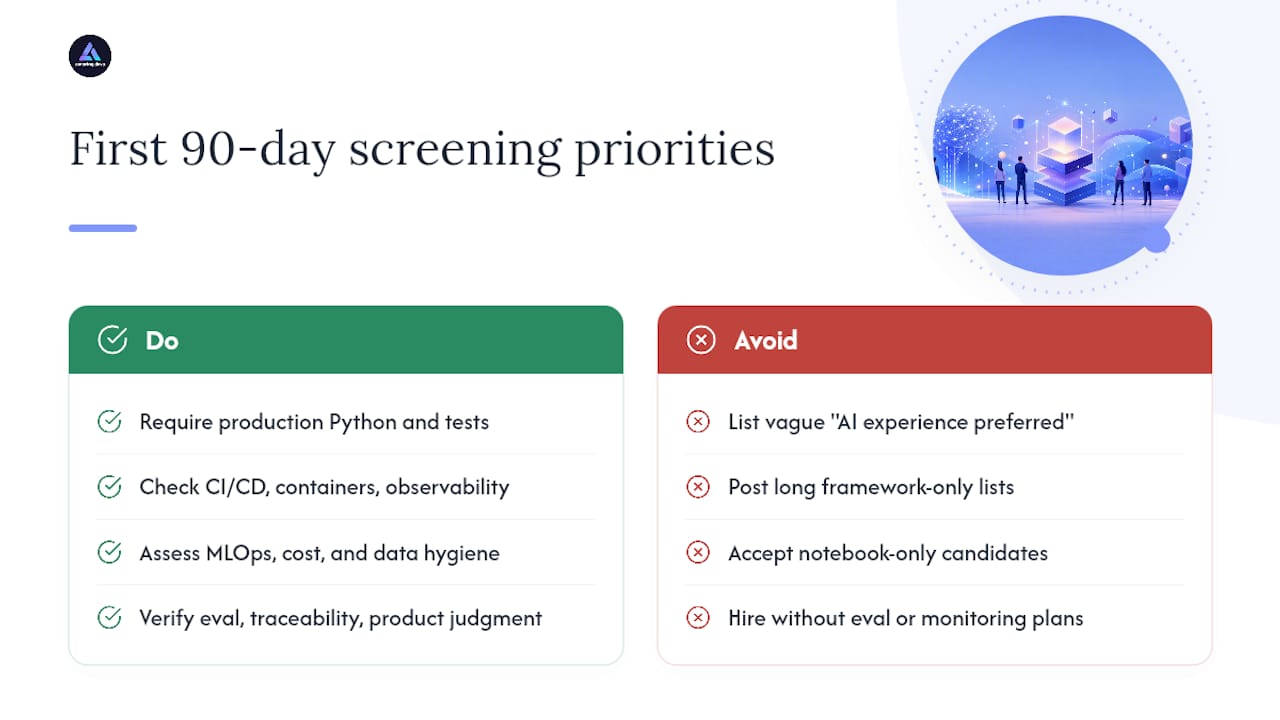
Production-grade coding. Look for real Python fluency, sane API design, and comfort handling async and streaming responses, backed by unit and integration tests. A candidate who’s only worked in notebooks will struggle here.
Software engineering fundamentals. CI/CD pipelines, containerization, observability, and testing tradeoffs matter more than model knowledge in year one. DeepLearning.AI’s AI Engineering Skills Map ranks these fundamentals among the four most employer-valued skills, alongside the ability to actually build and deploy AI applications.
MLOps and deployment awareness. Model serving, monitoring, rollback plans, and cost-per-inference intuition. This is where a lot of candidates who’ve only fine-tuned toy models fall apart.
LLM, RAG, and agent skills. Prompt and tool design, retrieval architecture, agent orchestration, and structured outputs. Industry write-ups consistently flag RAG and agentic patterns as the dominant enterprise deployment pattern, which makes production-grade retrieval experience worth a real premium in compensation.
Data engineering basics. Validation, ETL hygiene, and the ability to trace where a bad prediction’s data came from.
Evaluation discipline. Reference sets, structured error analysis, and A/B metrics for model changes, not just “it looked better in my testing.”
Soft skills and product judgment. Translating a business goal into a technical spec, documenting decisions, and pushing back on a bad idea before it ships. A quick primer on why soft skills matter for developers is worth sharing with your hiring panel before interviews start.
How Do You Evaluate AI Engineering Candidates?
Most technical screens fail because they test the wrong thing: whether someone can recite a framework, not whether they can operate one under pressure. Build a pipeline that tests production judgment instead.
- Scope the role before you post it. Define the system, the constraints, and measurable acceptance criteria. “Build an AI feature” is not a job description; “reduce support-ticket triage time by integrating a retrieval system with a 95th-percentile latency under two seconds” is.
- Run a 30-minute screening call with two questions. Ask the candidate to walk through a system they shipped and what broke in production. Qureos’s research points to this walkthrough as the clearest way to separate prototype builders from production engineers. A vague answer, or one with no failure story at all, is an instant disqualifier.
- Design the take-home around evaluation, not demos. Require an eval harness and a rough cost-per-inference estimate alongside the working code. Anyone can hand you a notebook that runs once.
- Run a paired debugging session. Give the candidate a broken or slow system and watch how they read logs and reproduce the failure. A recommends weighting debugging and observability far higher than algorithmic puzzles in this session.
- Check references for incident stories. Ask what runbooks they used and what role they played in the postmortem, not just whether they were “involved.”
Pro Tip: Skip the algorithm riddles. A candidate who can explain why a retrieval system started returning stale results at 2 a.m. tells you more than someone who can invert a binary tree on a whiteboard.
Junior, Mid, or Senior: Which AI Engineer Do You Actually Need?
Seniority in AI engineering maps less to years of experience and more to the size of the decision someone can own without supervision.
- Junior engineers need tight learning targets, close supervision, and small deliverables. They can implement a defined feature but shouldn’t be setting architecture.
- Mid-level engineers own a small feature end to end, run their own evaluation loops, and debug production issues without hand-holding.
- Senior engineers shape the product spec itself, estimate costs before a build starts, and lead the rollout and postmortem discipline afterward.
Specialization matters as much as level. Hire an applied AI engineer for model-API driven product features, a training or research engineer when you need custom model work, and an MLOps specialist once you’re scaling reliability across many models. The MLOps hiring guide breaks down that last distinction if you’re not sure which one your team needs right now.
Interview Questions and Red Flags to Watch For
Some answers should end the interview immediately, and some questions surface them fast.
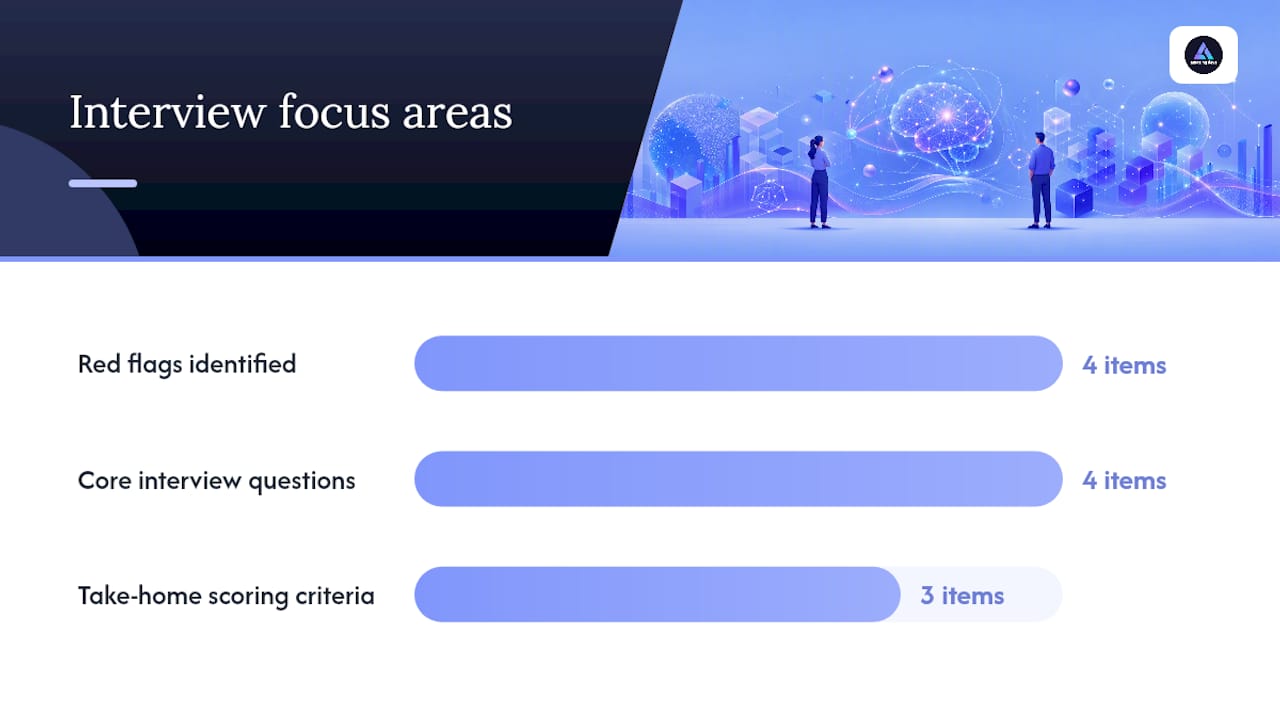
Red flags: a production story that stays vague no matter how many follow-up questions you ask, an inability to even roughly estimate inference cost, an unusually strong attachment to one specific framework, and zero mention of evaluation sets or error analysis. Kore1’s hiring guide lists eval discipline and cost intuition as primary differentiators for senior candidates, precisely because weak candidates skip both.
- “Describe a system you shipped that failed in production. What was the root cause, and what did you change?”
- “Roughly, what does it cost to run one inference on the model you’re currently using, and how would you cut that cost by half?”
- “How do you know when a model change is actually an improvement rather than noise?”
- “A product manager asks for a feature that’s technically risky. How do you push back?”
Take-home brief: ask the candidate to ship a small retrieval-augmented endpoint with an evaluation harness and a cost estimate attached, not a bare demo notebook. Score on whether the eval harness catches a deliberately planted failure case, whether the cost estimate is defensible, and whether the code would survive a code review.
Onboarding: What Should the First 90 Days Look Like?
A strong hire proves it fast if you give them the right checkpoints.
- Week 1: production access granted, a pass through recent failure cases, and a short list of the top three risks in the current system.
- Month 1: reproduce one known failure case, establish a baseline cost-per-inference metric, and stand up basic observability if it’s missing.
- Months 2 to 3: run one small improvement experiment with a measurement plan and a rollback path, then document the handoff for the next person.
Pro Tip: If a new hire can’t reproduce a known production failure by day 30, that’s not a knowledge gap, it’s an access or process gap. Fix the pipeline before you question the person.
Why Most AI Hiring Advice Gets the Order Wrong
Most hiring guides list skills top to bottom like a syllabus: math, then Python, then frameworks, then deployment. That ordering is backwards for a hiring manager. Deployment competence, the part that shows whether someone can survive a 2 a.m. page, should be the first filter, not the last box checked.
The overrated skill in AI hiring right now is framework fluency. Knowing LangChain or a specific vector database this quarter tells you almost nothing about next quarter, since the tooling churns faster than any resume line can track. What holds up is the ability to read a new system’s documentation and get productive in a week, which is exactly why A treats learning agility as a stronger signal than any tool list.
If there’s one thing worth prioritizing first, it’s this: stop asking candidates what they know, and start asking what they’ve watched break. Production judgment doesn’t show up on a resume. It shows up in the fourth follow-up question, when the polished answer runs out and the real experience either holds or doesn’t.
— Gabriel
How Amazing Devs Fits This Hiring Checklist
Amazing Devs is the direct route to vetted AI engineering talent for teams that don’t want to run the entire screening pipeline above in-house. Every candidate goes through technical assessment and cultural-fit screening before you ever see a resume, so the production-judgment and eval-discipline checks in this guide are already built into the process.
That matters most for U.S. companies trying to compete for AI engineers against much larger budgets. Nearshore Brazilian talent gives you overlapping work hours, English-fluent communication, and lower engineering costs without the six-week sourcing cycle of a solo hire. Amazing Devs also handles the contract management and compliance work that usually eats a hiring manager’s week, detailed in the nearshore hiring playbook if you want the full breakdown before committing.
If your team needs a production-ready AI engineer mapped against the exact checklist above, start with Amazing Devs and get matched with vetted candidates instead of running the funnel yourself.
Sources
For a deeper look at the skills employers now prioritize, DeepLearning.AI’s AI Engineering Skills Map breaks down the data behind this guide’s checklist. For systems-design thinking beyond hiring, see this AI workflow design piece. Internally, the nearshore hiring playbook and MLOps hiring guide expand on sourcing and specialization.
- Deeplearning
- A
- How to Hire an AI Engineer in 2026 – (August 2026)
- How to Hire an AI Engineer: 2026 Hiring Manager’s Guide – KORE1
FAQ
What Is the Single Best Screening Question for an AI Engineer?
Ask them to describe a system they shipped and what broke in production. A vague or evasive answer is the clearest disqualifier available in a 30-minute call.
How Important Is Cost-Per-Inference Knowledge in Hiring?
It’s a reliable practitioner-level indicator of seniority. Candidates who can roughly estimate inference cost without looking it up have usually operated a system at real scale.
Should I Prioritize Framework Experience Over Fundamentals?
No. Software engineering fundamentals like CI/CD, testing, and observability predict long-term performance better than familiarity with any specific framework, which tends to change every year or two.
What Should a Take-Home Task for an AI Engineer Include?
Require a small working system, an evaluation harness, and a cost estimate, not just a demo notebook. That combination reveals whether a candidate thinks about production, not just prototypes.
Is Nearshore Talent a Viable Way to Fill AI Engineering Roles?
Yes. Providers like Amazing Devs apply technical and cultural-fit screening to Brazilian engineering talent, giving U.S. companies a faster, lower-cost path to production-ready AI engineers.