Remote Code Reviews: A Workable Process for Distributed Teams
A good remote code review process comes down to five habits. Make asynchronous review the default. Keep pull requests small. Put the context in the description, not in someone’s head. Measure the queue, not the comment count. Save live calls for the changes that need them. Do those five things and a reviewer in Austin and an author in São Paulo can work together with little friction.
This guide is for engineering managers and tech leads who run reviews across locations. It is especially useful if you are adding nearshore developers to a US team. It covers the workflow, the tools, the metrics, and the failure modes we see most often.
TL;DR
- Default to asynchronous review for routine work. Escalate to a short video call for architecture disputes, repeated comment threads, onboarding and security-sensitive changes.
- Keep PRs small and self-contained, with a description that states the purpose, the tests run, the risk and the definition of done.
- Let CI, linters and security scanners handle objective rules. Use AI review as a fast extra pass, never as the release gate.
- Track time to first review, time to merge, queue age and reverted changes. Do not set targets for comment volume.
- Assign owners and rotate reviewers with the time zone in mind. More reviewers do not automatically mean better reviews.
Table of Contents
- What a remote code review actually is
- Why distance is not the real problem
- Make async the default, and know when to go live
- Write pull requests that a stranger can review
- Build the toolchain so humans review what matters
- Where AI review fits
- Etiquette that survives text
- Measure the queue, not the comments
- Our perspective on reviewing with nearshore developers
- Hiring for review-ready teams
- A 30-day rollout plan
- FAQ
- Sources
What a remote code review actually is
A remote code review is a distributed review of a commit, branch or pull request on a shared code-hosting platform. GitHub describes the flow in a way most teams will recognize. The author opens a pull request. Automated checks run. Reviewers read the diff and the surrounding context and leave inline comments. The author answers with changes or explanation. Reviewers look again, and the approved change merges under branch-protection rules.
Nothing in that loop requires anyone to be in the same room, or even awake at the same time. What changes in a remote setting is how much of the work the written record has to carry. In an office, a confusing diff gets a quick “walk me through this” at someone’s desk. Remotely, the same confusion costs a day while the author sleeps.
Review is more than a bug hunt
It is tempting to treat review as a defect filter. Google’s modern code review case study looked at logs from 9 million reviewed changes, plus interviews and a survey. It found that review also serves code understanding and shared standards. For a team with new remote members, that is the larger payoff. Every thread teaches someone how your codebase works and why, and the record stays searchable long after the people have moved on.
Why distance is not the real problem
The practical failure in distributed teams is rarely geography. It is missing context. A reviewer opens a PR and cannot tell what it is for, what behavior to expect, how it was tested or where the risk sits. So they ask, wait a day for an answer, and then ask again.
A study of distributed development, covering 201 project members and a survey of 50 practitioners, found two things. More changed lines lengthen review duration. And more teams, locations and reviewers can raise participation, but they add a severe duration penalty. The study dates from 2018, so treat it as foundational evidence rather than a current benchmark. The direction still matches what we see: big diffs and crowded reviewer lists are slow.
The fix is not more meetings. It is writing the context down once, in the right place.
Make async the default, and know when to go live
Asynchronous review means reviewers read the pull request and comment on their own schedule. Synchronous review means the author and reviewer walk through the change together. Cubic’s comparison of the two frames it as a decision remote teams face that office teams rarely do.
For US and Brazil teams, async is the practical default. Brazil’s main business centers are one to a few hours ahead of the US East Coast, depending on daylight saving, so overlap is generous. But async still protects focus on both sides, and it keeps a single missed meeting from blocking a merge.
When the team is committed to continuous delivery, the calculus shifts. The MinimumCD practice guide says review must happen within minutes or hours, not days, and it prefers synchronous review in that setting. That is a valid choice for small, high-trust teams. Most mixed US and nearshore teams do better with a hybrid.
A simple escalation rule
| Situation | Mode | Why |
|---|---|---|
| Routine feature or bug fix under a few hundred lines | Async | Reviewer reads when focused; no scheduling cost |
| Same thread passes two rounds without agreement | Short live call | Tone and nuance get lost in text |
| Architecture or API design change | Live walkthrough, then async sign-off | Align on direction before line-level detail |
| Security-sensitive change | Async plus a second named reviewer, live if unclear | Fresh eyes and explicit accountability |
| New developer’s first PRs | Pair review, live | Teaches norms faster than comments |
Treat video as an escalation path, not a default. A ten-minute call to resolve a stuck thread is cheap. A standing call for every PR defeats the purpose of working remotely.
If you want to test tools for those live sessions, our guide to remote pair programming tools shows how to evaluate them in 30 to 60 minutes.
Write pull requests that a stranger can review
The research on review points one way: keep changes small and reviewable. Split large work into connected PRs. Do not mix refactoring with unrelated feature changes. Tie the PR to an issue.
A description template that works for remote teams:
- Purpose: the user or business outcome, in one or two sentences.
- Link: the issue or ticket.
- What changed: the approach, and anything you deliberately left out.
- How it was tested: commands run, screenshots, test names.
- Risk: what could break, and what to look at first.
- Definition of done: what must be true before merging.
That takes five minutes to write. It saves the reviewer from reconstructing intent from the diff, and it saves the author a full overnight round trip.
Size and focus
There is no universal line count that is right for every codebase. A useful working rule is that a reviewer should be able to hold the whole change in their head in one sitting. If you cannot summarize the PR in two sentences, split it.
Build the toolchain so humans review what matters
People should not spend review time on things a machine can check. A practical remote toolchain layers these pieces:
- A code host such as GitHub for pull requests and inline discussion.
- CI for tests and build checks.
- Linters and formatters for objective style rules, so nobody argues about semicolons in a comment thread.
- Static analysis and security scanning for repeatable risk detection.
- Chat or issue tracking for context that does not belong in the PR.
- Optional AI review for an additional pass.
Tool features and plan limits change quickly. Before you buy anything, check plan limits, data-retention terms, repository access and AI-training controls.
Ownership and reviewer assignment
Adding reviewers is not free. The distributed-development research points to a real tradeoff between participation and duration, so give each area of the code a clear owner. On GitHub, a CODEOWNERS file lets you map paths to people or teams, and with required reviews enabled, it can make sure the right person approves changes to their area.
Then build a rotation that respects time zones. Pair each US reviewer with a Brazil-based counterpart so a PR opened late in one location lands in front of someone who is starting their day. Our post on time zone management moves goes deeper on cutting coordination delay.
If reviewer capacity is your bottleneck, see how code review tools can add reviewer capacity for US engineering managers.
Where AI review fits
AI review is useful and increasingly common. GitHub states that its review features support code written by humans or AI agents, and run checks before anything reaches main. Practitioner discussion is more mixed. In one Reddit thread of experienced developers, a common view is that automated review catches bad patterns in popular SDKs but struggles with a company’s own stack.
So use it as a fast extra pass, not an autonomous release gate. Open-source examples such as the Gemini review command for GitHub Actions show the usual setup: point the model at the changed lines, security-sensitive behavior, tests and project conventions. Then keep human judgment on business logic, architecture and high-risk changes.
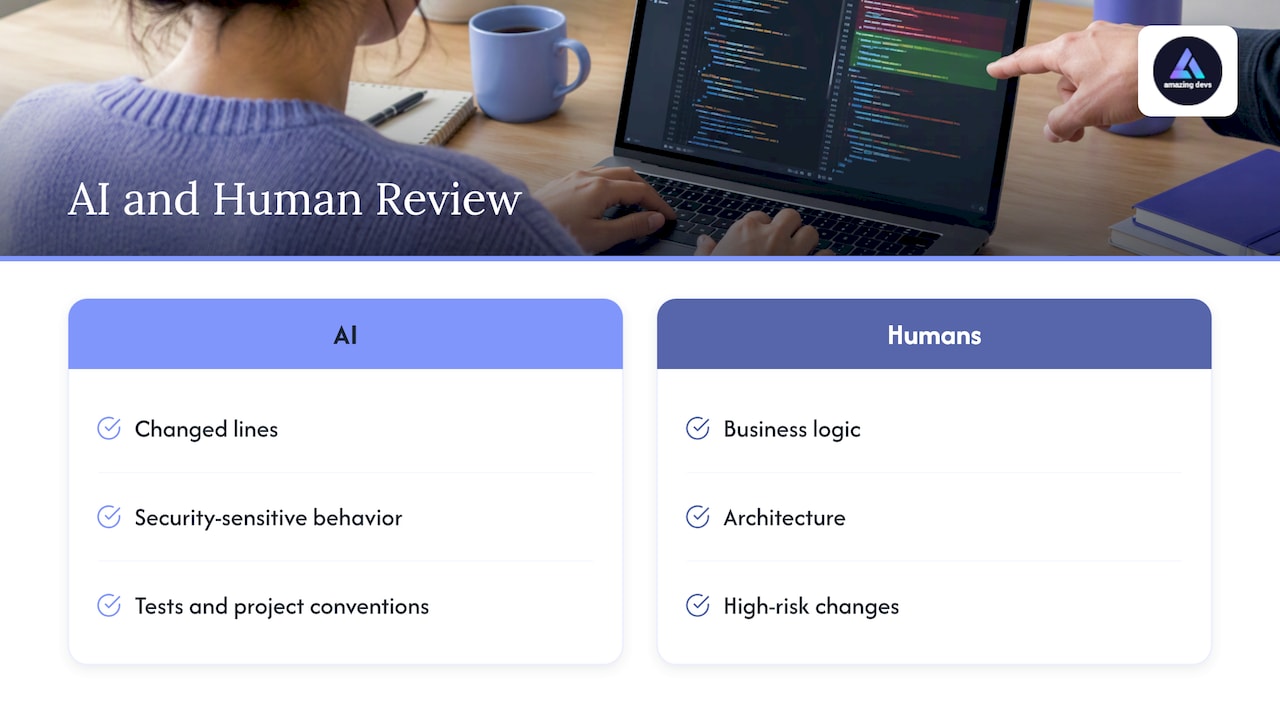
A useful side effect for remote teams: an AI pass gives the author feedback in minutes, even when the human reviewer is offline. That cuts the number of overnight round trips for trivial issues.
Etiquette that survives text
Review can feel like being judged, and text strips out tone. A few habits help:
- Comment on the code, not the person. Write “this function mixes two concerns” rather than “you mixed two concerns.”
- Ask before asserting. “What happens if this list is empty?” opens a discussion; “this is wrong” closes one.
- Label severity. Mark comments as blocking or optional so authors know what must change.
- Lead with core issues. Microsoft Research’s practitioner study of code review recommends focusing on core issues first, reviewing frequently, responding promptly, and tailoring checklists to the project.
- Say what is good. One specific compliment per review costs nothing and shifts how the rest reads.
- Move to voice when a thread hits round three. Then write the conclusion back into the PR so the record stays complete.
GitKraken’s tips for remote review make a similar point: the water-cooler chat has become a Slack ping, so the norms have to be explicit.
Measure the queue, not the comments
If you manage a nearshore or outsourced team, you need a way to tell whether review is working. Counting comments is the wrong way. It rewards noise and punishes clean code. Use operational metrics instead:
- Time to first review
- Time to merge
- Review queue age
- Reopened or reverted changes
- Escaped defects
- Change size
- Review participation across engineers
- Share of PRs that pass automated checks
The Microsoft material supports bounded review time and broad participation, but it does not give a universal target for each metric. Set your own baseline for a month, then improve from there. And never turn raw comment volume into an individual performance target.
For the bigger picture on how to read those numbers without falling into activity traps, see our pieces on remote developer productivity and on performance management for contractors.
Our perspective on reviewing with nearshore developers
We place Brazilian developers with US companies, so we see the first weeks of review from both sides. Here is what we have learned.
The first month is where review habits get set. When a new developer joins, the review record is the fastest way to teach them how your team thinks. We recommend that you treat their first PRs as onboarding, not as an audit. Pair live on the first few, then move to async.
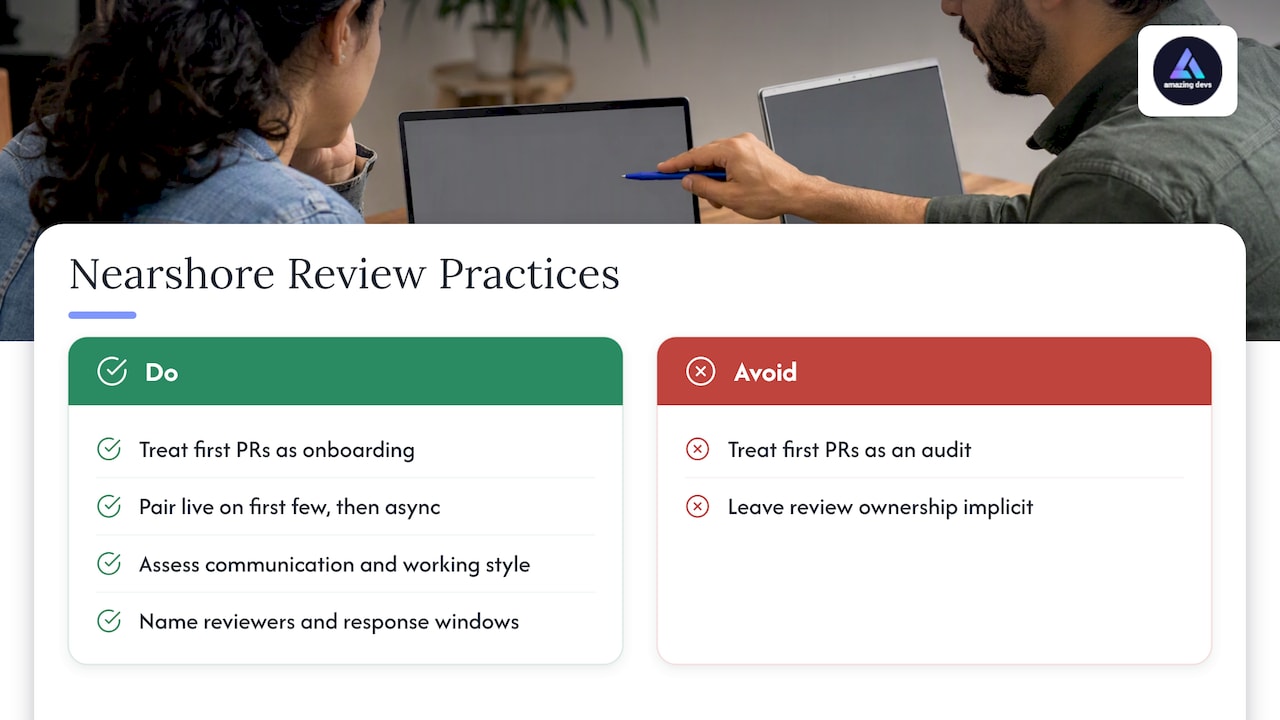
We also think the cultural-fit part of our assessment matters here more than people expect. A developer who is comfortable asking questions in a PR thread, and who explains trade-offs unprompted, makes review fast. A technically strong developer who stays silent when confused makes it slow. That is why we assess communication and working style alongside technical skill.
Finally, ownership should be explicit from day one. Name who reviews what, and agree on a response window. Our job is to handle contracts and the administrative side, so your managers spend their time on exactly this sort of work. For more on setting up the relationship, read our rules for managing nearshore teams.
— Gabriel
Hiring for review-ready teams
If you are scaling and your reviewers are already stretched, adding developers who can both write and review well is the most direct fix. Through nearshore staff augmentation, we source, assess and place pre-vetted Brazilian developers, including AI-enabled engineers, and we handle the contract and bureaucratic work. If you want a dedicated unit that works as part of your team, the Team Extension Model is built for that. Tell us your stack and your review workflow, and we will match developers who fit both.
A 30-day rollout plan
You do not need to change everything at once. A sequence that works:
- Week 1: write the PR template and the severity labels. Set up CI, a linter and a formatter so objective rules are automated.
- Week 2: add CODEOWNERS and a reviewer rotation across time zones. Agree on a response window for first review.
- Week 3: switch on an AI review pass for style and obvious bugs, with humans still approving. Start recording the baseline metrics.
- Week 4: hold a short retrospective. Look at queue age and PR size, find the slowest stage, and fix that one thing.
Repeat the retrospective monthly. Review process is something you tune, not something you finish.
FAQ
Should remote code reviews be synchronous or asynchronous?
Use async as the default for routine changes, because it fits time-zone differences and protects focus. Switch to a short live session for design disputes, threads that stall after a couple of rounds, onboarding and security-sensitive work. Write the outcome of any call back into the PR.
How big should a pull request be?
Small enough that a reviewer can understand it in one sitting and you can summarize it in two sentences. Research on distributed review links larger changes with longer review times. Split big work into connected PRs and keep refactoring separate from feature changes.
How do we know if nearshore developers review well?
Look at time to first review, time to merge, queue age, reverted changes and escaped defects. Check that participation is spread across the team. Avoid judging anyone by the number of comments they leave.
Can AI replace human reviewers?
Not safely. AI review is a quick additional pass for patterns, tests and conventions. Business logic, architecture and high-risk changes still need a human who understands your product.
Sources
- GitHub: code review and pull requests
- Google modern code review case study
- Peer code review in distributed software development (Springer, 2018)
- Async vs sync code reviews (Cubic)
- MinimumCD code review practice guide
- GitHub Docs: About code owners
- Reddit r/ExperiencedDevs: AI-based code review tools
- Gemini review command for GitHub Actions
- Microsoft Research: code review tech report
- GitKraken: tips for remote code reviews