Brazil AI Talent: What US Teams Can Hire and What It Costs

Brazil has a large, fast-growing pool of AI-capable engineers who work in time zones close to the US, and most of them are not hired through a US-style process. Demand is rising quickly, so competition for senior people is real. Hiring well means knowing which roles exist, what they cost, how strong the English is, and which legal points to settle before the first offer goes out. This guide covers each of those, with sources.
TL;DR
- Demand for AI skills in Brazil is accelerating: 3.6% of job postings required them in 2025, up from 1.1% in 2024.
- The supply is tight: Brazil had an accumulated shortfall of 530,000 technology professionals by 2025, so good candidates get several offers.
- A government plan is trying to widen the pipeline, but expect competition for senior engineers for years.
- Classification, 13th-month pay, FGTS and IP assignment are the legal points that most often catch US teams out.
- A nearshore partner can handle sourcing, vetting and contracts, which is how most US teams avoid setting up a local entity.
Table of Contents
- What kinds of AI talent Brazil actually has
- How big the pool is, and why it is still tight
- Education, experience and English
- What Brazilian AI talent costs
- Legal, payroll and IP points to settle first
- How to assess and onboard Brazilian AI hires
- Perspective: what we see when US teams hire in Brazil
- Hire Brazilian AI-enabled engineers with Amazing Devs
- FAQ
- Sources
What kinds of AI talent Brazil actually has
It helps to split AI hiring into two groups, because Brazil’s market does. PwC’s 2026 AI Jobs Barometer for Brazil describes AI user roles, which need AI literacy and applied skills, and developer roles, which need advanced AI skills. User roles dominate the demand. Developer roles are smaller but stable, and the same report shows them growing by around 16,700 in 2025.
For a US company, that split tells you where to look:
- AI-enabled software engineers. Backend, full-stack and mobile developers who build with LLM APIs, copilots and agents day to day. This is the largest group and the easiest to hire.
- Machine learning engineers. People who train, evaluate and deploy models. As of January 2026, one aggregator counted more than 3,000 LinkedIn postings for machine learning alone. Treat that as a rough signal of activity rather than a precise count.
- Data engineers and analytics specialists. The pipelines that feed every AI project. We cover this path in hiring data engineers in Brazil.
- QA and evaluation specialists. Testing AI features needs different habits from classic QA, and nearshore QA contractors are a cheap way to add that capacity.
If you are scoping a first AI hire, our nearshore playbook for hiring AI engineers walks through role definitions and interview design.
How big the pool is, and why it is still tight
Brazil is the biggest tech market in Latin America, but size does not mean surplus. The shortfall figure above, 530,000 technology professionals accumulated by 2025 with an annual gap above 100,000, comes from a Pearson AI readiness report. Local companies, banks and fintechs compete for the same people, and so do foreign employers.
That has two practical consequences. First, the best candidates move fast, so a slow interview loop loses them. Second, a title like “AI engineer” covers very different levels of ability, so the assessment matters more than the CV. Teams that want a structured way to map skills before scaling can look at AI workforce analytics for the HR data side of that work.
What the national AI plan changes
Brazil’s government has put money behind the problem. The PBIA, the Brazilian Artificial Intelligence Plan for 2024 to 2028, is described in an official Ministry of Science, Technology and Innovation document as a R$ 23 billion initiative covering sovereign AI, ethical governance and workforce training. It supports scholarships, professional qualification programs and new university courses. The same document sets a target of training 20,000 professionals a year in AI-related ICT by 2028.
The OECD’s AI policy dashboard also tracks the plan if you want an outside summary of its goals.
A realistic reading: the plan will grow the base of junior and mid-level people over the next several years. It will not quickly produce more senior ML engineers. Pearson’s report also notes that national AI frameworks are inconsistent and that readiness varies across higher education, so a degree alone tells you little about hands-on skill.
Education, experience and English
Brazil’s Ministry of Education describes informatics training as covering programming, algorithms, data structures, mathematics, technical documentation and reading technical texts in English. Technical English is built in from the start, which matches what US managers see in practice.
At the postgraduate level, a CAPES and CGEE study analyzes master’s and doctoral graduates in strategic areas, including engineering and computer science. Note that its graduate data runs from 1996 to 2014, so use it for context on the academic pipeline, not for current numbers.
English proficiency: the national score versus IT
Brazil is not a high-English country on average. The EF English Proficiency Index 2025 ranks it 75th globally with a score of 482, against a global average of 488. Its component scores are Reading 516, Listening 468, Speaking 464 and Writing 442.
The same fact sheet shows the picture changes for tech workers: Brazilian IT professionals score 551, tied with teachers for the highest job function listed. In other words, the national average understates what you will find among developers.
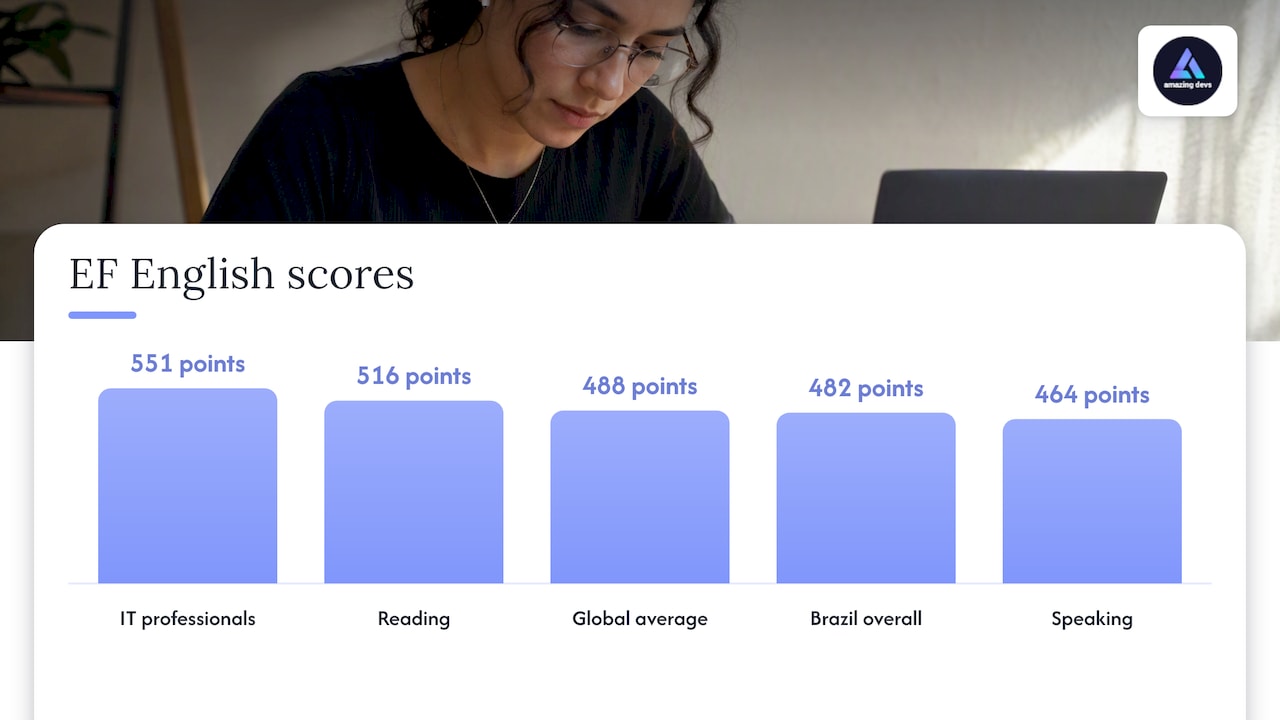
Still, do not assume. Reading is stronger than speaking, so test spoken English in a real technical conversation, ideally a pairing session or a design discussion, not a trivia call.
What Brazilian AI talent costs
Salary data in Brazil is published in reais and in mixed sources, so treat every figure below as a range with a date, not a quote.
| Data point | Figure | Source and period |
|---|---|---|
| AI Engineer, monthly salary | R$ 19,500 to R$ 27,100 | Robert Half Salary Guide 2026, via Forbes Brasil |
| Senior ML Engineer, monthly salary | R$ 18,000 to R$ 30,000, with the 90th percentile at R$ 54,667 | Aggregator data, January 2026 |
| Engineers and data scientists, annual average | About USD 67,000 | Deel’s 2025 report, via a news summary |
| Remote international roles, monthly | USD 3,000 to USD 15,000 depending on seniority and specialization | Aggregator data, January 2026 |
Two cautions. The Deel report ranks Brazil first in Latin America for technology compensation, so it is not the cheapest market in the region. And the wide remote range shows that specialization moves price far more than geography does. A senior engineer who has shipped LLM features to production costs much more than a strong generalist who is learning the tools.
The salary is also not the whole bill. For a full build-up including benefits and taxes, see our guides on Brazil developer rates and the all-in budget for Brazil developers. If you are weighing other countries, compare Brazil and Argentina or Brazil and India.
Legal, payroll and IP points to settle first
This is where US teams make expensive mistakes. Brazil does not let you treat everyone as a contractor by default, and the rules are different from US ones. Confirm your setup with Brazilian employment counsel before you sign anything.
Worker classification
According to Deel’s guide to hiring AI engineers in LatAm, contractor and employee engagements need careful classification and local tax compliance, and misclassification can trigger back-payment of social contributions and penalties. If a contractor works fixed hours, takes direction from your managers and works only for you, that looks like employment. Pick the model first, then write the contract to match how the person will actually work.
13th-month pay and FGTS
Brazilian employment comes with a 13th-month salary and FGTS contributions, which add cost and administrative overhead to compensation planning. That source is a 2022 law-firm briefing, so check current rates with counsel. When you compare an offer against a salary figure from the table above, ask whether those extras are inside or on top of it.
Intellectual property
In several Latin American countries, default IP rules do not automatically transfer work-product ownership to the hiring company, so explicit assignment clauses may be needed. For AI work, where models, prompts, datasets and evaluation harnesses are the product, write that clause explicitly and name each asset type.
One more note on AI in hiring itself: if you plan to use automated tools to screen Brazilian candidates, a local law firm has published a review of AI in recruitment in Brazil that is worth reading with your counsel.
How to assess and onboard Brazilian AI hires
Deel’s guidance says to choose a hiring model and then manage classification, local tax compliance, contracts, onboarding and IP assignment. Beyond that, the public evidence on assessment is thin, so what follows is our working method rather than a cited standard.
- Define the role by the work. “Build and evaluate a retrieval pipeline” beats “AI engineer”.
- Run a practical exercise. A small, paid or time-boxed task on your own stack shows more than a quiz.
- Test spoken English live. Use a design conversation, not a script.
- Check working-style fit. Brazilian teams tend to value relationships and context. Our guide to Brazil work culture for foreign managers covers feedback, meetings and holidays.
- Set overlap hours. Most of Brazil sits within a few hours of US time zones, so agree a daily overlap window. We outline three moves in our timezone management strategies and cover meeting rhythm in remote sprint planning.
- Plan the first 30 days. Access, a starter ticket, a named buddy and a clear definition of done.
If outbound sourcing is part of your plan, tools for AI for LinkedIn outreach can help you keep a warm pipeline of candidates. Expect the best people to answer slowly if your message reads like a template.
Perspective: what we see when US teams hire in Brazil
We place Brazilian developers with US startups and established companies, and our view is shaped by that work. Most teams that say they need “AI talent” actually need strong software engineers who are fluent with AI tools. Those engineers are far easier to find, and they ship faster than a team built around one scarce research profile.
The second thing we see is that the hard part is rarely the code. It is the contract, the classification question, the payroll and the cultural fit. That is why we spend our effort on assessment for both technical skill and working style, and on handling the contracts and local bureaucracy, so a manager can focus on the roadmap. We would rather present three well-matched candidates than ten loosely filtered ones.
Our advice is to start with one or two roles, get the process working, and then grow the team.
— Gabriel
Hire Brazilian AI-enabled engineers with Amazing Devs
Amazing Devs provides pre-vetted Brazilian developers, including AI-enabled and traditional software engineers, with sourcing, technical and cultural assessment and contract management included. You can add people to your team through nearshore staff augmentation, or build a longer-term group with the Team Extension Model.
If you are still deciding how to structure the engagement, our guide to hiring Brazilian developers without a local entity explains the steps, and the pros and cons of staff augmentation sets out the trade-offs plainly. Visit Amazing Devs to talk about the profile you need.
FAQ
Is Brazil a good place to hire AI engineers?
Yes, for most applied AI work. Demand for AI skills is rising, and Brazilian IT professionals score well on English, with an EF score of 551. The trade-off is competition: the country has a large shortfall of tech workers, so senior specialists are not cheap or quick to hire.
How much does an AI engineer in Brazil earn?
The 2026 Robert Half guide, reported by Forbes Brasil, puts AI Engineer salaries at R$ 19,500 to R$ 27,100 per month. Remote international roles are reported at USD 3,000 to USD 15,000 per month depending on seniority. Benefits, taxes and your hiring model come on top.
Do I need a Brazilian entity to hire AI talent there?
Not always. Companies can use contractor arrangements, an employer-of-record or a nearshore partner. Whichever you choose, classification matters, because misclassification can lead to back-payment of social contributions and penalties. Get local legal advice before you decide.
What is Brazil’s AI strategy?
It is the PBIA, a R$ 23 billion plan for 2024 to 2028 covering sovereign AI, ethical governance and workforce training. It includes scholarships, qualification programs and a goal of training 20,000 professionals a year in AI-related ICT by 2028.
Who owns the IP that a Brazilian contractor creates?
Do not assume it is you. Default rules in several Latin American countries do not automatically pass work-product ownership to the hiring company, so include an explicit IP assignment clause. Have Brazilian counsel review it.
Sources
- PwC, Brazil report, 2026 AI Jobs Barometer
- Pearson, AI Readiness: Building the Bridge from Higher Education
- Jobstera, IA e Machine Learning no Brasil
- Brazilian Ministry of Science, Technology and Innovation, IA para o Bem de Todos
- OECD.AI, Brazilian Artificial Intelligence Plan
- Brazilian Ministry of Education, Informática
- CAPES, Egressos da pós-graduação: áreas estratégicas
- EF English Proficiency Index 2025, Brazil fact sheet
- Forbes Brasil, Engenheiro de IA: o que faz e quanto ganha
- Click Petróleo e Gás, report on Brazilian tech pay in Latin America
- Deel, How Enterprises Can Scale AI Engineering Teams by Hiring in LatAm
- Cescon Barrieu, Labour and Employment in Brazil
- Feijó Lopes, AI in recruitment and hiring in Brazil
- TalentJam, AI workforce analytics
- Kynzo, AI for LinkedIn outreach