Machine Learning Engineer Rates in the US: 2026 Guide

Machine learning engineers in the US typically cost between $126,000 and $185,000 a year in base salary, or roughly $91 to $112 an hour on contract, depending on which benchmark you read. The gap between sources is real, and it comes from what each one measures. This guide shows what the main figures mean, how seniority, city and specialty move them, and how to compare a salary with an hourly rate on equal terms.
TL;DR
- Average US base salaries for ML engineers range from about $126,000 (PayScale) to about $185,000 (Indeed), because the samples and methods differ.
- One 2026 benchmark puts US AI/ML contractor rates at a $104/hour median, with a typical range of $91 to $112, and about $70 for juniors up to $181 for principal-level engineers.
- A salary is not the cost of an employee: benefits, payroll taxes and equipment can add 30% to 50% or more on top.
- Location and specialty matter, but a blanket “AI premium” can mean overpaying for skills the role already includes.
- If a US hire does not fit your budget, a nearshore model is one way to widen the talent pool without a US-level payroll.
Table of Contents
- What the headline numbers actually measure
- Hourly contractor rates: what US teams pay
- Salary versus hourly: how to compare them fairly
- What pushes a rate up or down
- A budgeting checklist
- Where nearshore fits into the comparison
- Hire ML engineers with Amazing Devs
- FAQ
- Sources
What the headline numbers actually measure
Search for ML engineer pay and you will find figures that disagree by tens of thousands of dollars. They are not all wrong. They measure different things.
| Source | Figure | What it reflects |
|---|---|---|
| Indeed | $184,510 average base salary | 5.4k salaries from job postings over 36 months, updated October 28, 2026 |
| PayScale | $126,315 average base salary | 944 salary profiles, as of October 12, 2026 |
| BLS | $140,300 median annual wage | Computer and information research scientists, May 2025 |
| PayMetric Labs | $104/hour median contractor rate | US AI/ML engineers on contract, 2026 |
Three things explain most of the spread.
Posted salaries versus reported salaries. Indeed draws on job postings, which skew toward companies actively hiring and often toward larger employers. PayScale draws on salary profiles submitted by workers. A posting is what a company offers to a new hire. A profile is what people already in seat earn, which is often lower.
Job titles. “Machine learning engineer” covers everything from a junior building data pipelines to a staff engineer training models at scale. The BLS does not publish a separate ML engineer category. The closest official occupation is computer and information research scientists, whose median was $140,300 in May 2025. The BLS also reports that the lowest-paid 10 percent earned less than $82,200 and the highest-paid 10 percent more than $230,630. Treat that as a reference point, not a precise match.
Salary versus rate. An annual salary and an hourly contractor rate are different products. The first is a base figure before the employer adds its own costs. The second already has overhead built in.
A sensible way to use these numbers: take the lowest and highest credible averages as your range, then narrow it using the factors below.
Hourly contractor rates: what US teams pay
PayMetric Labs’ 2026 US benchmark puts the median AI/ML engineer contractor rate at $104 an hour, with a typical range of $91 to $112. Its permanent-salary median for the same field is $141,000. It calculates that $104 an hour comes to about $183,000 gross a year, before tax and business costs.
That last part is the key. A contractor’s rate has to cover their own holiday, sick days, retirement savings and the gaps between contracts. So a contract rate looks high next to a salary, but it is not pure take-home pay, and for you it is not a pure premium either.
Rates by seniority
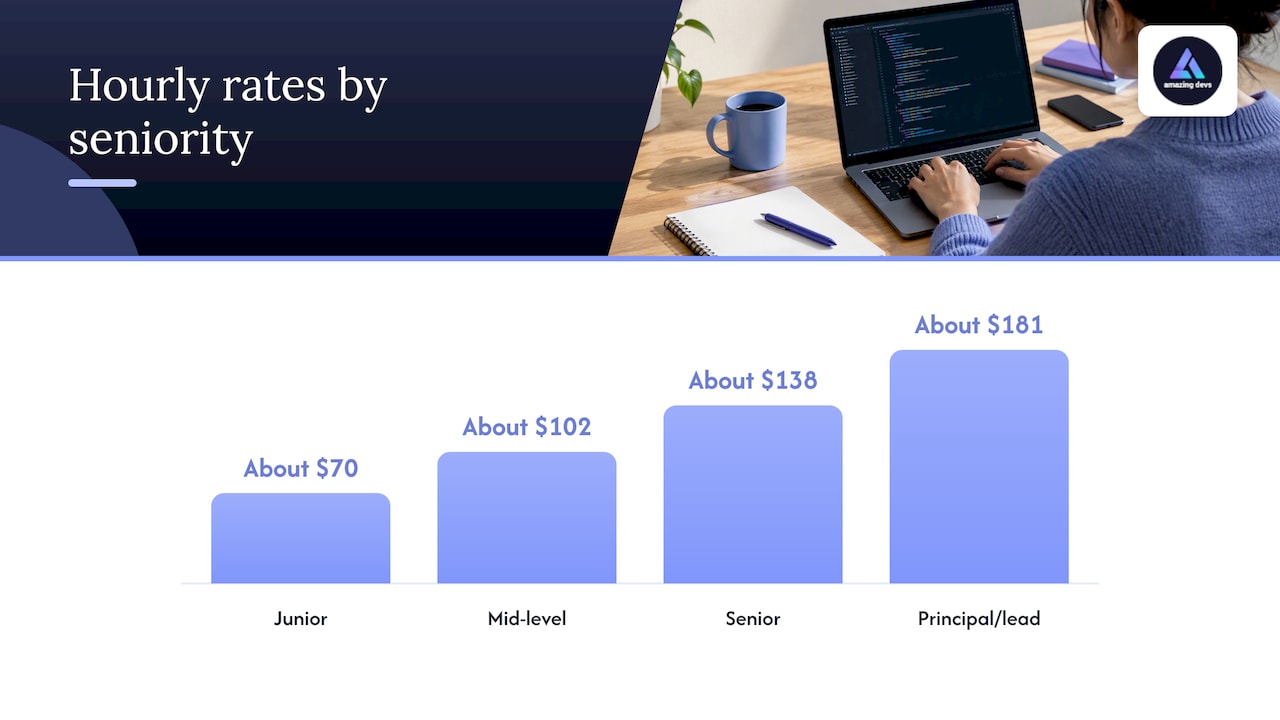
The same PayMetric benchmark breaks hourly rates down by career level:
| Level | Typical US hourly rate |
|---|---|
| Junior | about $70 |
| Mid-level | about $102 |
| Senior | about $138 |
| Principal / lead | about $181 |
The jump from mid-level to senior is about $36 an hour, and the jump to principal another $43. What are you paying for? Mostly independence and judgment. The US General Services Administration’s CALC+ guide describes labor categories by how independently someone works, the complexity of the tasks, their level of responsibility and how unique their expertise is, and notes that occupation level substantially affects hourly pricing. If you want a wider view of how those same factors shape technology pricing, this breakdown of technology project cost tiers shows how scope and complexity move quotes in a similar way.
In practice, a junior needs a senior nearby to review their work. A senior can own a model from data to deployment. If you have nobody to supervise a junior, the cheaper hourly rate may cost you more in rework.
Rates by city
PayMetric’s city medians for AI/ML contractors, per hour:
| City | Median hourly rate |
|---|---|
| San Francisco Bay Area | $125 |
| New York | $115 |
| Seattle | $113 |
| Washington, DC | $111 |
| Boston | $109 |
| Los Angeles | $106 |
| Austin | $95 |
| Chicago | $92 |
| Atlanta | $88 |
The spread from Atlanta to the Bay Area is $37 an hour, about 40%. Remote work has narrowed some of this, since many employers pay a national band rather than a local one. But if your only option is to hire locally in a coastal hub, expect to pay toward the top of the range.
Salary versus hourly: how to compare them fairly
The most common mistake is comparing a $141,000 salary with a $104 hourly rate by multiplying the rate by 2,080 hours and calling the contractor 50% more expensive. The comparison has to include what the employer pays on top of salary.
What an employee really costs
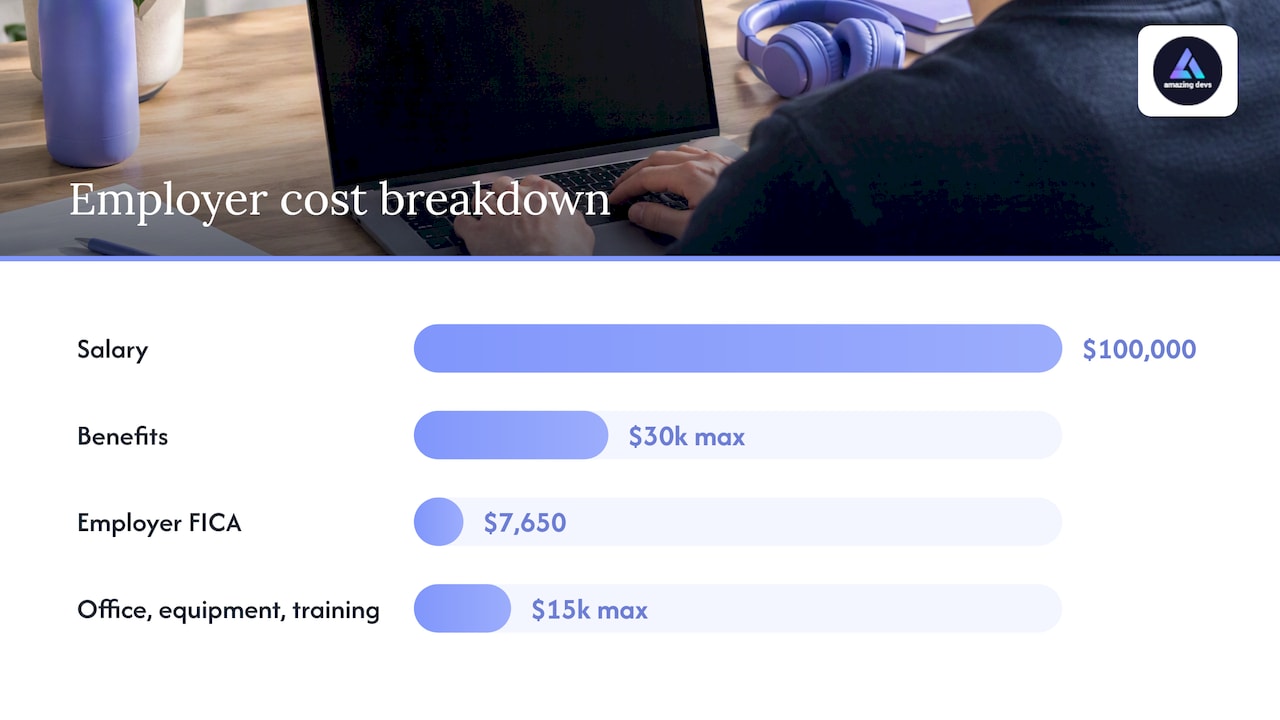
The US Chamber of Commerce offers a rule of thumb: employers may add up to 30% for benefits, 7.65% for employer FICA, and up to 15% for office, equipment and training. Its example turns a $100,000 salary into $152,650 a year in employer cost. A freelancer, by contrast, covers taxes, benefits and expenses through the hourly or project rate.
The BLS shows the same pattern in the data. In its Employer Costs for Employee Compensation release for June 2026, wages and salaries made up 69.2% of total hourly compensation for private industry workers in professional and related occupations. Benefits, including paid leave, insurance and retirement, made up the other 30.8%.
A worked example
Take PayMetric’s $141,000 permanent-salary median and apply the Chamber’s maximum percentages:
- Benefits at 30%: $42,300
- Employer FICA at 7.65%: $10,786.50
- Office, equipment and training at 15%: $21,150
- Total: about $215,237 a year
That is a ceiling, not a guarantee. Many employers will land lower. Even so, spread over a standard 2,080-hour year it is close to $103 an hour, which is almost exactly the $104 median contractor rate. In other words, the contractor is not necessarily more expensive. They are priced to include the things an employee’s salary leaves out.
The real differences are elsewhere: a contractor can be added or released faster, while an employee builds institutional knowledge and is easier to retain long term.
Costs that do not appear in either number
For ML work specifically, add what the engineer needs to do the job: cloud compute for training, data storage and labeling, experiment tracking and monitoring tools. These sit in your infrastructure budget, not in anyone’s rate, and they can be significant for model-heavy products. Also count recruiting. Our own breakdown of what it costs to recruit developers covers agency fees, interview time and the cost of an open seat.
One legal point belongs here. If you hire someone as a 1099 contractor, they need to be a real independent contractor. The Chamber warns that worker misclassification has serious consequences. Talk to an employment attorney or your accountant before putting a full-time, closely managed engineer on a 1099.
What pushes a rate up or down
Specialization
Not every AI-related skill earns a premium. Payscale’s October 2026 analysis found premiums for Machine Learning Engineer II roles of 4.1% for AI research, 3.0% for fraud detection and 2.0% for model training. It also says programming languages and frameworks such as TensorFlow or PyTorch are standard expectations of the role, not automatic extra pay.
Its broader advice is useful for budgeting: pay should reflect scarce, job-relevant value beyond what the role normally requires, and applying one AI premium to every seniority level can overpay for skills already priced into the job.
So before you set a rate, write down what you actually need. A useful test:
- Is the skill core to the role? Python and a major deep learning framework are the baseline.
- Is it scarce and tied to your product? Production deployment, evaluation, or pipeline reliability might be.
- Is it needed now, or is it a nice-to-have? Pay for the first, develop the second.
If your real need is getting models into production and keeping them there, you may want an MLOps profile rather than a research profile. Our MLOps hiring guide explains how the two differ. If you are building around language models, the LLM engineer role guide covers the core tasks to hire for.
Seniority and scope
As the table above shows, level is the single biggest driver. Hiring a senior to do junior work wastes budget, and hiring a junior to do senior work wastes time. Match level to the decision rights the role needs: who chooses the model approach, who owns the data pipeline, who is on call when a model drifts.
Location and employment model
City matters, but so does where the engineer sits relative to you. A US-based hire in a coastal hub sits at the top of the range. A remote engineer elsewhere in the US may cost less. A nearshore engineer in a neighboring time zone changes the cost structure again, which we cover next.
A budgeting checklist
Before you post a role or request quotes, work through this:
- Decide the level (mid, senior, lead) based on who will supervise the work.
- Pick a benchmark range, using both a salary source and a contractor source.
- Convert everything to a fully loaded annual cost, using the percentages above.
- Add compute, data and tooling.
- Add recruiting and onboarding time, then divide by how long you expect the engineer to stay.
- Compare the total with the cost of a nearshore or staffing option, over the same period.
This turns a debate about hourly versus salary into one number you can put in front of a finance lead.
Our view: rate is only half the equation
When founders and engineering leaders ask us about ML engineer rates, they usually compare two numbers and miss the third: how long the seat stays empty. A US search for a strong ML engineer can take months, and every month without the hire is a delayed model, a delayed feature or an overworked team.
That is why we built our service around speed and fit, not just price. We recruit and assess Brazilian developers for technical skill and for cultural and business alignment, and we handle the contracts and the bureaucracy so you do not have to. Brazil shares working hours with most of the US, which makes day-to-day collaboration with your team practical.
We do not claim that nearshore is right for every role. We do believe a team that can add a vetted engineer without a long hiring process, and without building a new entity or payroll abroad, can move faster and spend its budget on the work itself.
Gabriel
Where nearshore fits into the comparison
If the numbers above stretch your budget, or you cannot wait for a long US search, nearshore staff augmentation is worth pricing alongside the other two options. The engineer works as part of your team, in a compatible time zone, while the provider handles recruitment, contracts and administration.
Three of our guides go deeper on this:
- Brazil developer rates explains what US teams pay for developers in Brazil.
- Nearshore developer rates in LATAM covers the costs that headline quotes often leave out.
- Brazil AI talent looks at which AI roles US teams can hire there.
When you compare models, look at the whole arrangement, not just the hourly figure. Our comparison of outsourcing and staff augmentation shows how control, management load and cost differ between the two.
Hire ML engineers with Amazing Devs
We place pre-vetted Brazilian developers with US companies, including engineers for AI-enabled and traditional software roles. We source candidates, assess technical and cultural fit, and manage contracts, so your team gets a developer who can start contributing without the usual hiring overhead. Learn how nearshore staff augmentation works, or see how the Team Extension Model adds engineers to your existing team.
If you are planning an ML hire now, our guide to hiring ML engineers for your team is a good next step, and you can reach us through getamazingdevs.com to talk through your role.
FAQ
What is the average hourly rate for a machine learning engineer in the US?
PayMetric Labs’ 2026 benchmark puts the median US AI/ML contractor rate at $104 an hour, with a typical range of $91 to $112. Rates run from about $70 for juniors to about $181 for principal-level engineers. Your rate will depend on level, city and the specific skills you need.
How much does an ML engineer earn per year in the US?
It depends on the source. PayScale reported an average base salary of $126,315 in October 2026, while Indeed reported $184,510 the same month. The BLS median for the closest official occupation, computer and information research scientists, was $140,300 in May 2025. Base salary excludes benefits and employer taxes.
Is hiring a contractor cheaper than hiring an employee?
Not automatically. An employee’s salary leaves out benefits, employer payroll taxes and equipment, which the US Chamber of Commerce says can add up to about 52% in its example. A contractor’s rate already covers those items. The better question is how long you need the engineer and how much flexibility you want.
Do LLM and MLOps skills cost more?
Sometimes, but less than many assume. Payscale found premiums of 2% to 4.1% for specific ML specialties at the Machine Learning Engineer II level, and says standard frameworks are expected, not paid extra. Pay for skills that are scarce and central to your product.
Can a nearshore engineer reduce the cost of an ML hire?
It can change the cost structure, since you avoid a US-level payroll and a long local search while keeping overlapping working hours. Compare the full cost over the same period, including recruiting and management time, before deciding.
Sources
- Indeed: Machine learning engineer salary in United States
- PayScale: Machine Learning Engineer Salary in 2026
- BLS: Computer and Information Research Scientists
- PayMetric Labs: AI / ML Engineer Contract Rate in the US 2026
- GSA: CALC+ User Guide for BLS Rates
- U.S. Chamber of Commerce: How W2 Employees Are Taxed Differently Than 1099 Workers
- BLS: Employer Costs for Employee Compensation, Table 4
- Payscale: Hiring for AI skills? 4 rules for getting compensation right