Live Coding vs Take-Home: How to Pick the Right Test
Use live coding when you need to see how a candidate thinks, talks and recovers from mistakes in real time. Use a take-home when you need to see finished, considered work. For most engineering roles in 2026, the strongest option is a short, scoped take-home followed by a live walkthrough, because that pairing gives you both signals and makes AI-assisted shortcuts easy to spot.
This guide is for hiring managers, founders and recruiters who have to choose a format and defend it. It covers what each format measures, what each costs you and the candidate, how AI changes the picture, and how to build a process that is consistent and fair.
TL;DR
- Live coding is synchronous and observed. It shows problem-solving, communication and adaptability, but it uses engineer calendar time and can stress some candidates unfairly.
- A take-home is asynchronous and judged on the finished artifact. It shows craftsmanship, but it costs candidates unpaid hours and is hard to authenticate.
- AI tools can solve many generic take-home prompts in minutes, so a standalone take-home is a weaker signal than it was a few years ago.
- The hybrid works best for most teams: a scoped task of about 90 minutes or less, then a live conversation about the decisions behind it.
- Whatever you choose, tie the task to the real job, score it against a fixed rubric and state your AI rules up front.
Table of Contents
- What each format actually is
- What each format can tell you
- Fairness, stress and accessibility
- The AI problem, and why it changes the default
- When to use which: a decision guide
- Designing a task that predicts job performance
- Common mistakes
- Our perspective
- If you would rather not run the process yourself
- FAQ
- Sources
What each format actually is
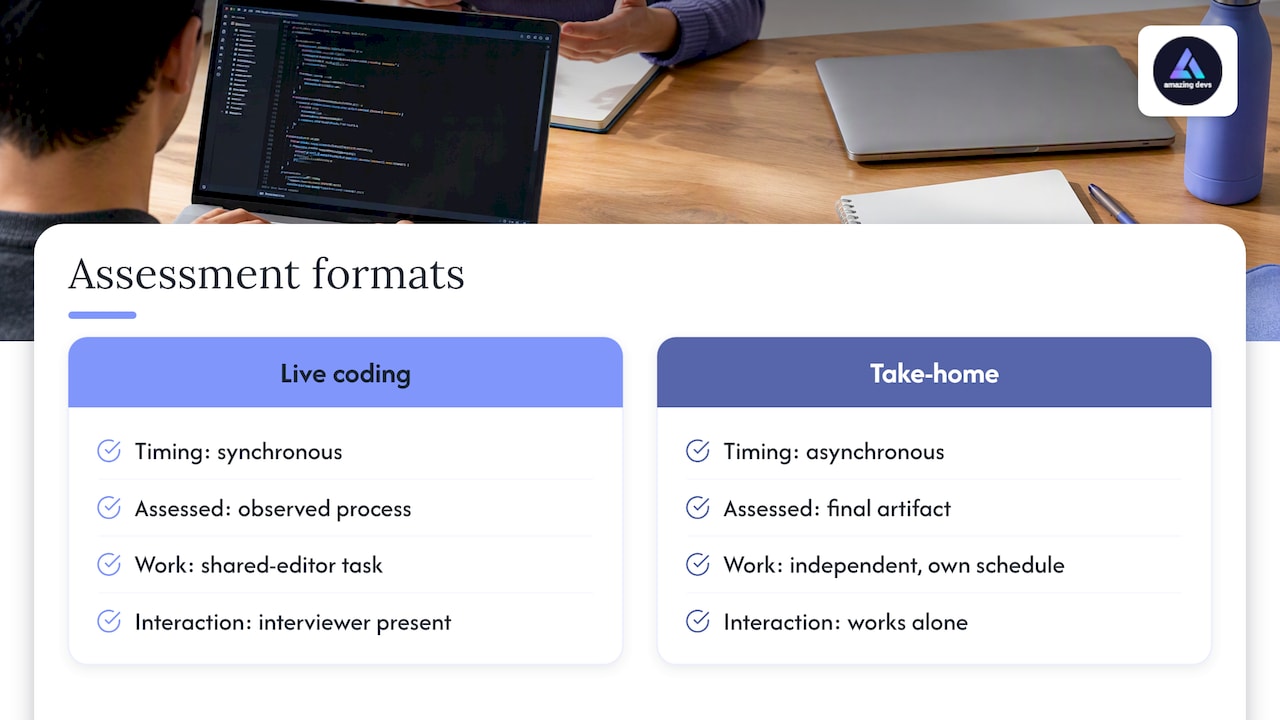
A live-coding interview is a synchronous, observed assessment. According to Canditech’s glossary, it typically runs 45 to 60 minutes, with the candidate solving a programming task in a shared editor while an interviewer watches or talks it through with them.
A take-home assignment is the opposite on both axes. The candidate works alone, on their own schedule, and you evaluate what they hand back. The same source describes it as asynchronous and judged on the final artifact, not on the process.
That difference in what you observe drives everything else. Live coding gives you a recording of the thinking. A take-home gives you the result of thinking you never saw.
How long each one takes
Time is the first practical difference. AssessDev describes live-coding tasks as time-boxed from 30 minutes up to about an hour and a half, while take-home tests can consume a few hours and, in the worst cases, up to two days of a candidate’s time.
That last number matters more than it looks. A strong senior engineer with a job and a family will not give you two evenings for a company they have not spoken to yet. Long take-homes quietly filter for people with free time, not people with skill.
What each format can tell you
| Signal | Live coding | Take-home |
|---|---|---|
| Problem-solving process | Directly observed | Inferred from the result |
| Communication | Strong signal | Weak, unless you add a debrief |
| Reaction to errors and hints | Visible | Hidden |
| Code structure, tests, documentation | Limited by time | Strong signal |
| Technology choices and trade-offs | Shallow | Deep, if you ask about them |
| Authenticity of the work | Fairly high in person, less so remotely | Hard to verify |
| Engineer time per candidate | High | Moderate (review time) |
| Candidate time | 45 to 60 minutes | Often 1 to 4 hours |
The pattern described in Canditech’s overview is consistent: live sessions quickly gauge communication, adaptability and real-time problem-solving under pressure, while take-homes measure craftsmanship and decision-making over time.
What live coding is good at
Live coding shows how someone approaches a problem, how they handle an error, how they ask questions, and how they use tools. That last point is now relevant for AI assistants: you can watch whether a candidate prompts well, reads the output critically and catches a bad suggestion.
It is also fast. In one hour you get a usable read on collaboration, which is hard to get any other way.
The weaknesses are real. It costs engineer calendar time, and the interview itself is an artificial situation. Someone who writes excellent code at their own desk can freeze with a stranger watching. That is a measurement problem, not a character flaw.
What a take-home is good at
A take-home lets a candidate show what they would produce on a normal workday: project structure, naming, tests, error handling, a README that explains their choices. These are the things you will live with after hiring.
It also removes the performance pressure that disadvantages some people. Candidates who find live observation especially stressful, including those with anxiety or other conditions, often do better in a quiet setting.
The weaknesses are the mirror image. You see the polished final product and not the path to it, you cannot easily tell who actually wrote it, and candidates are doing unpaid work. Drop-off is higher, and the people who drop off are often the ones with the most options.
Fairness, stress and accessibility
Neither format is neutral. Each one favors a type of candidate.
- Live coding favors people who are comfortable thinking aloud under observation, who have practiced the format, and who can block out an hour on a weekday.
- Take-homes favor people with spare evenings, a quiet workspace and no caregiving load. They also favor anyone willing to over-invest.
Three practical steps reduce the unfairness in both:
- Cap the time and say so. If you tell candidates the task should take 90 minutes, and design it so it genuinely does, you stop rewarding the person who spends a weekend on it. Our guide to capping technical screens at 90 minutes goes through how to size a task.
- Offer a choice where you can. A candidate who dreads live observation can be offered a scoped take-home plus a short conversation, and the reverse also works.
- Standardize the scoring. The U.S. Office of Personnel Management’s guidance on structured interviews recommends basing questions on competencies identified through job analysis, using predefined questions and proficiency benchmarks, and notes that higher structure goes with higher validity and rater reliability. That advice was written for interviews in general, and it applies cleanly to coding exercises.
If you also ask for feedback loops, you help the candidate and yourself. Even two sentences on why someone did not move forward builds your employer reputation, which matters when you are competing for scarce senior talent.
The AI problem, and why it changes the default
Take-home assignments used to be the comfortable middle ground. Generic prompts, such as building a small API or a to-do app, are now exactly what AI tools handle in minutes. A polished submission no longer proves much about the person who submitted it.
The industry response is visible in primary sources. Karat’s white paper on AI and the future of interviewing reports that some organizations have seen up to a five-fold increase in AI-based cheating detection over the last two years, and describes a shift toward live, high-touch interviews. It also argues that hiring processes must balance measuring AI-related skills against consistency and integrity.
But banning AI outright is not realistic, and it is not even desirable if the job involves it daily. Several employers now publish explicit rules:
- Wayfair’s AI guidelines ask candidates to disclose or cite the AI tools they used, permit research on take-home assignments, and say AI use during a live interview requires permission.
- Rapid7’s recruitment AI policy says responsible use of coding assistants usually means the candidate can explain how the agent was used, what the output does, where bugs might hide and how the code could improve.
- CoderPad’s AI policy stresses that human interviewers stay responsible for hiring decisions and that AI-supported content in the platform is clearly labeled.
The common thread is that the explanation is what you assess, not the typing. A candidate who can walk through generated code, point out its weak spots and improve it is showing the exact skill you need on an AI-enabled team. For more on what that skill set looks like, see our piece on AI-native development and our list of AI code assistants that work for teams.
Writing your AI rules
Put the rules in the invitation, not in the middle of the session. A workable policy covers four points:
- Which tools are allowed in which stage (for example: permitted and disclosed on the take-home, permitted only when you say so in the live round).
- What the candidate must disclose.
- What you will ask them to explain afterward.
- What happens if the rules are broken.
Then make the debrief do the verification. You do not need detection software if the candidate has to defend every decision to a senior engineer.
When to use which: a decision guide
Choose live coding when
- The role is collaborative and communication is a core part of the job.
- You are screening a high volume of candidates and need a fast, cheap-to-the-candidate filter.
- You want to observe how someone uses AI tools in real time.
- You do not have time to review take-home submissions carefully.
For a well-run version, our pair programming interview scripts give you 60 to 90 minute formats, and the comparison of remote pair programming tools helps you choose an environment that works.
Choose a take-home when
- The role depends on code quality, architecture and testing discipline.
- Your candidates are senior and you want to respect their time with a single, well-scoped task instead of multiple rounds.
- You can commit to reviewing submissions within a day or two and giving feedback.
- The task is specific to your product, not a generic puzzle an assistant can solve.
Choose the hybrid when
This is the default we would pick for most teams. Canditech notes that many teams now use a scoped take-home followed by a live walkthrough: the take-home assesses craftsmanship and depth, and the live session checks communication and verifies reasoning behind AI-assisted work.
Here is a version that stays humane:
- Recruiter screen (20 to 30 minutes). Confirm role fit, location, time zone and compensation range.
- Scoped take-home (90 minutes or less). A small slice of your real domain, with a stated time budget and clear AI rules.
- Live walkthrough (45 to 60 minutes). The candidate shares their screen, explains their choices, and then extends the code with you in a small change you specify on the spot.
- System design or architecture conversation (about an hour) for senior roles. Our guide to running system design interviews in one hour covers the format.
- Reference and background checks at the offer stage, with a consistent set of developer background screens.
The live extension in step 3 is the important part. If the candidate wrote the code, adding a small requirement takes minutes. If they did not, it becomes obvious very quickly, and you never had to accuse anyone.
Designing a task that predicts job performance
Whichever format you pick, the task decides most of the quality.
Make it job-relevant. Ask for something a person in this role would actually do in the first month: fix a bug in a small codebase, add an endpoint, review a pull request, refactor a messy function. Puzzle problems measure puzzle practice.
Score against a rubric. Define four or five criteria before the first candidate: correctness, readability, testing, handling of edge cases, and quality of explanation. Give each a simple 1 to 4 scale with a sentence describing each level. Two reviewers score independently, then compare.
Keep the scope honest. Run the task yourself first. If your own senior engineer needs two hours, a candidate will need three.
Pay for long tasks. If you truly need more than a couple of hours, compensate the candidate. It signals respect and keeps your pipeline diverse.
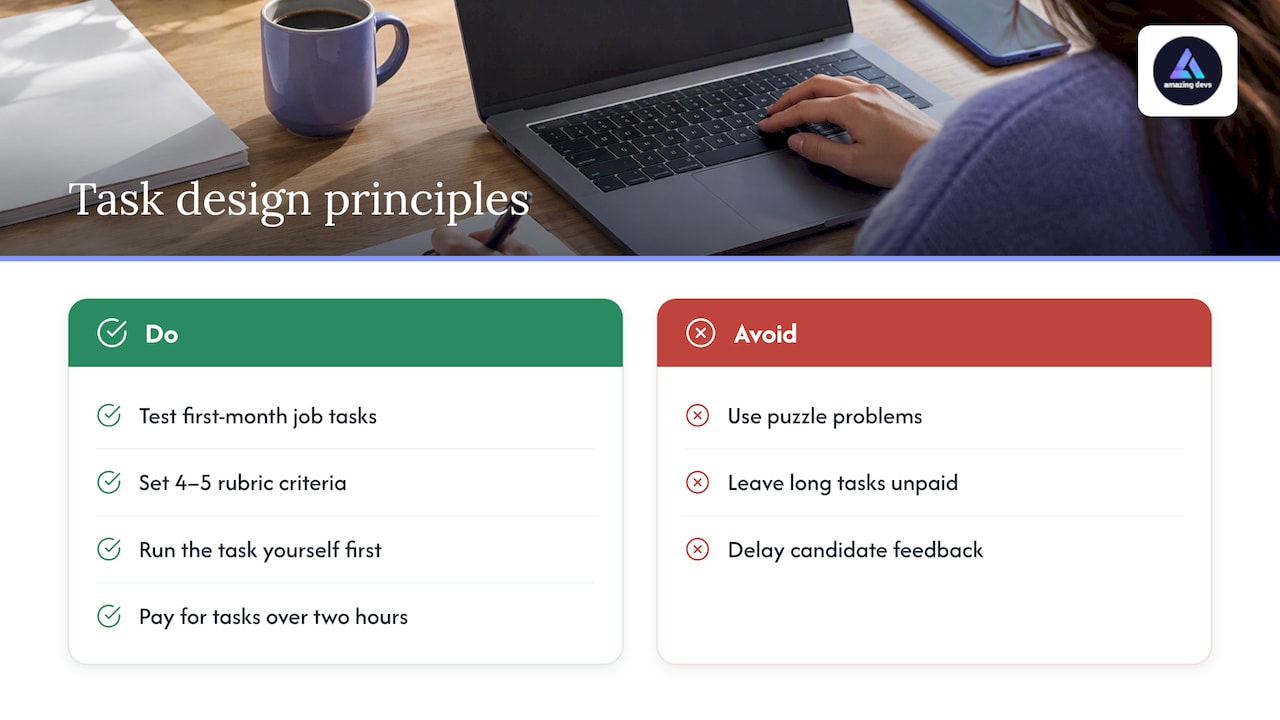
Close the loop. Reply quickly and share feedback. Candidates talk to each other, and slow, silent processes cost you offers.
Common mistakes
- Using the same generic prompt for every role and year.
- Letting interviewers improvise their own questions, which makes comparison meaningless.
- Running live coding on a whiteboard-style puzzle that nobody in the role will ever face.
- Sending a take-home with no time limit and no stated review timeline.
- Treating a missing polish in a live session the same as missing skill. Time-boxed code is rarely clean.
- Adding rounds instead of improving a round. Three weak signals do not make one strong one.
Our perspective
We place nearshore Brazilian developers with US companies, so we see both sides of this debate every week: hiring managers who want a reliable signal, and engineers who are tired of unpaid homework. Our view is that the format matters less than whether it matches the job and respects the candidate’s time.
We lean toward short, structured, job-relevant assessments, with a conversation about the work, because technical skill is only half of what makes a placement succeed. The other half is cultural fit and business alignment, and no coding test measures that. A live discussion about trade-offs, how someone handles disagreement and how they communicate across time zones tells you things a repository never will.
We also think AI fluency belongs inside the assessment, not outside it. A developer who can use an assistant, explain its output and catch its errors is more valuable than one who avoids the tools or one who pastes without reading. So we would rather see you test that explicitly than pretend the tools are not there.
— Gabriel
If you would rather not run the process yourself
Building a fair, consistent assessment loop takes engineering time that many startups and scaling teams do not have. At Amazing Devs, we handle sourcing, technical and cultural fit assessment, and contract management for Brazilian developers, so you meet candidates who are already pre-vetted. If you want to add capacity without redesigning your hiring process, look at our nearshore staff augmentation service, or read how the Team Extension Model works for teams that want developers embedded in their workflow.
FAQ
Is live coding or a take-home better for senior engineers?
For senior candidates, a short take-home followed by a discussion usually works better than a puzzle-style live round. Seniors are judged on design judgment and trade-offs, which a conversation about their own code reveals well. Keep the take-home to about 90 minutes and tell them so, because senior candidates often have multiple offers and little patience for long unpaid tasks.
How long should a take-home coding assignment take?
Aim for 90 minutes or less, and test it internally first. Sources describing common formats put take-homes anywhere from a few hours to two days, which is more than most strong candidates will give. A shorter, well-scoped task with a live follow-up gives you a better signal than a long one that candidates abandon.
Can candidates use AI on a coding assessment?
That is your decision, and you should state it before the assessment starts. Some employers, such as Wayfair, allow disclosed AI use on take-homes but require permission during live interviews. Whatever you choose, ask the candidate to explain what the code does, where it could fail and how they would improve it.
How do I know a candidate did the take-home themselves?
You usually cannot know from the submission alone, so verify in conversation. Schedule a walkthrough where the candidate explains their decisions, then ask them to make a small change to their code live. A candidate who wrote it will do this comfortably, and one who did not will struggle.
Are take-home tests fair to candidates?
They can be, if they are short, relevant and paid when long. They are unfair when they are open-ended, because they favor candidates with free evenings. Live coding has its own fairness issues, particularly for candidates who find observation stressful, so offering a choice of format where possible helps.
Sources
- Live Coding Interview: What It Is and How It Works (Canditech)
- 3 common tech interview formats (AssessDev)
- Structured Interviews (U.S. Office of Personnel Management)
- AI Guidelines (Wayfair)
- Recruitment AI Policy (Rapid7)
- AI Policy (CoderPad)
- AI and the Future of Interviewing white paper (Karat)