Outsourcing Due Diligence: A Software Vendor Checklist
Outsourcing due diligence is the structured check you run on a vendor before you sign: who they are, whether they can deliver, how they protect your code and data, and what happens if the relationship ends. Do it in this order: verify the company, verify the people who will actually work for you, rate the risks, then test the contract. A nearshore partner that has already screened its developers for technical and cultural fit, and that handles contracts for you, shortens the most draining parts of this process. At Amazing Devs, that is how we approach Brazilian developers for U.S. teams.
TL;DR
- Due diligence has four layers: the company (existence, finances, insurance), the delivery (references, process, named team), the risk (security, IP, privacy, continuity) and the exit (data return, code ownership).
- Ask about the people who will be on your project, by role, seniority and location, not about the vendor’s best case study.
- Match the depth of review to the sensitivity of what the vendor touches. Source code and customer data deserve a full security review. A small QA task does not.
- For a nearshore vendor, add checks for time zone overlap, cross-border payment and employment structure, and cultural fit.
- Score every answer against evidence (documents, references, a trial), and write down the decision and who owns each open risk.
Table of Contents
- What due diligence means when you outsource software
- The four layers of a vendor check
- How to run an outsourcing risk assessment
- A simple scoring method
- Assessing technical skill and delivery record
- Extra checks for nearshore vendors
- Verifying claims before you decide
- Where our nearshore model fits
- Our perspective
- FAQ
- Sources
What due diligence means when you outsource software
When you hire an employee, you interview, check references and sign an offer. When you outsource, you are buying the same thing at a larger scale: access to people who will touch your repositories, your customers’ data and your roadmap. Due diligence is the equivalent of that hiring process, applied to a company as well as to the individuals.
Startups usually skip it because they are in a hurry. Established companies usually skip it because procurement has a generic form that never asks about code ownership. Both pay later. The American Bar Association’s cybersecurity task force puts it bluntly: “know your supplier” cannot be overstated, and it points to Target’s 2013 breach, which came through an HVAC vendor. A vendor’s weak spot becomes yours.
The good news is that the process is not mysterious. The checklists published by U.S. regulators and professional bodies agree on most of it, and you can run a proportionate version of it in two to four weeks.
The four layers of a vendor check
The FFIEC IT Examination Handbook, written for U.S. financial institutions, lists what regulators expect a buyer to confirm: the provider’s existence and corporate history, the qualifications and backgrounds of its principals, references, audited financial statements, service delivery capability, technology architecture, internal controls, security history, legal and regulatory compliance, insurance coverage, and disaster recovery ability. The AICPA & CIMA offshoring checklist, published in February 2024, groups similar items under legal compliance, financial stability, infrastructure, data security, quality assurance, workforce expertise, client references, contract terms and insurance.
You do not need a bank’s full program. Fold those lists into four layers.
Layer 1: The company
Confirm the vendor is a real, stable entity that can survive the length of your project.
- Legal existence and history. Registration, years in operation, who owns it and who runs it.
- Financial stability. Audited or at least reviewed statements for larger engagements. For a smaller vendor, ask how many clients they have and how much revenue the largest client represents.
- Insurance. Professional liability and cyber coverage, with a certificate you can read.
- Litigation history. Any disputes with clients over IP, data or payment.
- Subcontractors. Whether any work is passed to another company, and where.
Layer 2: The delivery
This is where most buyers under-ask. A sales deck shows the vendor’s best project. You need to know what the people assigned to you can do.
- Comparable work. Ask for projects similar to yours in stack, size and stage, and ask what the individuals proposed for your team personally built.
- The named team. Roles, seniority, location and allocation, plus a clause that you approve any substitution.
- Workflow. How code review, testing, release and defect handling work day to day.
- References. Speak to two or three current or recent clients, ideally one that left a bad moment behind it, and ask how the vendor behaved when something broke.
- Communication. Working-hours overlap, English level in a live conversation, and who your day-to-day contact is.
Layer 3: The risk
Cover the four risk areas in the next section.
Layer 4: The exit
Before you sign, decide how you leave. That means code and documentation handover, return and destruction of data, access revocation and a notice period. The Barclay Damon guide on technology contracts warns that a terminated provider has little incentive to protect a former customer’s data, so the contract should require return and destruction of data when the relationship ends.
How to run an outsourcing risk assessment
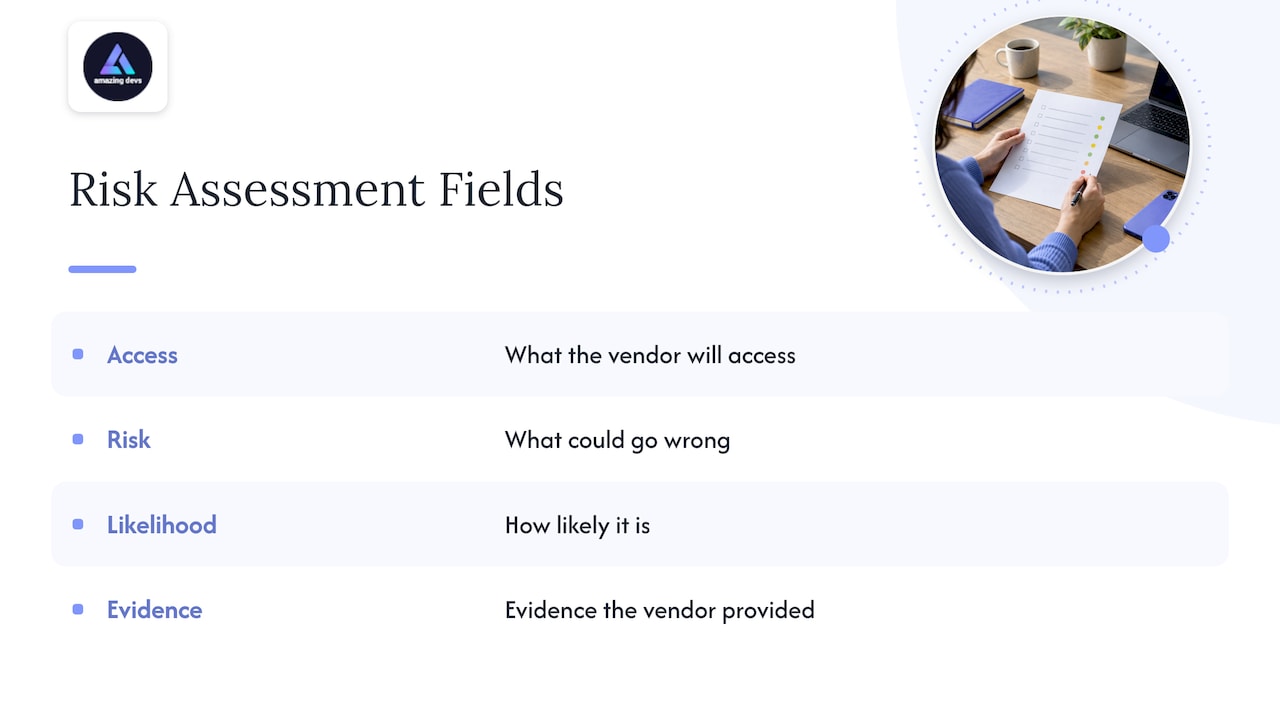
A risk assessment turns the checklist into a decision. For each area, write down what the vendor will have access to, what could go wrong, how likely it is, and what evidence the vendor gave you.
Cybersecurity and data privacy
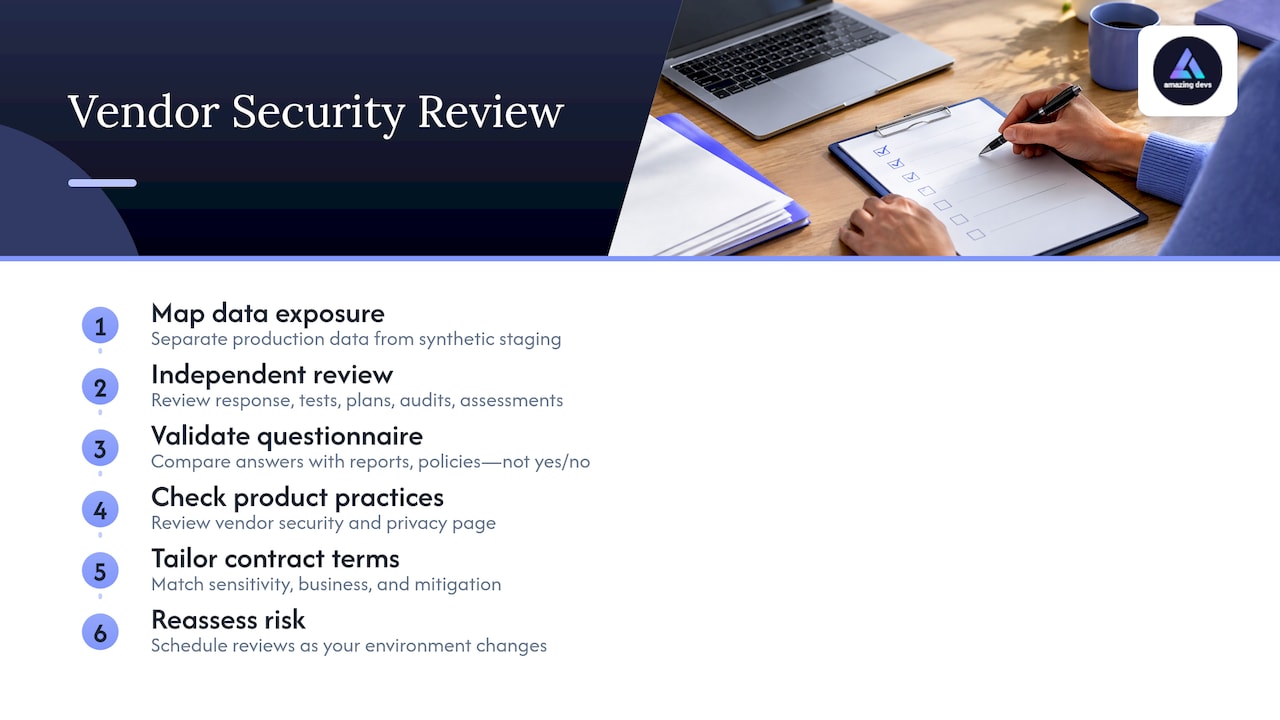
Start with what the vendor will touch. Production customer data is a different risk from a staging environment with synthetic records. The Barclay Damon guide notes that third-party providers are often the weak link in an organization’s cybersecurity and recommends independent review of the provider’s cybersecurity response program and test results, contingency plans, internal audits and security assessments.
In practice, send a security questionnaire, and read the answers against documents such as audit reports and policies rather than accepting yes/no replies. We cover how to build and score one in our guide to the vendor security questionnaire, and the three controls procurement and security teams should insist on in data security outsourcing. If your vendor will handle payment card data, the duties are different again: see our PCI compliance outsourcing checklist.
It also helps to look at how the vendor treats information it handles about you. Reviewing vendor security and privacy practices on a product’s own security page is a good habit for any tool the vendor will connect to your systems.
The ABA task force adds that contract security provisions are not one-size-fits-all: they should reflect the sensitivity of the data, the nature of your business and the mitigation available, and the risk should be reassessed as your environment changes. Put a reminder in the calendar to do it.
Intellectual property
The questions are simple, and the answers should be in writing.
- Who owns the source code, documentation, designs, test assets and build pipelines?
- Where is the code stored, and who holds the repository credentials?
- Which open-source and third-party components are used, and who approves their licenses?
- Do developers sign IP assignment agreements that pass to you?
Supply chain guidance from ATARC, published in January 2025, asks how an entity protects IP in software development and what safeguards cover source code and related assets. For contract language, see four rules for developer contracts that protect IP.
Continuity
Ask what happens if your lead developer resigns, if the vendor’s office loses power or connectivity, or if the vendor goes out of business. Look for a business continuity and disaster recovery plan, a documented knowledge-transfer practice and a way to keep access to your code and data under any scenario.
Regulatory exposure
If you operate in a regulated field such as banking or healthcare, your regulator may expect specific controls over third parties, which is why the FFIEC list is useful even for non-banks. Ask your counsel which U.S. federal or state privacy laws apply to the data your vendor will see, and ask the vendor to name the laws it works under.
A simple scoring method
A spreadsheet is enough. List 15 to 25 criteria, weight them by how much they matter for this engagement, and score each from 0 to 3 based on evidence.
| Score | Meaning |
|---|---|
| 0 | No answer, or an answer with no evidence |
| 1 | Verbal answer only |
| 2 | Written policy or reference confirms it |
| 3 | Independent evidence confirms it (audit report, certificate, tested control) |
Then set two rules in advance. Any 0 on a critical item (code ownership, data protection, insurance) stops the process until it is fixed. A total below your threshold means you do not move forward. This turns a gut feeling into something you can defend to a CFO, a board or an auditor later.
Assessing technical skill and delivery record
This is the part that is hardest to verify from documents. Three techniques work.
- Test the individuals, not the brand. Interview the specific developers proposed for your team. Use a consistent set of questions, scenario-based rather than trivia, and score them the same way for every candidate. A structured approach such as defensible interview question design keeps the comparison fair.
- Run a short paid trial. A two-to-four-week scoped task shows code quality, communication and responsiveness better than any slide deck.
- Check the process, not only the outcome. Ask to see a sample pull request, a test report and a release checklist, with client data removed.
For AI-enabled or AI-native engineers, add a question about how they use coding assistants: which tools, what code gets reviewed by a human, and how they keep proprietary code out of tools that your policy does not allow.
Extra checks for nearshore vendors
The FFIEC notes that for a foreign-based provider you assess the standard due diligence items plus its Appendix C on foreign-based third-party providers, and that you should probe intangibles such as service philosophy, quality initiatives and management style to ensure cultural fit. Nearshore adds a short list of its own.
- Time zone overlap. Brazil sits close to U.S. working hours, which makes daily stand-ups and live code review realistic. Confirm the overlap in hours for your own team’s location, and see our timezone management strategies.
- Employment and payment structure. Find out whether developers are employees or independent contractors of the vendor, and how you pay. Our guides on how to pay foreign contractors and international contractor payments walk through U.S. compliance.
- Cultural fit. Look at how the vendor handles disagreement, estimates and bad news. Fit is not a soft extra, it determines whether problems surface early.
- Background screening. Ask what is checked, at which access level and under which local rules. Our overview of background checks for developer hires lists four screens by access tier.
- Nearshore versus offshore. If you are still choosing a location, our nearshore vs offshore guide compares them on the criteria buyers care about.
Verifying claims before you decide
Every claim in a proposal should map to one of three kinds of proof: a document, a person you can speak to, or something you observe. Make a short table of the vendor’s ten most important claims and next to each write which proof you obtained.
Then make the decision explicit. The Barclay Damon guide recommends a business review that checks whether the business benefits outweigh the legal risks, particularly when a provider will not change one-sided terms. If the answer is yes, record which risks you accepted and who owns them. If you are still comparing models, our pages on in-house versus vendor development and outsourcing versus staff augmentation help set the frame.
Where our nearshore model fits
Much of the work above is work you would rather not repeat for each hire. Amazing Devs provides pre-vetted Brazilian developers through a recruitment and assessment process that covers technical skills and cultural and business fit, and we manage the contracts and bureaucratic steps so your team does not have to. You still run your own review of us, and you should, but the individual-level screening is already done when profiles reach you.
If you want to extend your team with dedicated developers, start with nearshore staff augmentation, or see the Team Extension Model for a longer-running setup. QA needs are covered by our nearshore QA contractors.
Tell us the roles, stack and security constraints you are working with, and we will show you the profiles that fit them from Amazing Devs.
Our perspective
Buyers often treat due diligence as a hurdle between them and a signed contract. We see it as the first month of the relationship. The questions you ask a vendor show how that vendor answers questions, and the way a team responds to a hard security questionnaire is a good preview of how it will respond to a production incident.
That is why we put the weight of our work on the people. A rigorous recruitment and assessment process, covering technical ability as well as cultural fit and business alignment, means a client is evaluating developers who have already been screened with their needs in mind. Handling contracts and the bureaucracy on the client’s behalf frees engineering leaders to spend their diligence time on what only they can judge: architecture, code quality and how a developer fits their team.
Our advice is to be specific. Name the access level each role needs, name the data it will touch, and ask for evidence at that level. Proportionate diligence beats a 200-line form nobody reads.
Gabriel
FAQ
What should a vendor due diligence checklist include?
Cover the company (registration, finances, insurance, litigation), the delivery (comparable work, named team, workflow, references), the risks (security, privacy, IP, continuity) and the exit terms. The FFIEC and AICPA & CIMA lists linked above are good models to adapt.
How long does outsourcing due diligence take?
For a small engagement with limited data access, a focused review can take a couple of weeks. A vendor that will touch production data or core IP needs more time for security evidence, references and contract negotiation. Set the depth by the sensitivity of the access.
Who should own the process?
An engineering lead owns the delivery and technical questions, security or IT owns the risk review, and legal or procurement owns the contract. In a startup one person may cover all three, so write the checklist down to make sure none of the layers is skipped.
Is nearshore due diligence different from domestic?
The core is the same. You add checks for time zone overlap, cross-border payment and employment structure, local legal requirements, and cultural fit, as the FFIEC guidance on foreign-based providers suggests.
Should I review the vendor again after signing?
Yes. Reassess risk when your systems, data or the vendor’s team change, and review security evidence on a regular schedule.
Sources
- FFIEC IT Examination Handbook: Due Diligence
- AICPA & CIMA: Offshoring Vendor Due Diligence Checklist
- Barclay Damon: Technology Contract Traps and Tactics
- ABA Cybersecurity Legal Task Force: Vendor Contracting Cybersecurity Checklist
- ATARC: Supply Chain Risk Assessment Considerations