Build vs Buy Engineering: How to Staff Your Team
Build vs buy in engineering comes down to one question: is this capability something your company must own for years, or something you need delivered well and soon? Build in-house for work that defines your product and needs lasting institutional knowledge. Buy outside capacity, such as nearshore staff augmentation, when you need proven skills quickly, for work that is bounded or still moving. Most growing companies end up doing both.
This guide shows how to draw that line, what each path really costs, and how to run a hybrid team without losing control.
TL;DR
- Build in-house when the work is strategic, recurring and depends on knowledge that must stay in your company. Buy or borrow capacity when the need is bounded, urgent or specialized.
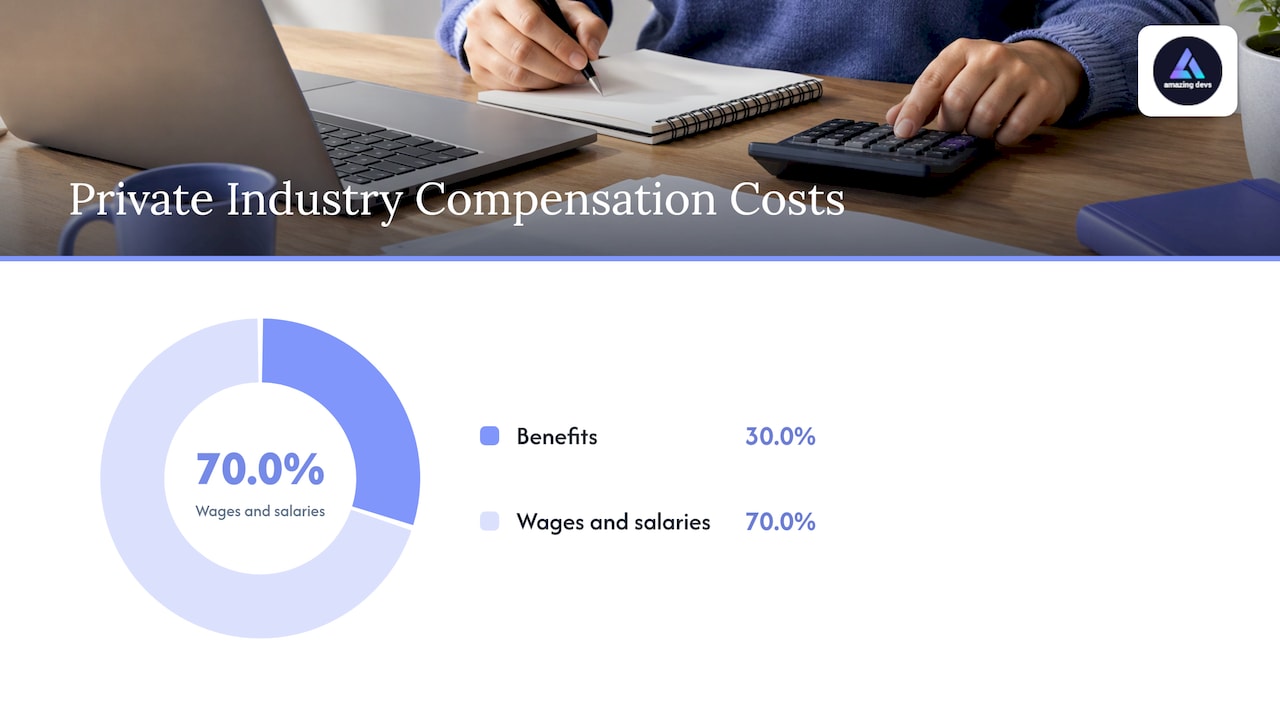
- Compare total cost, not salary against rate. In US private industry, benefits alone make up about 30% of employer compensation costs, before recruiting and management time.
- Speed, control, flexibility and retention risk matter as much as price. Score each one for the specific role.
- A hybrid model, with your core team in-house and dedicated nearshore engineers working inside it, fits most startups and scaling companies.
- Decide per capability, not per company. Revisit the decision every six to twelve months.
Table of Contents
- What build vs buy means for engineering capacity
- The five criteria that decide it
- Comparing the true cost of building and buying
- Speed, control, flexibility and delivery risk
- When a hybrid model makes the most sense
- Getting AI-enabled engineering skills
- A simple process to make the call
- Working with Amazing Devs
- FAQ
- Sources
What build vs buy means for engineering capacity
The classic framing is about software: do you write a system yourself or license one? One widely cited build versus buy framework weighs the cost to build, the cost to maintain, and the cost to buy, alongside your core expertise, how critical the system is to the business, and how mature the products on the market are.
When the question is about people rather than products, the same logic applies with different labels:
- Build means recruiting, employing and growing your own engineers.
- Buy means engaging outside engineers or a vendor to deliver capacity or a defined outcome.
- Borrow sits in between: external developers who work as part of your team, on your tools and your roadmap, under your direction.
That third option is why the debate is no longer binary. APQC’s guidance puts it plainly: build when a capability is strategically important, recurring and needs enduring organizational knowledge or control. Buy when an established external solution meets your governed requirements. Borrow specialized expertise for bounded needs, while keeping accountability for the process inside the organization.
For an engineering leader, that translates into a practical test. Ask of each piece of work: will we still need this skill in three years, and does it carry knowledge nobody outside should hold? If yes to both, lean toward building. If the answer is no or not sure, lean toward outside capacity.
The five criteria that decide it
Any honest framework for sourcing engineers ends up weighing the same handful of factors. Use them as a scorecard for each role or workstream.
1. How central is the capability to your product?
Your core algorithm, your data model, your differentiating features: these deserve in-house owners. Integrations, internal tooling, QA, mobile ports, migrations and maintenance of mature modules are common candidates for outside capacity. They matter, but they rarely define why customers choose you.
2. How fast do you need it?
An in-house hire involves sourcing, several interview rounds, offer negotiation, notice periods and onboarding. Even a well-run process often takes a quarter before the new engineer ships meaningful work. If your roadmap cannot wait, a pre-vetted external engineer is the faster route. Our own playbook on scaling an engineering team fast goes through how to do that without breaking team habits.
3. What does it really cost?
Covered in the next section, because it is where most comparisons go wrong.
4. How much retention risk can you absorb?
Every engineer who leaves takes context with them. In-house retention is your responsibility, including compensation, career paths and counteroffers. With a staffing partner, part of that burden, such as replacement sourcing and contract administration, shifts to the partner. Ask any provider how it handles a departure mid-project.
5. How sensitive is the intellectual property?
If a component is the crown jewel, keep design authority in-house, even when external engineers contribute code under your repositories, access controls and review standards. Contracts should assign IP to you clearly.
If you want a structured way to document these trade-offs for stakeholders, strategic build planning tools can help you map options against your priorities before you commit budget.
Comparing the true cost of building and buying
The mistake is comparing a salary to an hourly rate. A salary is not the cost of an employee.
The Bureau of Labor Statistics reported that in June 2026, benefits accounted for 30.0% of employer compensation costs for private industry workers, with wages and salaries making up the other 70.0%. For full-time private industry workers the benefit share was 31.5%. That is a broad all-occupation average, so use it as a floor for thinking, not a precise figure for software engineers. On top of it sit costs the BLS figure does not capture:
- Recruiting: job ads, recruiter fees or internal recruiter time, interviewer hours.
- Equipment, software licenses and workspace.
- Management and onboarding time, which is real engineering capacity diverted from delivery.
- The vacancy period: the weeks or months a seat sits empty while the roadmap slips.
- Replacement cost when someone leaves.
Outside capacity has its own cost lines. Rates are usually higher per hour than an employee’s loaded cost, but you pay only for contracted time, and recruiting, payroll administration and contract handling are bundled. The honest comparison is cost per delivered outcome, over the period you actually need the work done. For a project of nine months, the build path’s fixed costs are spread over fewer months. For a five-year capability, they spread out nicely.
Two of our pages go deeper here. Our guide to Brazil developer rates explains what US teams pay for Brazilian engineers, and our piece on reducing engineering costs shows how to prioritize where spend goes. If you are weighing a vendor, read about hidden costs in outsourcing first so your budget includes management time, rework and handoffs.
It also helps to budget every option in layers rather than as a single build number. This view of three cost layers applies to people just as it does to internal tools: the initial effort, the ongoing running cost, and the cost of change.
Speed, control, flexibility and delivery risk
Cost is one axis. These are the others, side by side.
| Factor | Build in-house | Buy (project outsourcing) | Borrow (nearshore staff augmentation) |
|---|---|---|---|
| Speed to first contribution | Slowest: full hiring cycle plus onboarding | Fast to kick off, but scoping takes time | Fast: candidates arrive pre-assessed |
| Control over daily work | Full | Limited: you manage through specs and milestones | High: engineers join your standups and tools |
| Flexibility to scale up or down | Low: hiring and layoffs are slow and costly | Moderate: tied to contract scope | High: adjust team size as the roadmap changes |
| Knowledge retention | Strongest, if you keep people | Often sits with the vendor | Stays with your team if you document and pair |
| Main delivery risk | Vacancies and attrition | Misaligned scope, hand-off gaps | Weak integration if onboarding is skipped |
The table points to something many leaders miss: staff augmentation and project outsourcing are different purchases. Outsourcing hands over an outcome and much of the management. Augmentation adds people to your team while you keep direction. If control matters to you, our comparison of outsourcing vs staff augmentation will help you pick, and our article on in-house vs vendor development covers the broader choice.
When a hybrid model makes the most sense
Pure build and pure buy are both rare in practice. A hybrid is usually right in these situations:
- You are scaling faster than you can hire. Keep architecture and product ownership with in-house leads, and add external engineers to widen delivery throughput.
- You need a skill your team lacks, for a limited period. A data migration, a mobile app, a test automation build-out: borrow it, and require knowledge transfer before the engagement ends.
- Your workload is uneven. Hold a stable core and flex around it for launches, audits or seasonal peaks.
- You want to test a new product line. Staff it externally first. If it proves strategic, convert the capability to in-house later.
- QA is the bottleneck. Dedicated testers extend your release cadence without touching core design decisions.
A workable pattern: your own staff hold product management, architecture, security decisions and code review authority. External engineers handle implementation in defined areas, work in your repository and ticketing system, and attend your ceremonies. Nothing about their daily work should be a black box.
The model fails when external engineers are treated as a separate shop. Give them the same onboarding documents, the same access to context and the same standards as employees. Share timezone overlap on purpose. Brazil’s working day overlaps heavily with US hours, which is why many US teams look to it first, and our piece on timezone management strategies covers how to keep coordination delays low.
Getting AI-enabled engineering skills
Many leaders now frame build vs buy around AI skills: engineers who use AI-assisted development effectively, or who build AI features. The same five criteria apply.
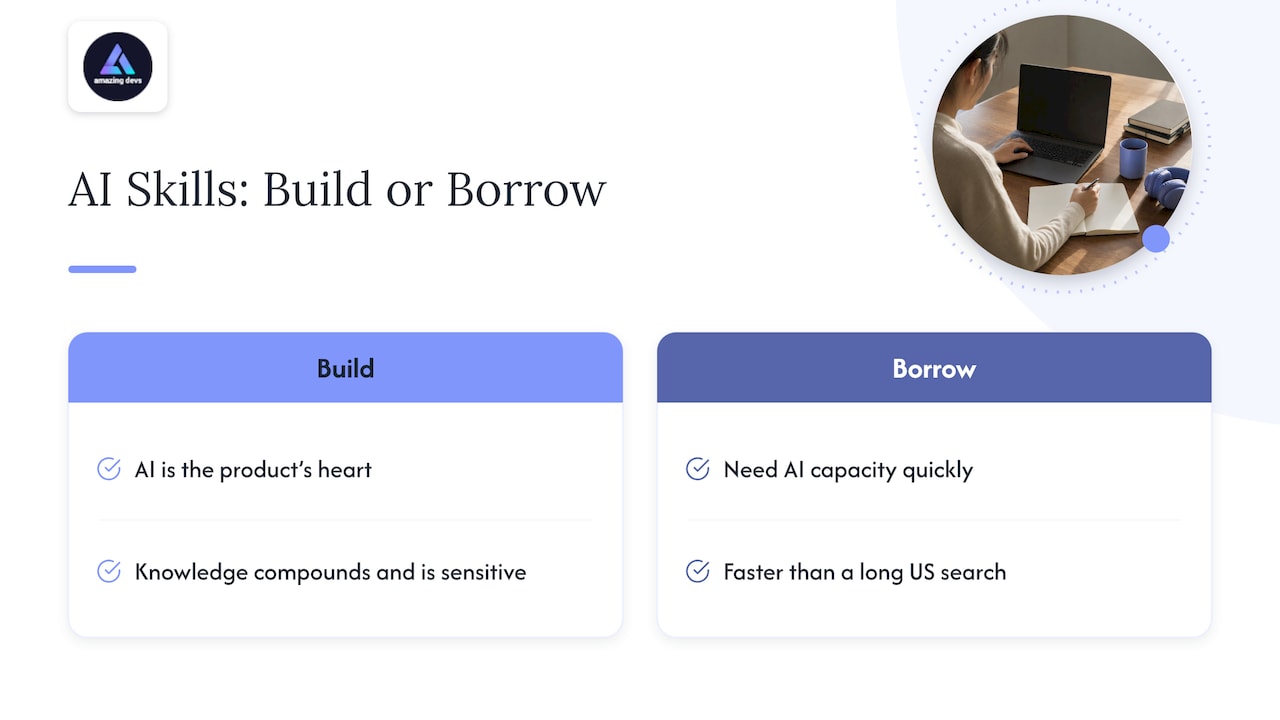
If AI is the heart of your product, build core expertise in-house, because the knowledge compounds and is sensitive. If you need to add AI-enabled capacity quickly, such as engineers fluent in AI coding tools or teams to integrate existing models into your product, borrowing is faster than a long search in a competitive US hiring market.
When you assess candidates, whether employees or contractors, test the work rather than the buzzwords: how they review generated code, how they handle testing and security, and how they explain trade-offs. Our guides on building an AI team with a US nearshore playbook and sourcing engineers with skills-based hiring and responsible AI lay out the process.
Our perspective
We place Brazilian engineers with US companies every week, and the pattern we see is consistent: the companies that do best stop treating build vs buy as a one-time verdict. They ask, for each workstream, what must be owned and what must simply be delivered.
We designed our process around the borrow option. We source, assess for technical skill and cultural fit, and handle the contracts and bureaucracy, so your engineering managers spend their time on the product rather than on paperwork. The engineers we place are dedicated to your team, not shared across clients, and they work in your tools and your rituals.
Our view is that the strongest teams keep ownership of architecture and product direction in-house, then use nearshore engineers to add speed and range around that core. That gives you control where it matters and capacity where you need it, without a hiring cycle that takes a quarter.
Gabriel
A simple process to make the call
Use these steps in a working session with your product and finance leads.
- List the workstreams. Break the roadmap into capabilities: core product, integrations, QA, internal tools, data, infrastructure.
- Score each on the five criteria. Use a one to five scale for criticality, speed need, cost sensitivity, retention risk and IP sensitivity.
- Model total cost over the real horizon. Include recruiting, benefits, equipment, management time and vacancy. For external options include management overhead too.
- Assign a default. Highest scores on criticality and IP lean build. High speed need and bounded scope lean borrow or buy.
- Define the control model. Who sets priorities, who reviews code, who owns documentation, and what happens at exit.
- Set a review date. Revisit in six to twelve months. A capability you borrowed may now deserve to be built, and the reverse.
One caution from the research: sourcing decisions are easy to regret when made by default. Treat the scorecard as a record of why you chose, so the next leader can see the reasoning.
Working with Amazing Devs
If your scorecard points toward borrowing capacity, we can help. Amazing Devs provides nearshore IT staff augmentation with Brazilian developers: end-to-end sourcing, technical and cultural fit assessment, and contract management, for startups and established companies alike. We support both AI-enabled and traditional software engineering roles.
Our nearshore staff augmentation service adds engineers to your team directly. If you want a longer-term structure, the Team Extension Model builds a dedicated group around your product, and our nearshore QA contractors cover testing. To see how these fit your situation, talk to us at Amazing Devs.
FAQ
Is it cheaper to hire in-house or use external developers?
It depends on the horizon and the full cost. In-house employees carry benefits, recruiting, equipment and management costs, and US private industry benefits alone average 30% of employer compensation costs per the BLS. External capacity costs more per hour but bundles recruiting and administration and flexes with demand. Compare cost per delivered outcome over the period you need the work.
Should a startup build its engineering team before using outside help?
Not necessarily. A common approach is to hire a small in-house core that owns architecture and product decisions, then add outside engineers for extra throughput. That keeps knowledge where it matters while letting you move at the speed your funding and roadmap demand.
What is the difference between staff augmentation and outsourcing?
Staff augmentation adds engineers to your team, working under your direction and in your tools. Outsourcing hands a defined project or outcome to a vendor who manages delivery. Augmentation gives you more control. Outsourcing takes more management off your plate.
When does a hybrid model make sense?
When you need to scale faster than you can hire, fill a skill gap for a limited period, or handle uneven workloads. Keep strategic ownership in-house and use external engineers for implementation in clearly defined areas.
How do I keep control over code quality with external engineers?
Put them inside your own repository, review process and standards. Keep code review authority and architectural decisions with your in-house leads, and require documentation as part of the work.
Sources
- A Comprehensive Guide To The ‘Build Versus Buy’ Decision Framework (Forbes Tech Council)
- How Should Organizations Decide Whether to Build, Buy, Borrow or Automate a Capability (APQC)
- Employer Costs for Employee Compensation, June 2026 (U.S. Bureau of Labor Statistics)