Staff Augmentation Pricing: What You Pay in 2026

Staff augmentation is almost always billed by the hour, and the rate you see is a bill rate: the developer’s pay plus the provider’s markup, taxes, benefits and overhead. For US software developers, the government’s own contract ceiling rates give a useful benchmark. The median GSA CALC+ ceiling rate for software developers was $128.58 an hour as of October 2026. Nearshore and offshore rates sit below that, and the gap is the main reason teams look abroad. What matters is what that hourly figure includes, what it leaves out, and how long you need the person.
This guide explains the pricing models, what drives the rate up or down, how to compare augmentation with a full-time hire, and which contract terms to check before you sign.
TL;DR
- Staff augmentation is usually billed hourly (time and materials), sometimes as a monthly retainer or a placement fee. Ask which one you are being quoted.
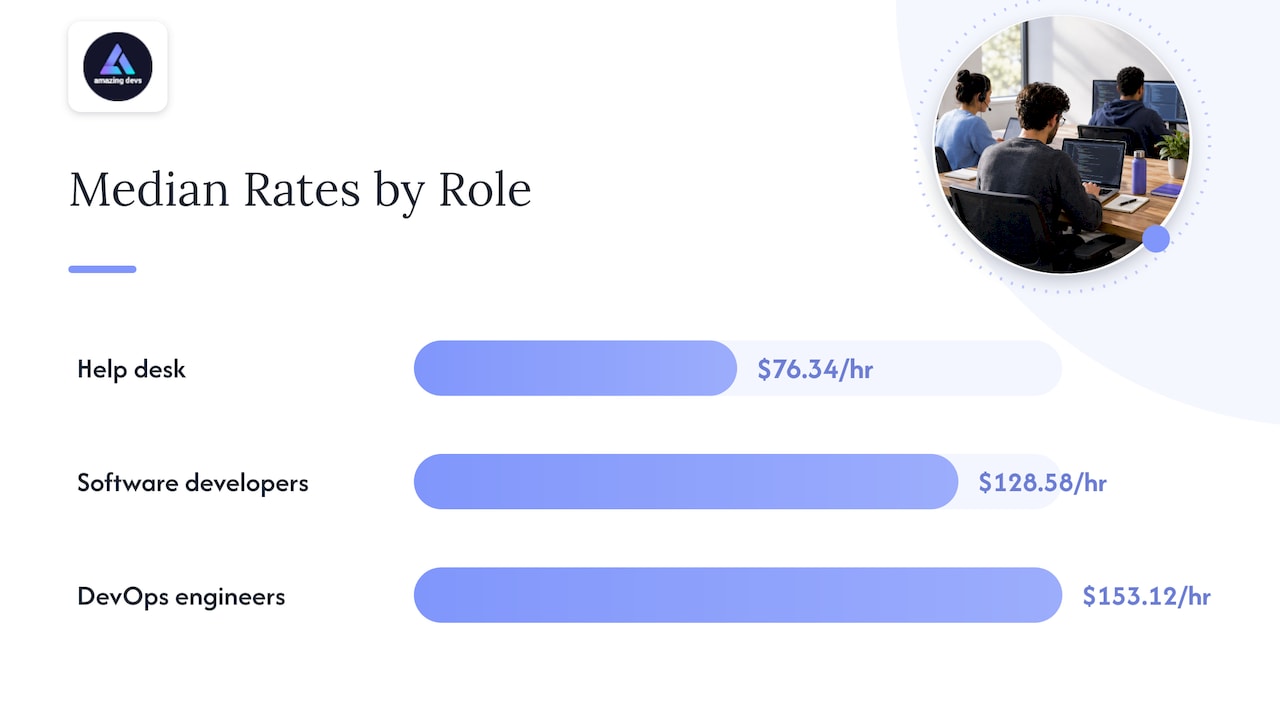
- US government ceiling rates put the median software developer at $128.58 an hour and DevOps engineers at $153.12, as of October 2026.
- Compare total cost, not the hourly figure. Benefits alone add roughly 48% on top of wages for professional roles in the US.
- Short or uncertain needs favor augmentation. Needs that run for years can favor hiring directly.
- Before signing, check conversion fees, minimum terms, notice periods and who handles payroll and contracts.
Table of Contents
- How staff augmentation is priced
- What the bill rate contains
- What moves the rate
- Comparing augmentation with a full-time hire
- Costs people forget to put in the budget
- What to check in the contract
- Our perspective
- How Amazing Devs prices and delivers
- Choosing a model that fits your plan
- FAQ
- Sources
How staff augmentation is priced
There are three models you will meet in quotes. Each moves risk differently.
| Model | How you pay | Best for | Watch for |
|---|---|---|---|
| Hourly (time and materials) | A bill rate per hour worked | Changing scope, ramp-up, short engagements | Monthly totals that drift if hours are not tracked |
| Monthly retainer or fixed monthly rate | One flat amount per developer per month | Stable, full-time, long-running roles | What happens in months with holidays or leave |
| Placement or conversion fee | A one-time fee when someone is hired permanently | Direct hire, or converting a contractor | The fee percentage and any time window attached |
Hourly billing is the default in the market. A direct-placement recruiter, by contrast, is paid once, when a candidate accepts an offer. That difference is why the two are not comparable line by line. Hourly augmentation spreads the cost across the months the person works for you. A placement fee is paid up front and then you carry payroll yourself.
Industry groups also describe pricing structures you should know about in the contract itself. The American Staffing Association notes that agreements may include negotiated conversion fees when a client hires a staffing firm’s employee permanently. If you think you might want to keep a contractor, ask about this on day one.
If you are used to executive search or retained recruiting, pricing there follows its own logic. A breakdown of common pricing models in technology staffing and search shows how fee structures differ between retained, contingent and hourly arrangements, which helps when you are comparing a placement quote with an hourly bill rate.
What the bill rate contains
A provider’s hourly rate is not what the developer takes home. It typically has to cover:
- the developer’s compensation, including local benefits and statutory costs
- recruiting, screening and replacement guarantees
- payroll, contracts, compliance and local administration
- equipment, software and workspace, where the provider supplies them
- account management and the provider’s margin
This is why a markup is not a pure profit figure. When you read a quote, ask which of these are inside the rate and which you pay separately. Two quotes at the same hourly number can differ by thousands of dollars a year once tools, onboarding or replacement terms are counted.
The question you will see everywhere, how much markup staffing agencies charge, has no single honest answer. It varies with the role, the country, the contract length and the services bundled. Be wary of any article that hands you one universal percentage. Ask each provider to show you the developer’s pay, or at least the structure of the rate, so you can judge what you are buying.
What moves the rate
Four factors explain most of the price differences between quotes.
Role and stack
The government benchmark shows how much role matters. As of October 2026, the median GSA CALC+ ceiling rates were $76.34 an hour for help desk, $128.58 for software developers and $153.12 for DevOps engineers. Scarce skills, such as cloud infrastructure, machine learning and security, cost more than general web development.
Seniority
A senior engineer who needs little direction costs more per hour than a mid-level developer, but can cost less per shipped feature. Think in terms of output and management time, not rate alone. A junior hire who needs a senior’s attention for ten hours a week is not a cheap hire.
Location
Location drives the biggest swing. A US-based contractor carries US cost levels. A nearshore developer in Latin America works in a similar time zone at a lower cost base, and an offshore team in a distant time zone can be cheaper still but adds coordination cost. If you want detail on one market, we publish what US teams pay for Brazilian developers and a wider view of nearshore developer rates across LATAM. Time zone overlap has a price of its own, which we cover in how to manage time zones.
Engagement length and volume
Longer commitments and several developers at once usually earn a better rate, because the provider spends less on sales and replacement. Very short engagements often carry a premium. If your plan is uncertain, a flexible month-to-month arrangement may be worth a slightly higher rate in exchange for being able to scale down.
Comparing augmentation with a full-time hire
The fair comparison is total cost of employment against total cost of augmentation. Start with what a salary hides.
The employer cost on top of salary
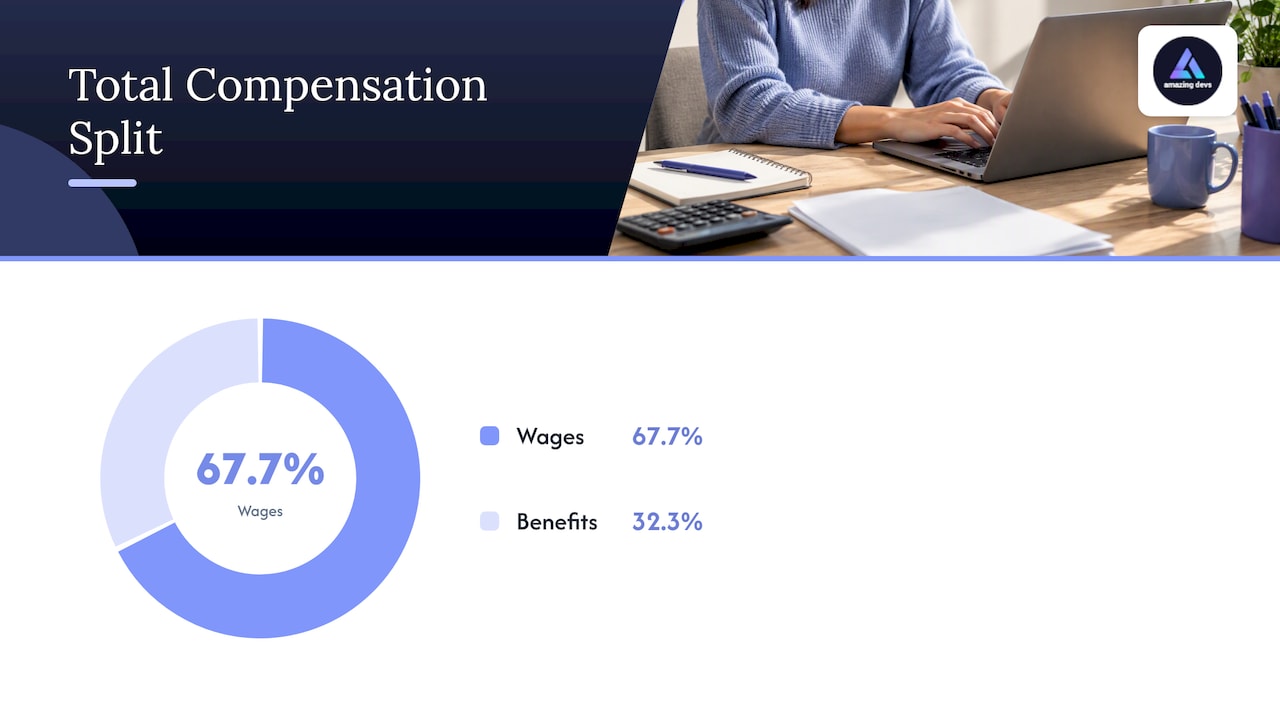
The Bureau of Labor Statistics reports that, as of June 2026, total compensation for professional and related occupations is about 67.7% wages and 32.3% benefits. Benefits are therefore roughly 48% of wages (32.3 divided by 67.7). A developer paid $150,000 in wages costs you well beyond that figure once benefits are counted. That is arithmetic from the BLS shares, not a quote, and your own plan will differ.
Payroll tax comes on top of benefits. For 2026, the employer share is 6.2% Social Security on wages up to $184,500 and 1.45% Medicare with no wage cap. Add recruiting, onboarding, equipment and the time your managers spend interviewing.
On recruiting specifically, our own analysis of what it costs to recruit developers and of how long hiring takes shows why the up-front cost of a direct hire is easy to underestimate.
The break-even question
Augmentation carries a premium per hour, and hiring carries up-front costs. Analysis of GSA rates finds that with a 20% recruiter fee, hiring repays the augmentation premium in 2.7 months for a median systems administrator and 5.0 months for a software developer. The same analysis frames the practical conclusion: shorter or uncertain needs favor augmentation, while hiring costs less once the need outlasts the time required to repay hiring costs.
That comparison uses US-based contractor rates. A nearshore engagement starts from a lower hourly figure, so the premium you are repaying is smaller, and the case for augmenting for longer stretches gets stronger. Run the math with your own numbers:
- Take the quoted hourly rate and multiply by the hours you expect per month (a full-time month is roughly 160 to 173 hours).
- Add anything billed separately: equipment, software licenses, onboarding, management time.
- For the hire, take wages, add the benefits share and employer payroll taxes, then add the recruiter fee or internal hiring time.
- Spread the hire’s one-time costs across the months you expect to keep the role.
- Compare the monthly totals at 6, 12 and 24 months.
If you want a view on the structural trade-offs beyond price, see our piece on in-house versus vendor development and our pros and cons of staff augmentation.
Costs people forget to put in the budget
The hourly rate is the visible line. These are the ones that surprise teams:
- Ramp-up time. Every new developer needs weeks to reach full speed. Budget for it whichever route you take.
- Management time. Someone on your side reviews code, assigns work and unblocks people.
- Tooling and access. Licenses, cloud accounts and security tooling.
- Replacement and notice terms. What happens if the fit is wrong, and how many weeks of notice you owe.
- Taxes on services. The American Staffing Association argues that sales taxes on temporary and contract services raise staffing costs and can pile up when services are taxed at several stages. Ask your provider whether any tax applies in your state.
- Coordination overhead. Our guide to the hidden costs of outsourcing covers where budgets leak when the arrangement is loosely managed.
What to check in the contract
Before you sign, ask for these in writing:
- Billing basis: hourly, monthly or fixed, and how overtime and holidays are treated.
- Minimum term and notice period: how long you are committed and how quickly you can scale down.
- Conversion terms: whether you can hire the developer directly, and what that costs.
- Replacement guarantee: what the provider does if a developer leaves or is a poor fit.
- Who is the employer: the provider should handle payroll, contracts and local compliance, and the agreement should say so.
- IP and confidentiality: assignment of work product to your company.
- Inclusions: equipment, software, management, QA, and anything else you assumed was covered.
Where several vendors offer similar services, ask each to quote the same role, same hours and same term. Differences in what is included then become obvious.
Our perspective
We see the same mistake in most pricing conversations: teams compare an hourly rate with a salary and stop there. The more useful comparison is cost per month of productive engineering, including recruiting, taxes, benefits, management time and the months it takes to find someone.
Our model is built around that. We source Brazilian developers, assess them for technical skill and for cultural fit with your team, and manage the contracts and local bureaucracy so you do not need a Brazilian entity or a payroll setup. In our experience, that removes the part of hiring that burns the most time and leaves you with a developer working in a time zone close to yours.
Our advice is to define the role and the horizon first. If you need to move fast, test an idea or grow a team without a long recruiting cycle, a dedicated nearshore developer gives you flexibility a direct hire cannot. If the role is permanent, tell us, and we will plan for it from the start.
Gabriel
How Amazing Devs prices and delivers
We do not publish a fixed price list, because the right quote depends on the role, seniority, team size and how long you need the developers. We scope each engagement with you and give you a clear structure of what is included before you commit.
What you get is nearshore staff augmentation with Brazilian developers who go through technical and cultural-fit assessment, with contract management handled for you. If you want developers who work as an extension of your own team, our Team Extension Model is built for that, and we also supply nearshore QA contractors.
To see how it works in practice, read how to hire Brazilian developers in two to four weeks without a local entity, or talk to us about your roles and get a quote scoped to your team.
Choosing a model that fits your plan
Match the pricing model to the shape of your need:
- Uncertain scope or a pilot: hourly billing with a short notice period.
- A steady full-time role for a year or more: a monthly rate per developer, with a conversion clause if you may hire later.
- A team you want to keep: a placement or conversion arrangement agreed in the contract from the start.
If you are still deciding between staff augmentation and project outsourcing, our comparison of outsourcing versus staff augmentation sets out how the billing differs, and our overview of nearshore partnership models shows how teams structure the relationship over time.
FAQ
How much does staff augmentation cost per hour?
It depends on role, seniority and location. As a US benchmark, the median GSA CALC+ ceiling rate for software developers was $128.58 an hour as of October 2026. Nearshore providers usually quote lower than US-based contractors, so ask for a quote for your exact role.
Is staff augmentation cheaper than hiring full-time?
For short or uncertain needs, usually yes, because you avoid recruiting costs and long-term commitments. For roles that last for years, direct hiring can cost less once the up-front costs are repaid. Compare monthly totals at 6, 12 and 24 months with benefits and taxes included.
What is the difference between a bill rate and a salary?
The bill rate is what you pay the provider per hour. It covers the developer’s compensation plus recruiting, administration, compliance and the provider’s margin. A salary is only the wage, and the employer still pays benefits and payroll taxes on top.
Can I hire a staff augmentation developer permanently?
Often yes, but the agreement may include a conversion fee. Ask about this before you start, and have the fee and any time window written into the contract.
Sources
- IT Staff Augmentation: 2026 Rates vs Hiring and MSPs
- Table 2. Civilian workers by occupational and industry group, Bureau of Labor Statistics
- Topic no. 751, Social Security and Medicare withholding rates, IRS
- ASA Policy Agenda 2026, American Staffing Association
- Talent Leaders: Cut $125K+ From Executive Search Fees With Benchmarks